
CAMP: Coherent Alignment of Multimodal Prototypes for Explainable Complementary Learning
Abstract
Lay Summary
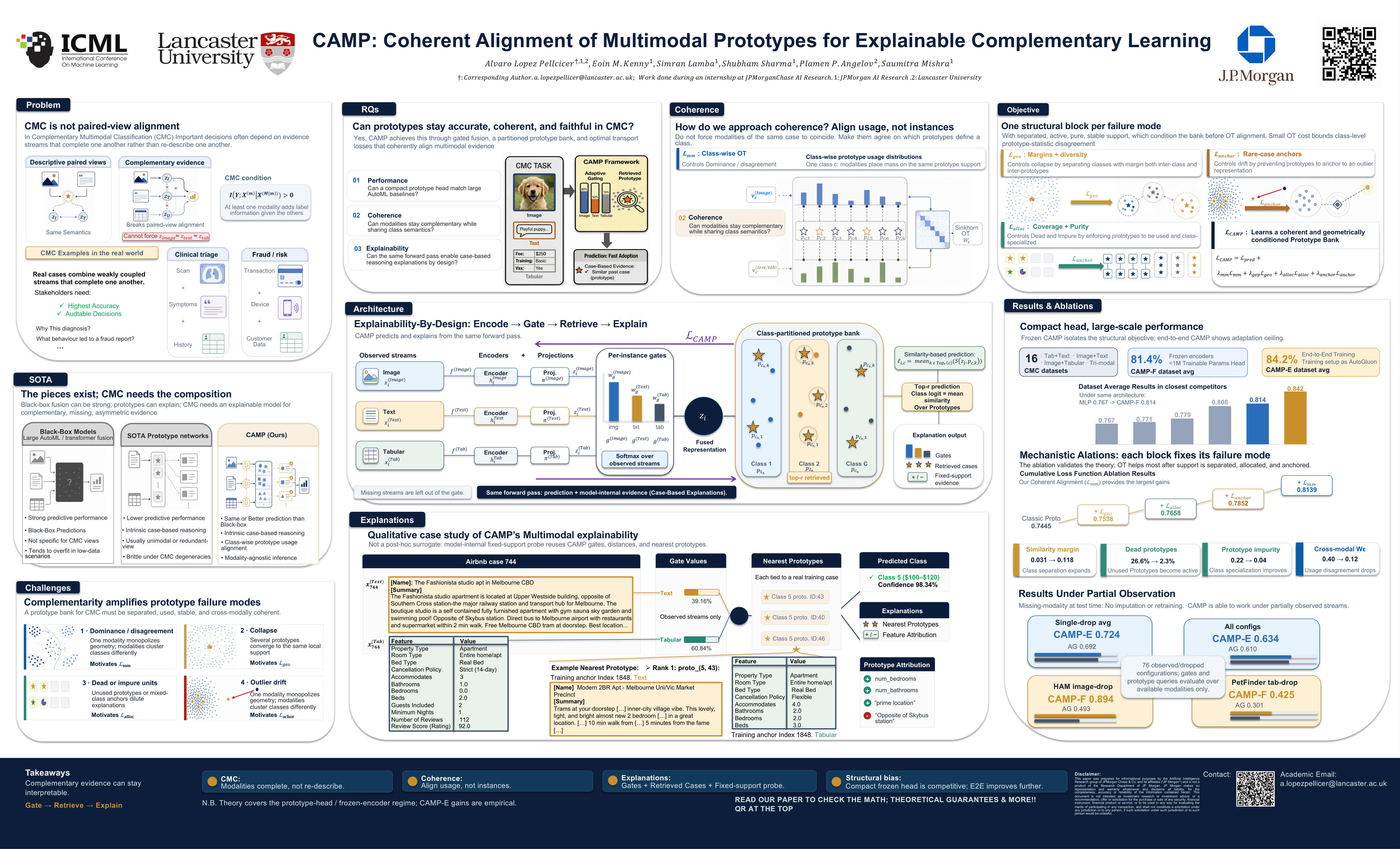
Many machine-learning systems must combine different kinds of evidence, such as a medical image, a doctor’s notes, and patient metadata. These sources often complement one another rather than simply describing the same thing, but today’s models can be hard to audit and may lean too heavily on one source. We introduce CAMP, a model that predicts by comparing a new case with a small set of learned “representative cases.” CAMP decides how much weight to give each available source of information and can still run when some sources are missing. During training, CAMP keeps the representative cases for each class consistent across data sources while preventing them from becoming redundant, unused, or dominated by one source. This lets the model provide built-in evidence for its decisions: which sources mattered and which similar cases supported the prediction. Across 16 public multimodal benchmarks, a lightweight version of CAMP with fewer than 1 million trainable parameters matched or outperformed much larger automated systems on most tasks, and the fully fine-tuned version achieved the best results overall. CAMP shows that accurate multimodal prediction and inspectable, case-based explanations can be combined, which is especially important for healthcare, fraud detection, and online safety.