
Source-Free Open-World RF Fingerprint Identification
Abstract
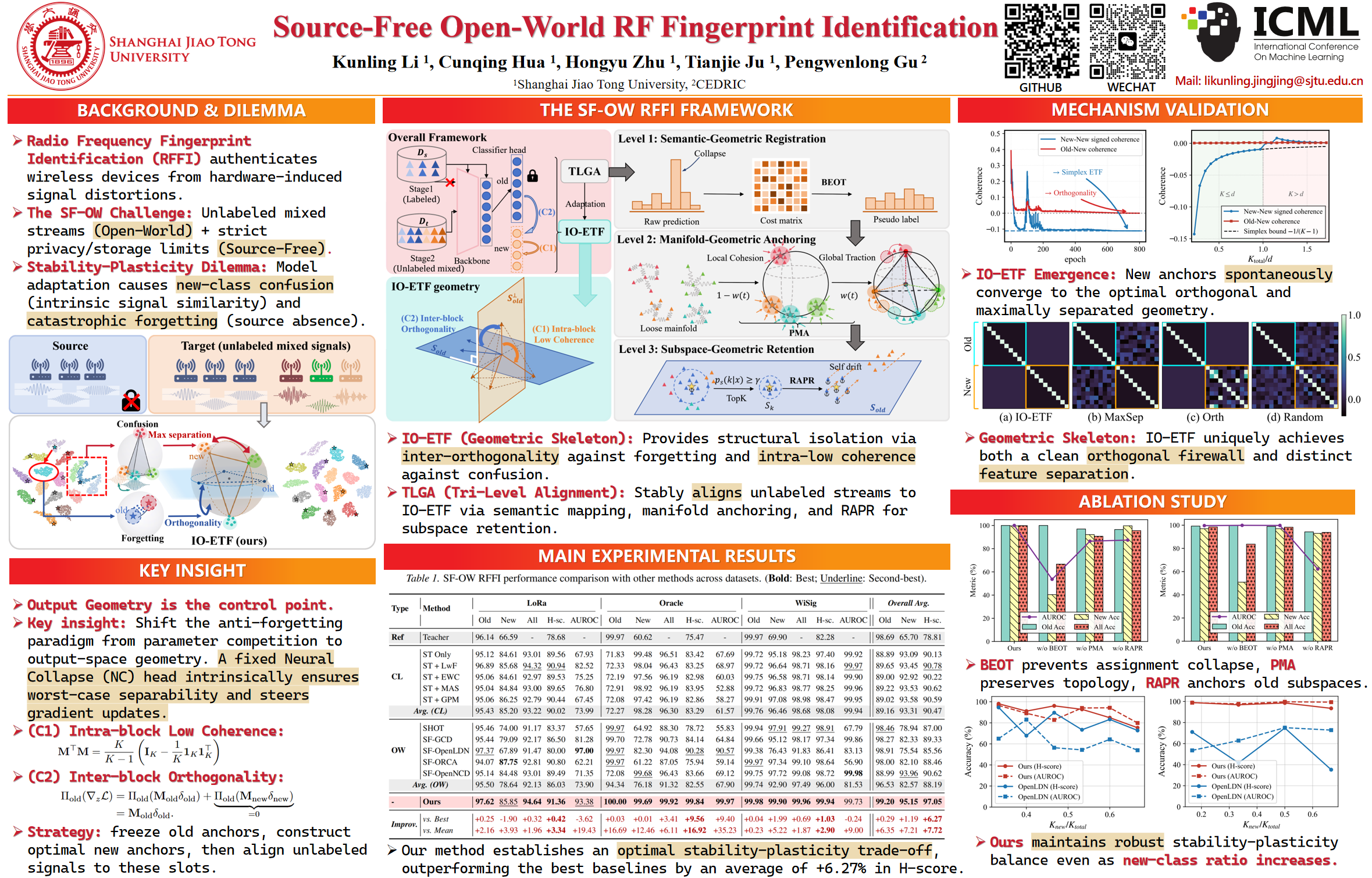
Radio Frequency Fingerprint Identification (RFFI) is a foundational pillar of physical-layer security, providing unclonable identity authentication and lightweight defense mechanisms for zero-trust wireless networks. Its practical deployment, however, often occurs in a source-free open-world (SF-OW) setting, characterized by a continuous influx of unregistered devices and privacy constraints that preclude the retention of historical data. In this paper, we formalize SF-OW RFFI task, which manifests a severe stability-plasticity dilemma: intrinsic signal similarity confuses new classes, while source absence precipitates catastrophic forgetting. To address this, we propose Incremental Orthogonal ETF (IO-ETF), a novel neural collapse-inspired framework utilizing output geometry to actively induce parameter separation and isolation. We further devise a Triple-Level Geometric Alignment (TLGA) strategy via semantic optimal transport, manifold progressive anchoring, and reliable subspace retention to stably align unlabeled streams to this geometric skeleton. Experiments on benchmarks demonstrate a superior trade-off between old-class retention and new-class discovery, offering a promising solution for secure access in dynamic networks.
Lay Summary
Every wireless device leaves tiny radio traces shaped by its hardware, much like a fingerprint. These traces, embedded in signals, can help a network decide which devices are trusted. In real networks, however, new devices may appear continuously, while old signal records may be unsafe to store because of privacy and security concerns. This creates a dilemma for AI: how can it learn the newcomers without forgetting the devices it already knows? We study this realistic open-world setting and propose a novel geometry-guided learning method. Instead of relying on old data, our system creates a fixed, well-separated structural map. It assigns each device’s identity to a dedicated, isolated position within this map, which separates unknown devices while protecting old ones from being overwritten. A three-level guidance strategy then smoothly directs unlabeled, mixed signals into their target positions. More broadly, this work highlights a crucial real-world challenge and offers a new perspective: shifting from relying on historical data to designing smart geometric structures for secure and continuous learning in dynamic networks.