
A Geometric Lens on Physics-Aligned Data Compression
Abstract
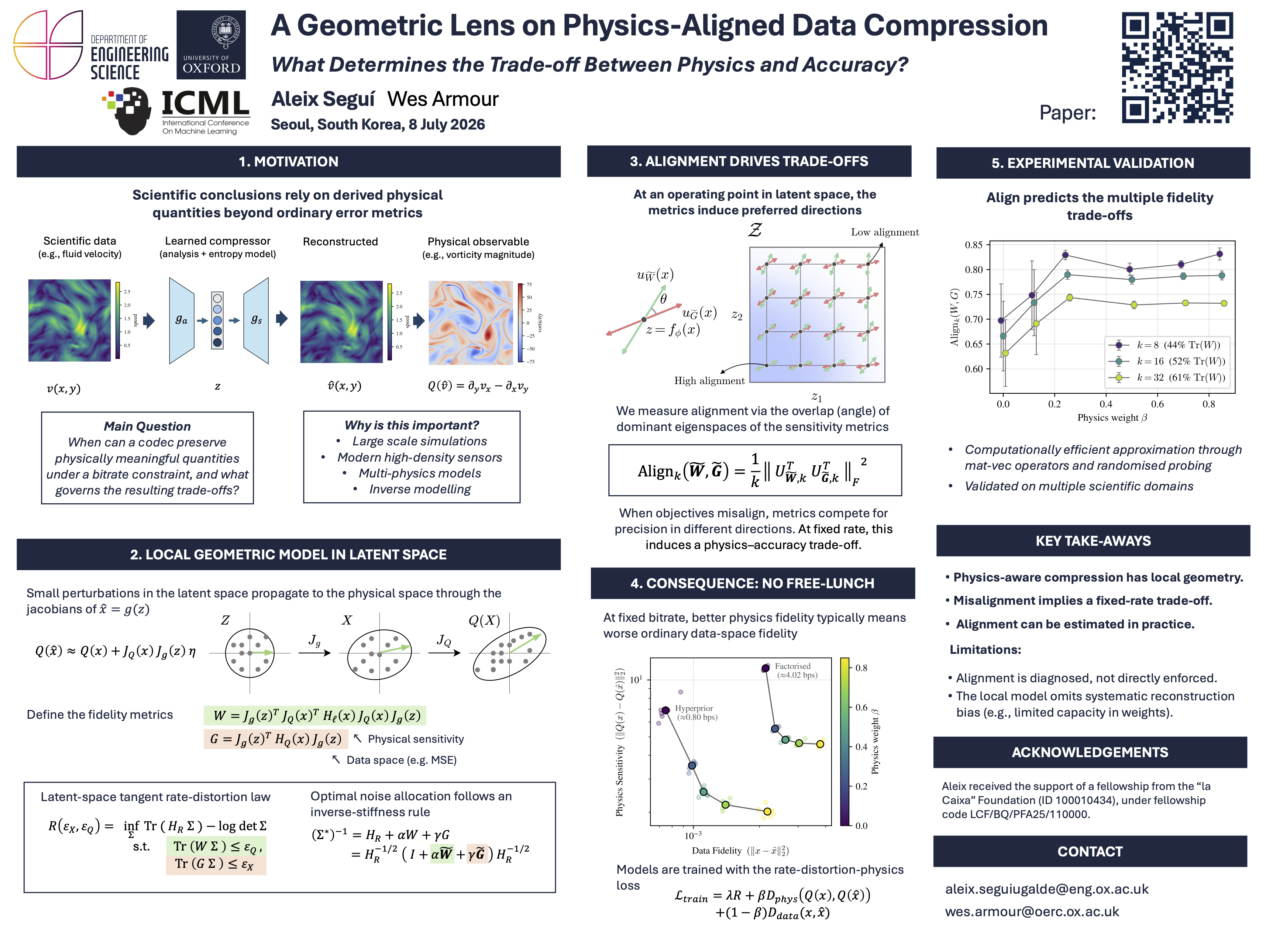
In AI for Science, physics-informed losses are increasingly used to train learned compressors for scientific data, but their rate--distortion implications remain poorly understood. At fixed bitrate, these objectives often improve preservation of a target physical observable while degrading standard reconstruction fidelity. We develop a local geometric theory showing that this tradeoff is governed by the interaction of latent-space sensitivities induced by the entropy model, the physical observable, and the distortion metric. At each operating point, these induce preferred directions along which compression noise should be suppressed, yielding an anisotropic error-allocation mechanism. When these directions are misaligned, improving the observable at fixed rate necessarily worsens standard distortion, establishing a fundamental limit on simultaneous preservation. We formalise this through a local tangent-space rate--distortion law and introduce a practical alignment diagnostic based on dominant eigenspace overlap. Experiments across scientific domains test the theory and validate that the alignment diagnostic correlates with observed data- and physics-space trade-offs.
Lay Summary
Scientific simulations and instruments now generate data in volumes that make storage and transfer an important bottleneck. In this context, the utility of compressing data depends on the error on the derived physical observables that are used to draw conclusions. When training an AI compressor to protect these quantities, it remains poorly understood when doing so will cost more bits or reduce ordinary reconstruction quality, such as mean-square error. We study this problem by examining how small compression errors move through a learned compressor. Our theory shows that these errors have directions: some directions matter most for file size, some for ordinary data accuracy, and some for the target physical quantity. When the relevant directions for physics and ordinary accuracy are not aligned, improving one without increasing the file size necessarily hurts the other. Based on this result, we propose a physical alignment score to estimate this compatibility, and validate it on fluid simulation, cosmology, and electron microscopy data. This gives a practical way to anticipate when physics-aware compression will involve a trade-off, and decide which physical quantities a compressed representation should prioritise.