
Exact and Approximate Algorithms for Polytree Learning
Abstract
Lay Summary
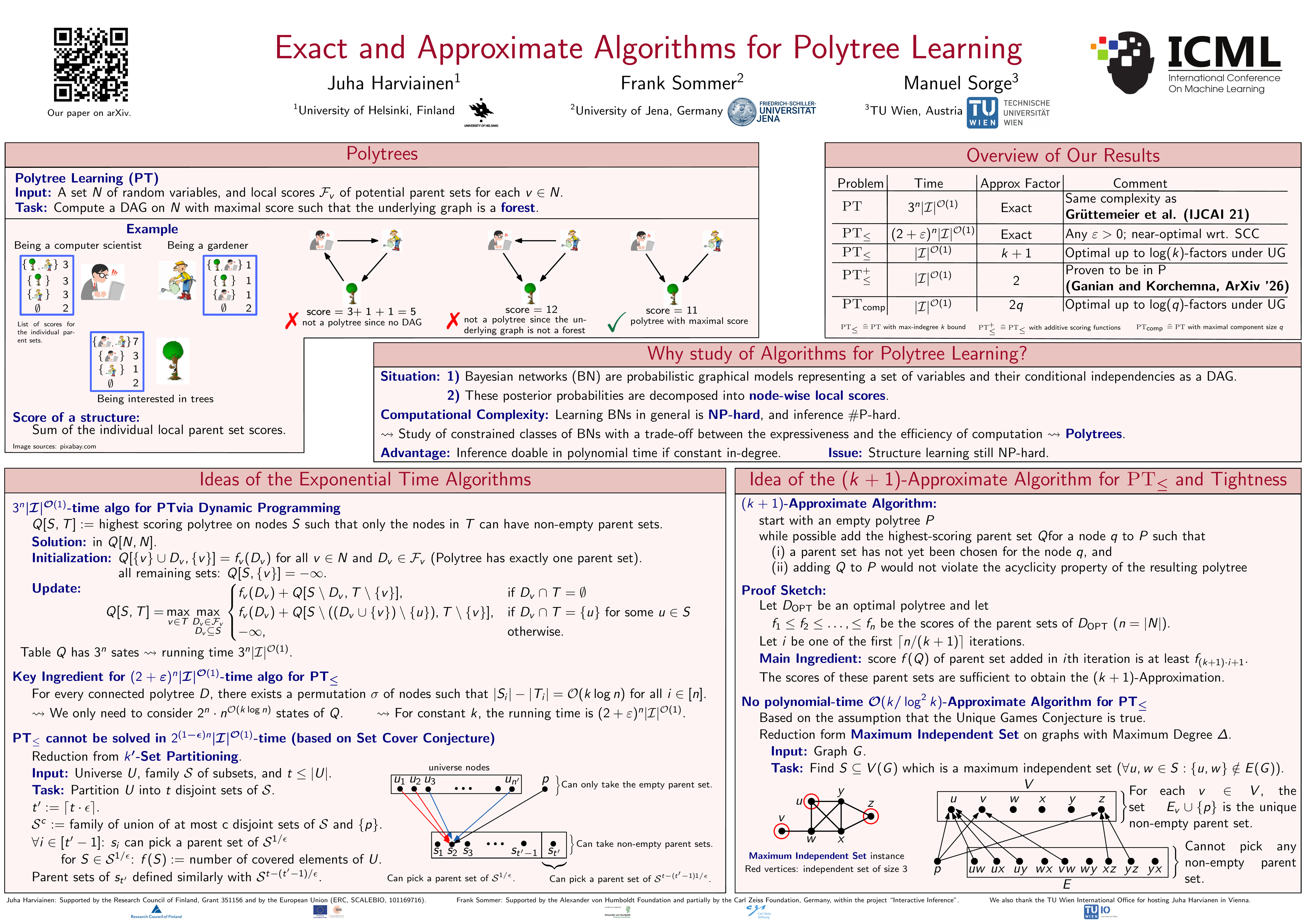
Modern AI systems often reason about uncertainty by modeling how variables — say, symptoms, diseases, and test results — influence each other. A standard tool is the Bayesian network, a diagram of these influences. In general, these networks are slow to query, so practitioners often prefer a simpler shape called a polytree, in which the underlying connections form no cycles. Polytrees are fast to use, but finding the best one from data is computationally intractable: in particular, the number of candidate diagrams explodes with the number of variables. We study how much that intractability can be tamed. Our new exact algorithm finds the best polytree noticeably faster than the previously known ones whenever each variable depends on at most a small fixed number of others. We also give fast "approximation" algorithms that produce a polytree provably close to optimal, even when finding the very best one is hopeless. Matching mathematical lower bounds show that many of our running times and approximation ratios cannot be substantially improved unless long-standing conjectures in theoretical computer science are wrong.