
Subspace-Aware Feature Reshaping for Open-Set Graph Class-Incremental Learning
Abstract
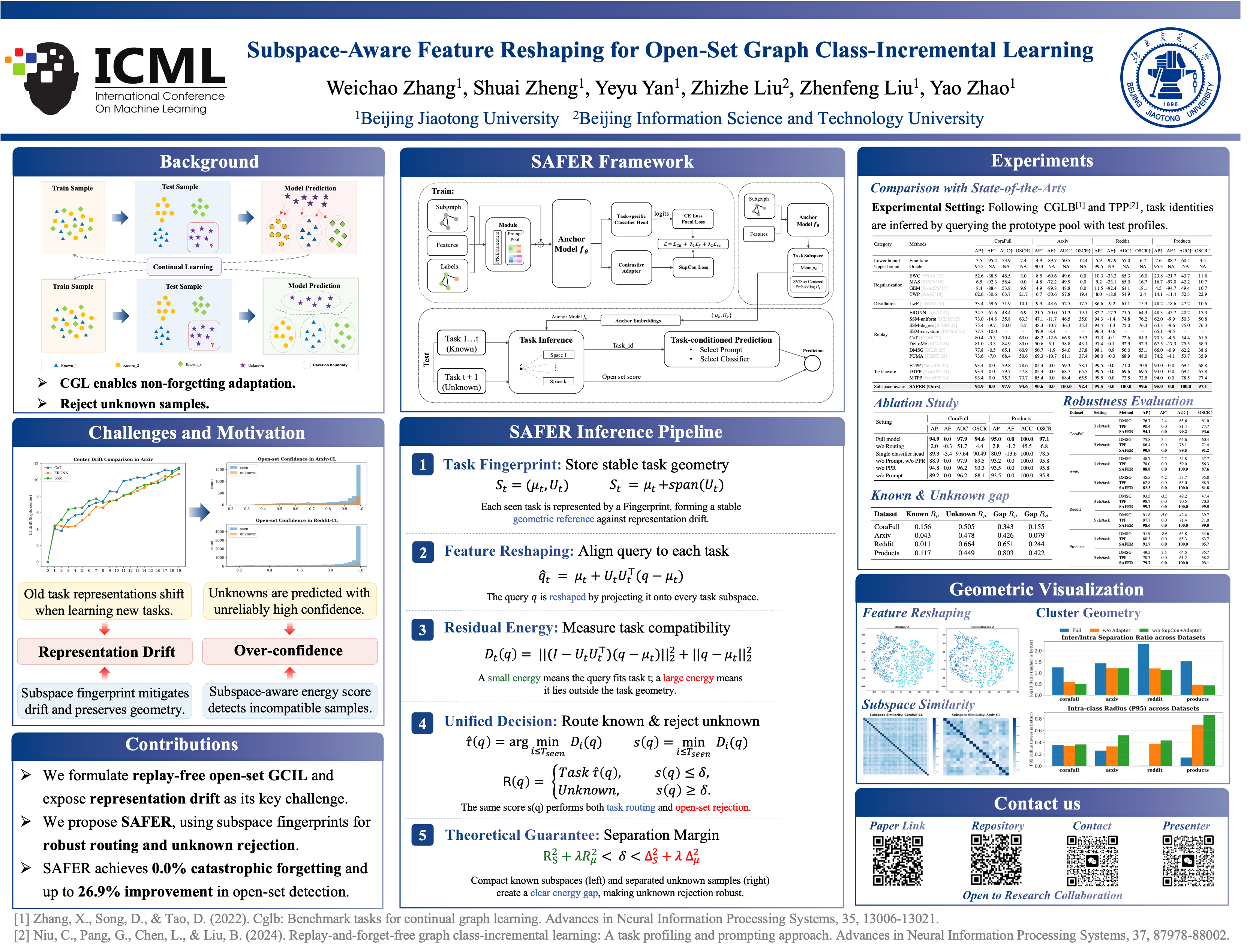
Graph class-incremental learning (GCIL) has emerged to address the challenge of learning from dynamically evolving graphs, which continuously learns new classes over a sequence of tasks while retaining performance on previously seen classes. However, existing GCIL methods assume a closed-set test distribution drawn only from seen tasks. This fundamentally contradicts real-world open-ended scenarios where future unknown classes inevitably emerge. Empirically, we observe that existing GCIL methods falter in such open-set settings due to severe representation drift and generalized overconfidence. To bridge this gap, we investigate the Open-Set GCIL problem and propose \textbf{SAFER} (\underline{S}ubspace-\underline{A}ware \underline{FE}ature \underline{R}eshaping), a novel framework that endows GCIL with intrinsic open-set capabilities under a replay-free constraint. Specifically, \textbf{SAFER} performs subspace-aware feature reshaping with drift-free fingerprints, unifying task routing and open-set rejection into a single energy-based metric. Furthermore, we introduce a geometric space-consistency regularization that explicitly improves intra-class compactness and suppresses cross-task representation drift. Extensive experiments on four benchmarks demonstrate that SAFER outperforms state-of-the-art baselines by margins of up to 5.2\% in accuracy and 31.3\% in open-set AUROC, all while maintaining near-zero forgetting under strict no-replay constraints.
Lay Summary
Graph data in the real world evolves over time, so models must expand on previously acquired knowledge as new classes emerge. Existing graph class-incremental learning methods usually assume that test data only comes from known classes. In practice, however, unknown classes often appear, which can lead to incorrect and overconfident predictions. To address this problem, we study open-set graph class-incremental learning and propose SAFER, a new framework for learning from evolving graphs without storing past data. SAFER stabilizes feature representations across tasks, helps the model recognize known classes, and improves its ability to detect and reject unknown ones. It also reduces representation drift, which is a major cause of forgetting. Experiments on four benchmark datasets show that SAFER consistently outperforms strong baselines. It improves both classification accuracy and open-set detection while maintaining near-zero forgetting. These results suggest that SAFER can make graph learning systems more reliable for dynamic and open-ended real-world applications.