
SAQNN: Spectral Adaptive Quantum Neural Network as a Universal Approximator
Jialiang Tang ⋅ Jialin Zhang ⋅ Xiaoming Sun
Abstract
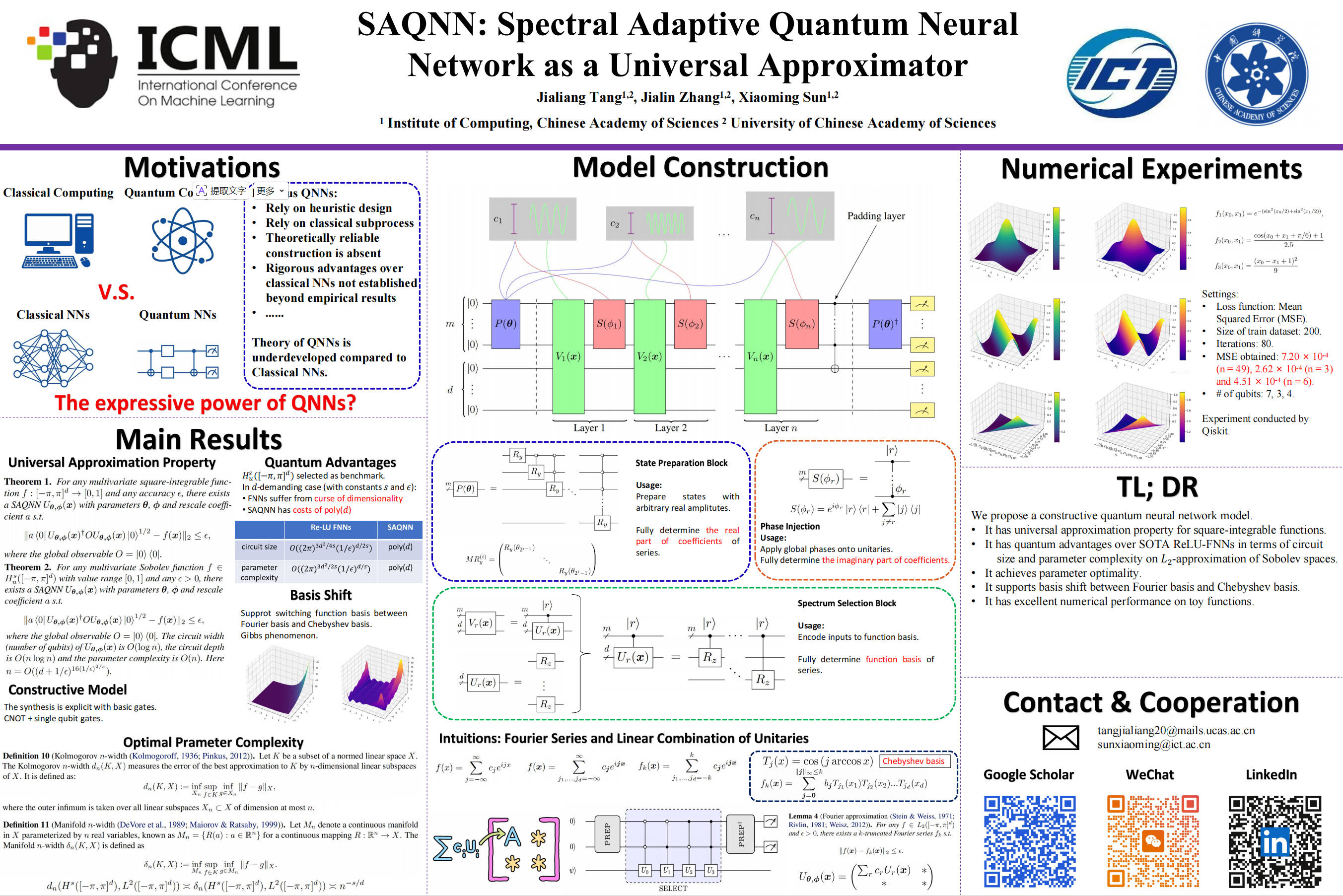
Quantum machine learning (QML), as an interdisciplinary field bridging quantum computing and machine learning, has garnered significant attention in recent years. Currently, the field as a whole faces challenges due to incomplete theoretical foundations for the expressivity of quantum neural networks (QNNs). In this paper we propose a constructive QNN model and demonstrate that it possesses the universal approximation property (UAP), which means it can approximate any square-integrable function up to arbitrary accuracy. Furthermore, it supports switching function bases, thus adaptable to various scenarios in numerical approximation and machine learning. Our model has asymptotic advantages over the best classical feed-forward neural networks in terms of circuit size and achieves optimal parameter complexity when approximating Sobolev functions under $L_2$ norm.
Lay Summary
While quantum neural networks show great promise, they still lack a solid theoretical foundation, particularly regarding their expressive power. To address this, we propose a novel quantum network architecture with guaranteed expressivity and quantified resource costs. Notably, our model has an exponential quantum advantage over classical networks, showcasing the potential of quantum computing in machine learning.
Video
Chat is not available.
Successful Page Load