
Automatic Pruning Discovery for Large Language Models
Abstract
Lay Summary
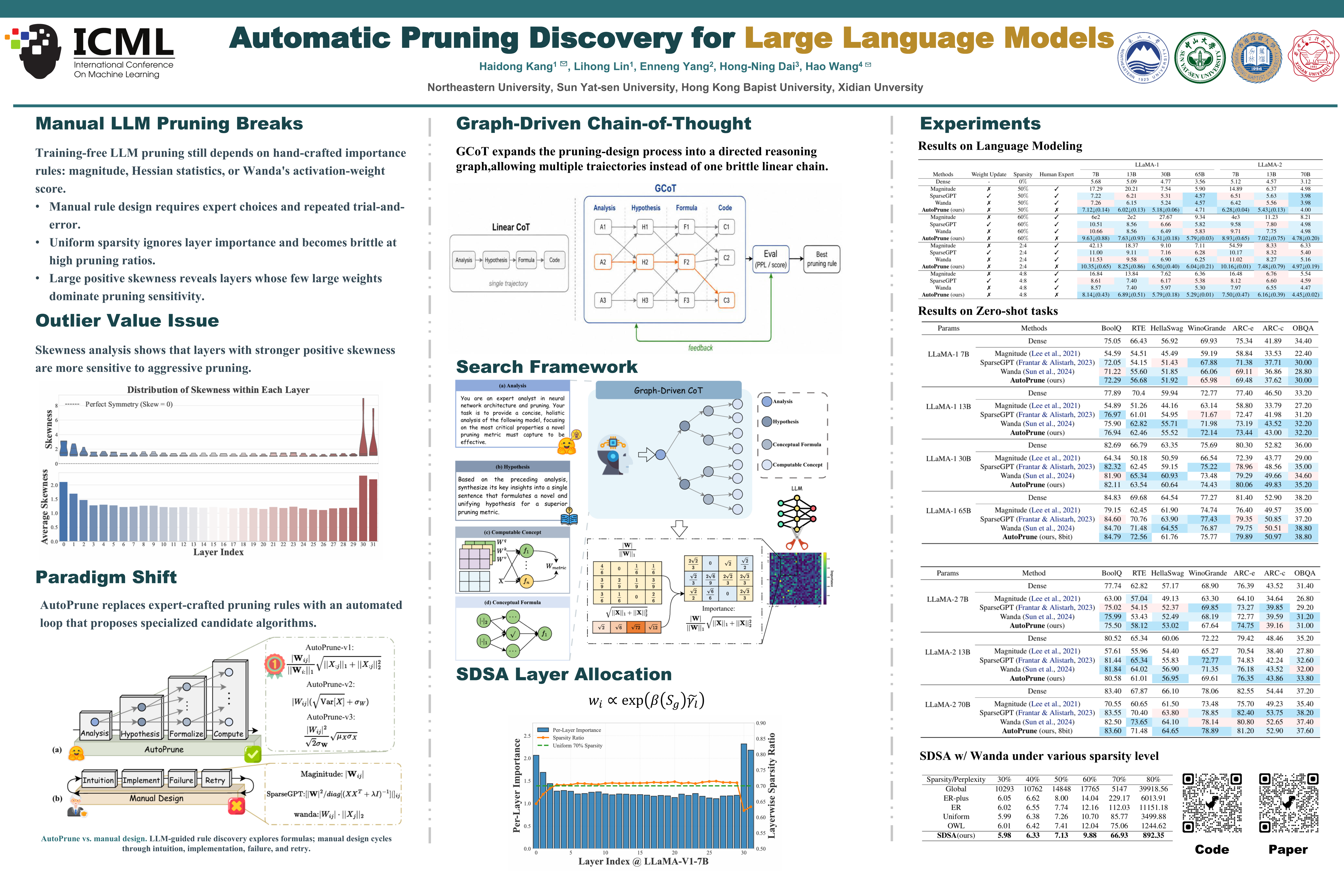
Large language models, such as systems used for chatbots and writing assistants, are powerful but expensive to run because they contain enormous numbers of internal components. A common way to make them smaller is to remove parts that appear less important, but deciding what can be safely removed usually requires substantial human expertise and trial-and-error. This work asks whether large language models can help design better ways to shrink themselves. We introduce AutoPrune, a method that uses a language model to propose and test strategies for identifying which parts of another language model can be removed with limited damage. We also find that some parts of a model contain unusually important values, so removing the same fraction of components everywhere can hurt performance badly. To address this, AutoPrune gives extra protection to these sensitive parts while allowing less important parts to be reduced more aggressively. Across several widely used language models and evaluation tasks, AutoPrune produces smaller models that retain better performance than strong existing pruning methods. This can make powerful AI systems easier to deploy on devices or services with limited computing resources.