
UltraLIF: Fully Differentiable Spiking Neural Networks via Ultradiscretization and Max-Plus Algebra
Abstract
Lay Summary
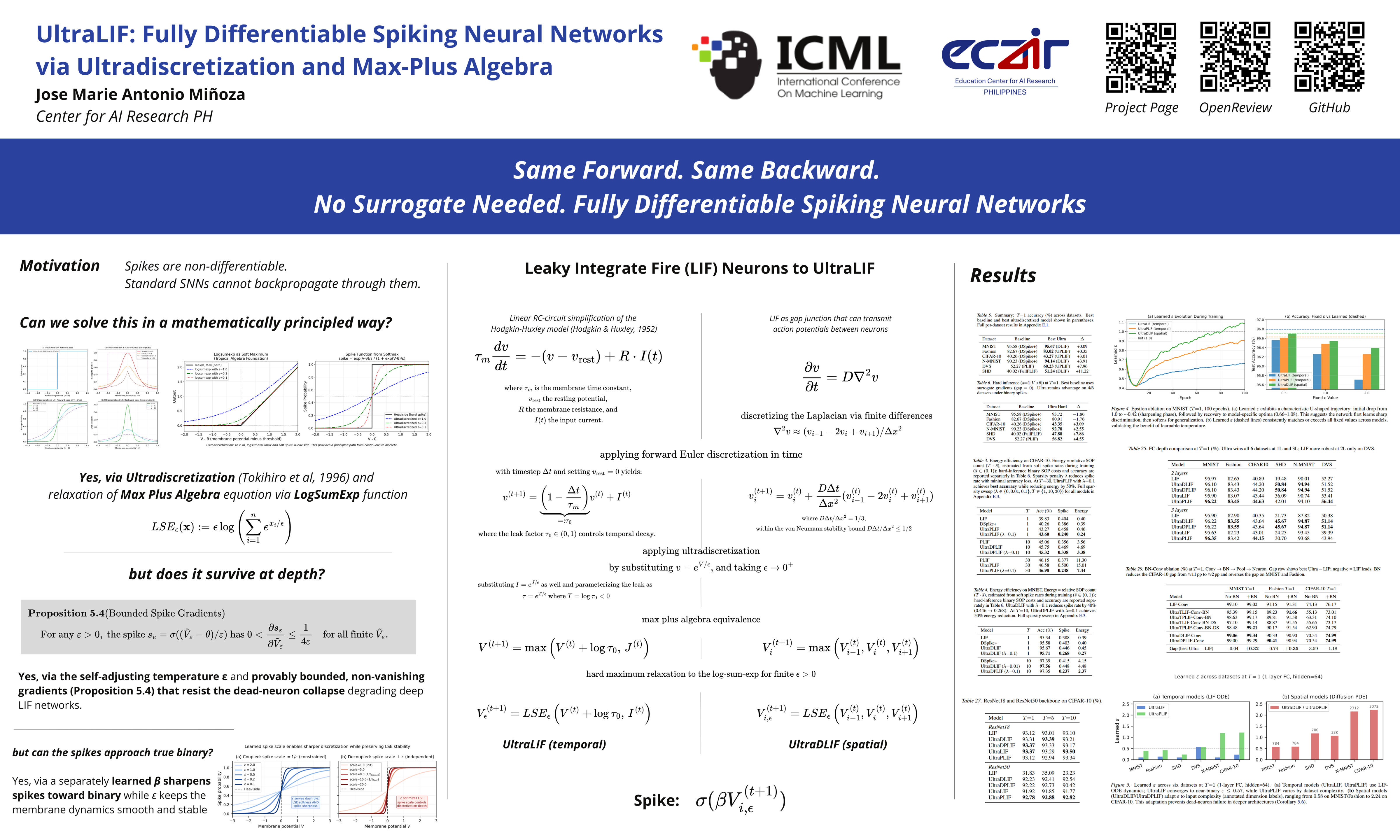
Spiking Neural Networks (SNNs) are brain-inspired AI models that communicate through brief electrical pulses, making them far more energy-efficient than conventional AI. However, a fundamental training challenge has persisted as an open problem: the "spike" is like an on/off switch, and on/off switches have no smooth middle ground for standard learning algorithms to work with. Current methods (surrogate gradient methods) work around this by training the network using a smoothed approximation of the spike, then switching to the real discrete spike at test time, creating a mismatch between how the model learns and how it actually runs. This inconsistency is a known limitation of virtually all existing SNN training methods. This work introduces UltraLIF, a spiking neuron derived from first principles using a mathematical technique from physics. Rather than approximating the spike, the smooth trainable operation emerges directly from the neuron's governing equation, making training and inference identical by construction. A temperature parameter, learned automatically during training, controls how sharp each spike is and adapts to the complexity of the task. UltraLIF outperforms existing methods across six benchmarks, including spoken word recognition, moving-object detection from event-driven cameras, and standard image classification. It also scales to larger, deeper architectures where conventional spiking neurons permanently switch off and stop learning, a failure mode UltraLIF resolves through its self-adjusting firing sensitivity.