
FIPN: Forward Self-Organizing Interpretable Polynomial Networks for Time Series Forecasting
Abstract
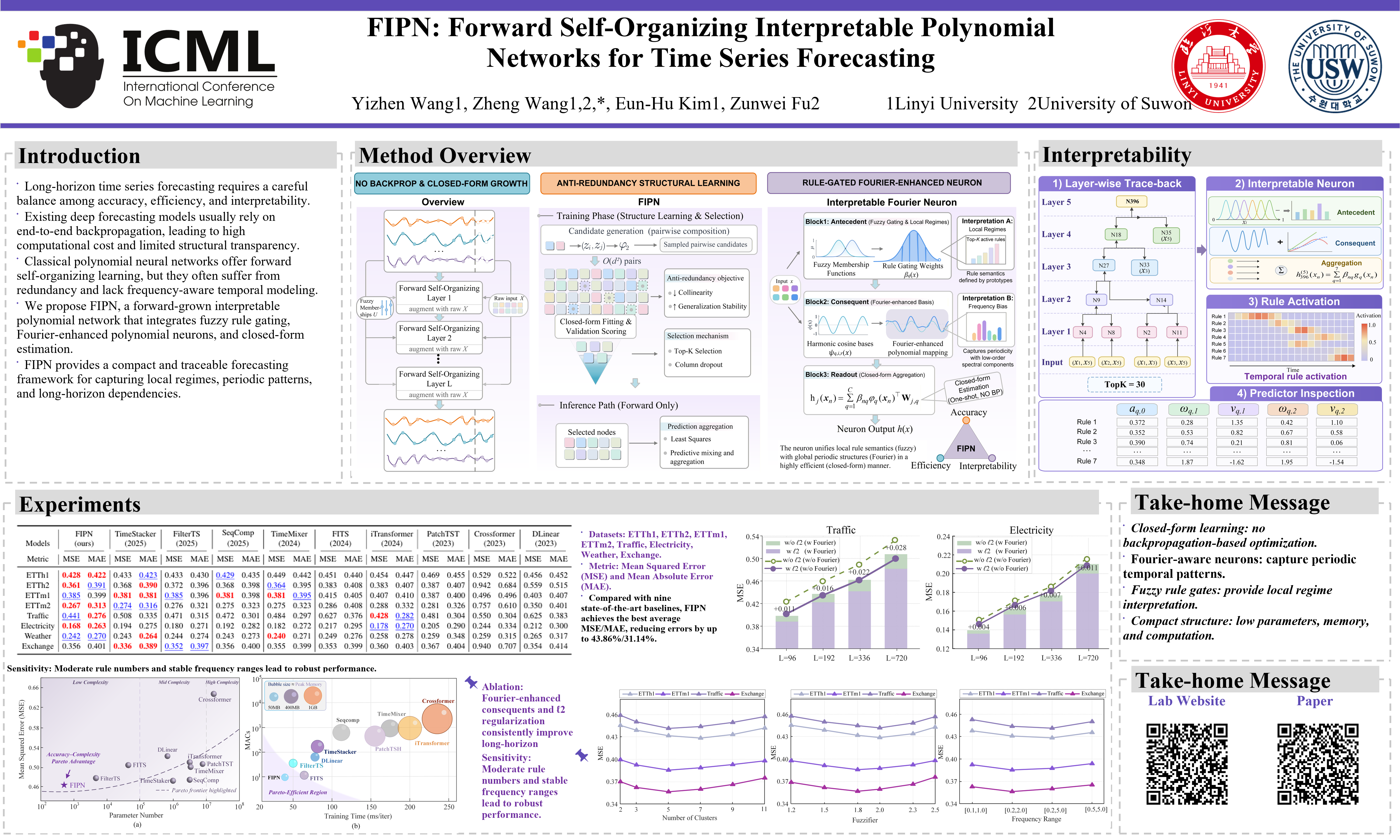
Most existing time-series forecasters are trained end-to-end with backpropagation, which often increases computational cost and limits structural transparency. As a result, it remains difficult to trace how their predictions are formed. This paper presents FIPN, a forward self-organizing interpretable polynomial network for time-series forecasting. FIPN grows its architecture layer by layer through candidate generation, closed-form estimation, and validation-based selection, without relying on backpropagation-based optimization. Each neuron couples a fuzzy rule antecedent with a Fourier-enhanced polynomial consequent: fuzzy clustering softly partitions the input space and produces interpretable rule weights for local regimes, while the consequent retains access to original features and uses Fourier functions to capture periodic and frequency-related structures. Since forward growth may introduce redundancy, collinearity, and overfitting as depth increases, FIPN further incorporates regularized node scoring, dropout-based redundancy control, and persistent access to raw inputs. Experiments on long-horizon forecasting benchmarks show that FIPN achieves competitive accuracy with a compact model size, while the learned fuzzy rules provide rule- and structure-level explanations. These results suggest that forward self-organizing polynomial networks offer a practical balance among accuracy, efficiency, and interpretability for long-horizon forecasting.
Lay Summary
Time-series forecasting is widely used in areas such as traffic, electricity, weather, and finance. Many existing forecasting models are accurate but difficult to understand. This paper introduces FIPN, a model that builds its prediction structure step by step. This design makes the forecasting process easier to trace and interpret. FIPN also uses frequency information to capture repeated patterns in time-series data. Experiments on several standard datasets show that FIPN provides strong forecasting accuracy with low computational cost, while offering a clearer explanation of how its predictions are formed.