
Transfer Learning in High-dimensional Ising Models
Abstract
Lay Summary
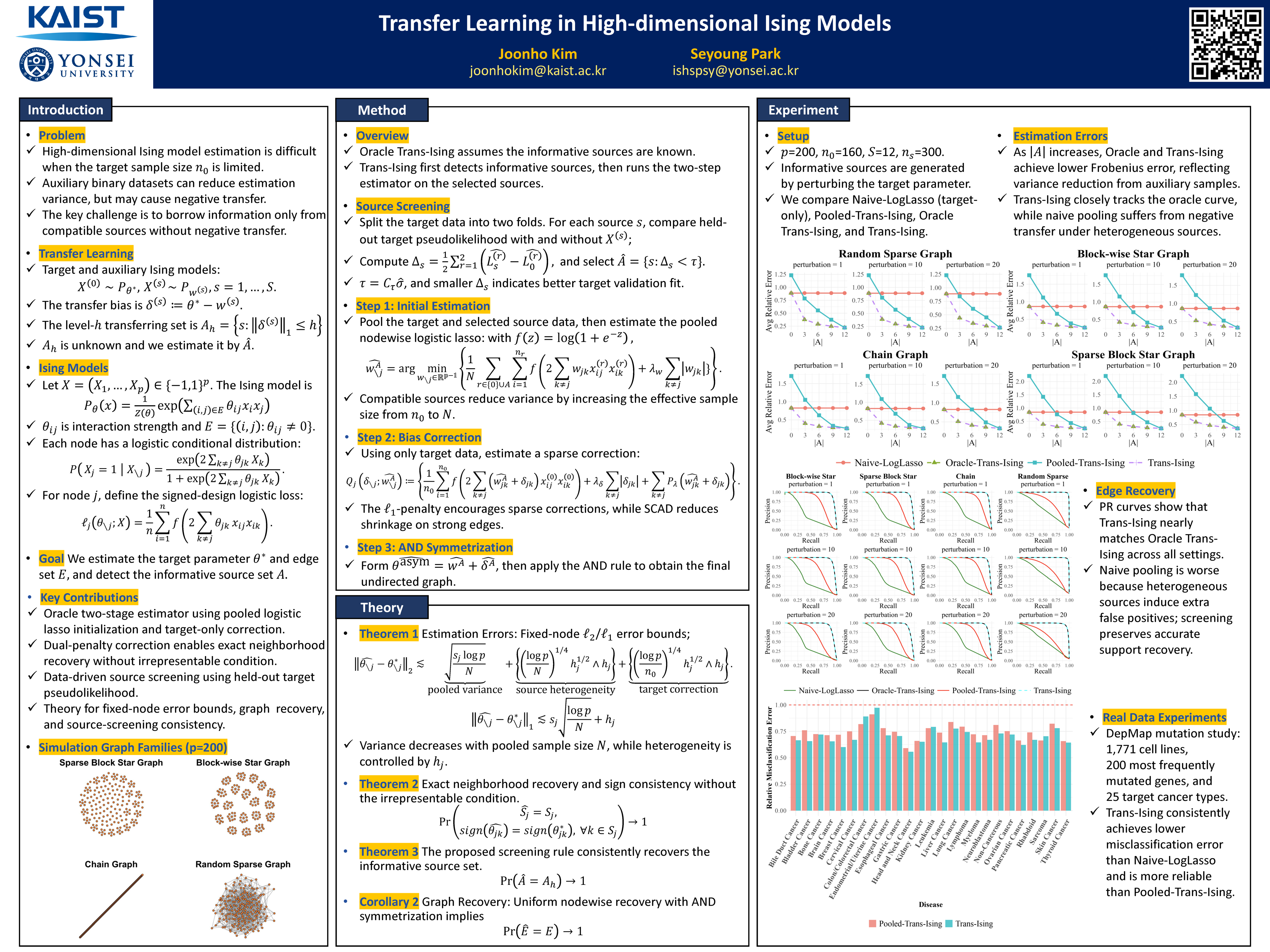
Many scientific and social datasets record yes-or-no information, such as whether a gene is mutated, whether a customer bought an item, or whether a user liked a movie. A common goal is to understand how these variables are related to one another, but this can be difficult when the dataset of main interest is small. Related datasets may help, but using all of them without checking can make the result worse if some of them come from different populations or settings. We propose Trans-Ising, a method that helps learn networks from binary data by using related datasets more safely. It first checks which additional datasets appear useful for the main dataset, and then combines the selected information with a correction step based only on the main dataset. This design aims to benefit from extra data while reducing the risk of negative transfer. Our theory shows when this approach can improve estimation and recover the underlying network structure under suitable conditions. In experiments with simulated data and real datasets, Trans-Ising gives more accurate results than using only the main dataset or simply pooling all available datasets.