
Attention Sinks in Diffusion Transformers: A Causal Analysis
Abstract
Lay Summary
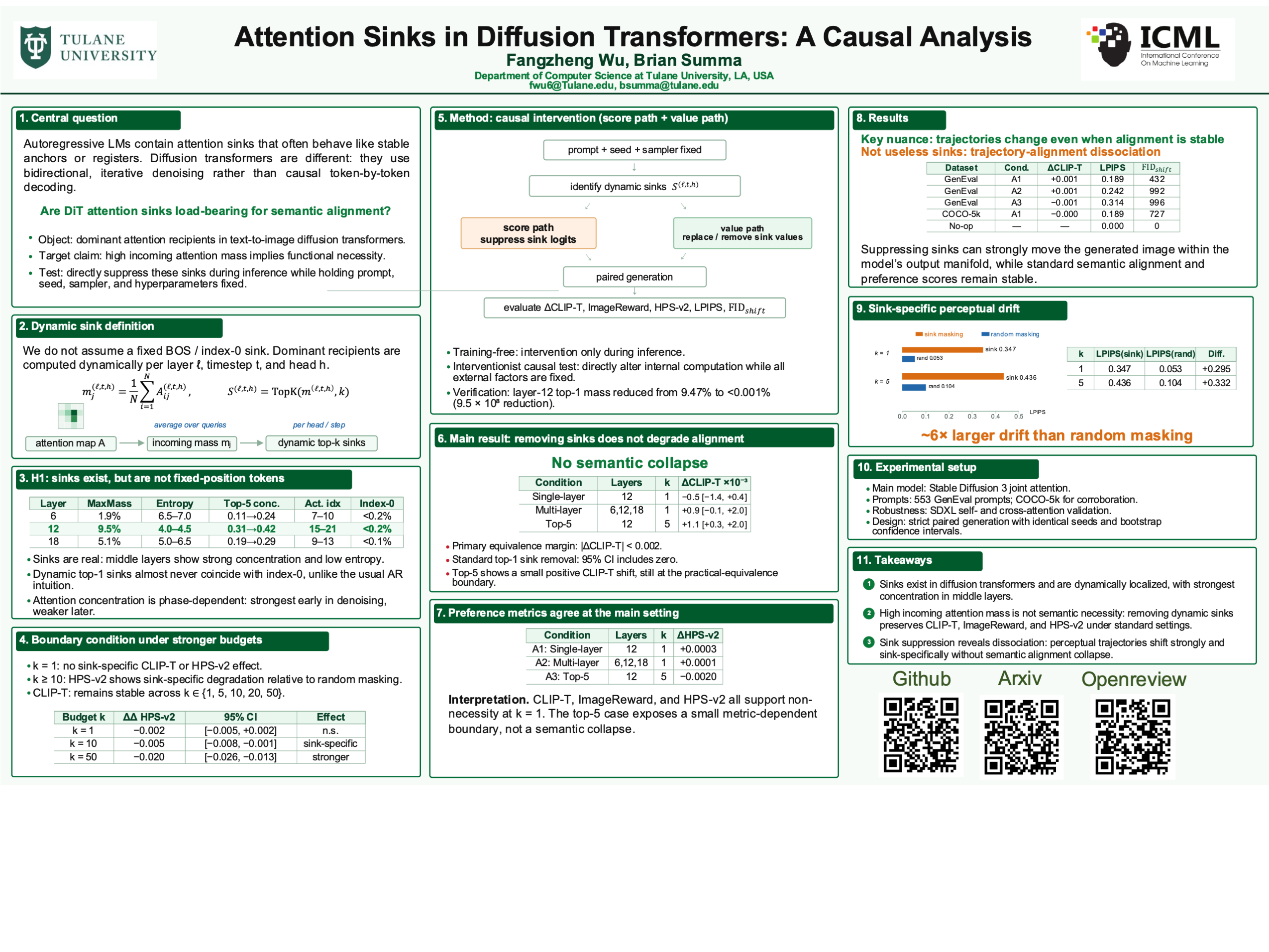
Modern image generation systems use attention mechanisms to decide how different parts of a prompt and image influence one another. A common intuition is that the tokens receiving the most attention are especially important, and therefore should be protected when making these models faster or easier to analyze. We tested this intuition in diffusion transformers, a family of models behind many recent text-to-image systems. Instead of only observing where attention goes, we directly intervened during image generation: at each denoising step, we identified the tokens receiving unusually high attention and suppressed their contribution. Surprisingly, removing these high-attention “sink” tokens did not reduce standard measures of text-image alignment or preference under normal settings. However, the generated images often changed visually, and these changes were much larger than those caused by removing random tokens. Our findings show that high attention does not necessarily mean semantic necessity. In diffusion transformers, dominant attention recipients can shape the visual path of generation without being required for preserving the prompt’s meaning. This cautions against treating attention mass alone as a reliable signal of importance in efficient or interpretable image generation systems.