
The Devil is in the Spectrum: Mitigating Representation Collapse in LLMs via Topologically Regularized Side-Path
Abstract
Lay Summary
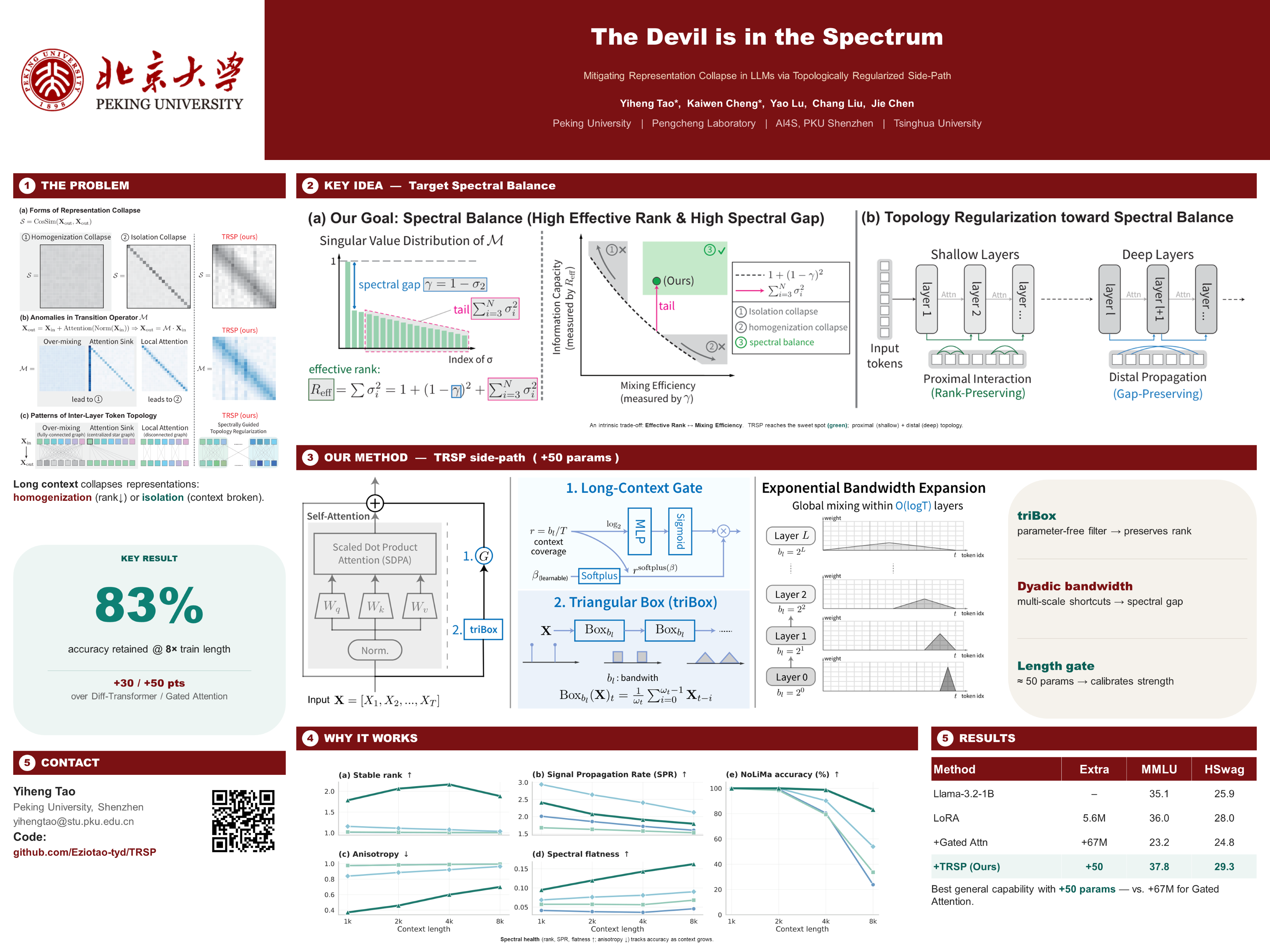
Large language models often struggle to process very long documents. When handling large amounts of text, the internal representations of words tend to either blur together into indistinguishable noise or become completely isolated from each other. Existing methods fail to solve both issues at the same time. We address this problem by introducing a new architectural component called the Topologically Regularized Side Path. This lightweight addition acts as a structural guide for the model. It uses a mathematical filtering mechanism to control how information flows between words. This ensures that nearby words share context effectively while distant words maintain strong connections throughout the text. Our method significantly improves the ability of artificial intelligence models to understand and reason over extremely long sequences of text. It outperforms current leading approaches by a large margin on long document evaluation benchmarks. This advancement allows models to process extensive information more reliably without requiring massive computational resources.