
Holonomy Grid Codes for Generalisation Under Directed Actions
Abstract
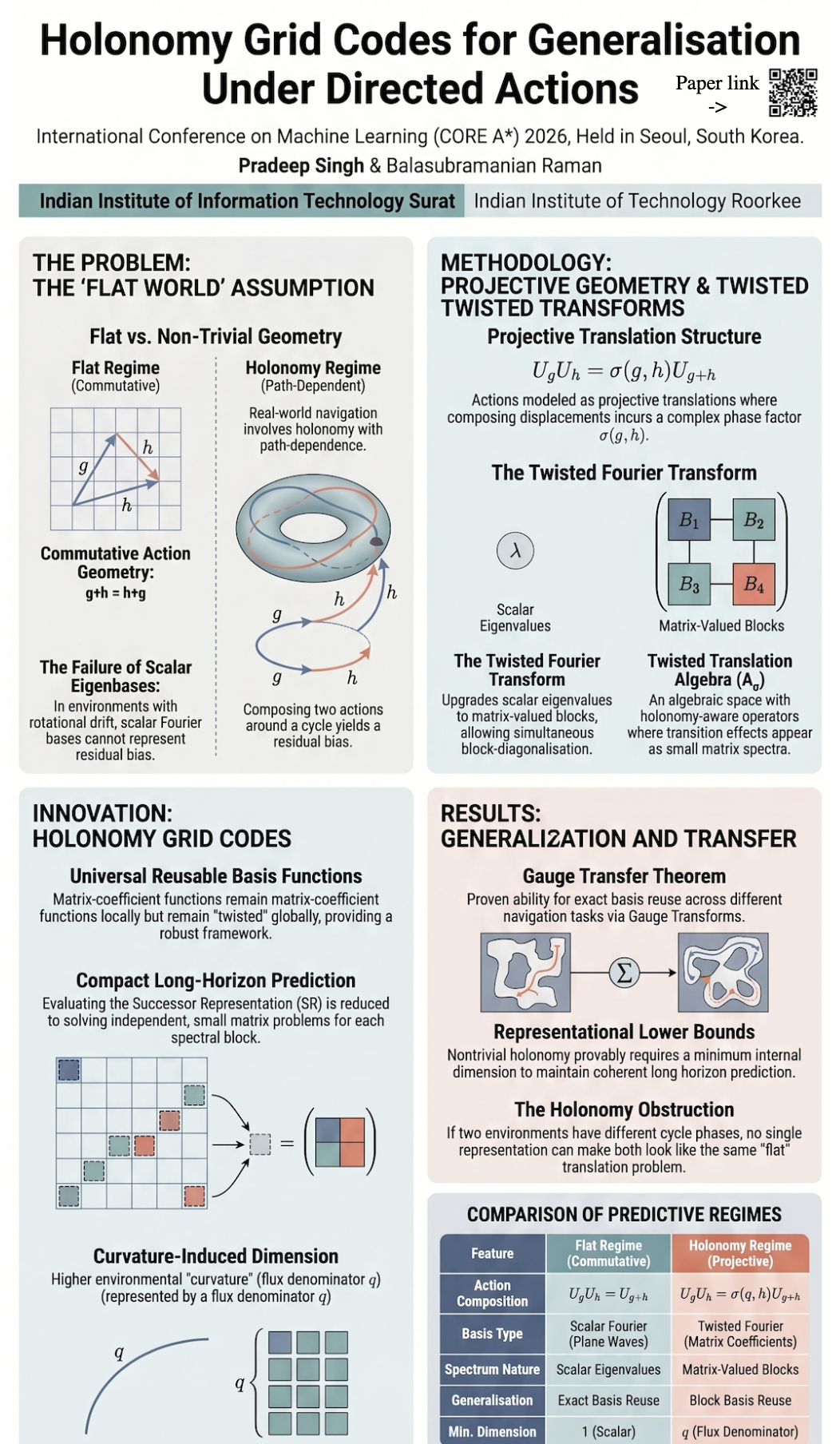
Efficient prediction and planning in structured environments often relies on spectral decompositions of transition operators, yet existing grid-cell and successor-representation theories implicitly assume “flat” action geometry where translations commute and a single Fourier eigenbasis suffices. We show that this assumption breaks in the presence of path-dependent effects—e.g., circulation, rotational drift, or topological loops—whose defining signature is nontrivial holonomy. We introduce a theory of directed-action prediction on discrete tori based on twisted translation operators forming a projective representation of the underlying motion group, and prove that the resulting controlled Markov operators admit an exact block-diagonalisation under a twisted Fourier transform: actions share a universal harmonic basis while their effects appear as small matrix-valued spectra rather than scalar eigenvalues. This yields closed-form resolvent expressions for the successor representation, a gauge-invariant transfer principle characterising when two environments admit identical predictive structure, and a curvature-induced lower bound showing that nonzero holonomy provably necessitates internal representational dimension. Together, these results generalise Fourier/grid-based prediction from commutative to curved action geometries, providing a principled foundation for generalisation under directed actions without learning environment-specific eigenvectors.
Lay Summary
Many methods for prediction and planning work well when movement behaves in a simple, predictable way. But in many settings, the result of moving from one place to another can depend on the exact path taken, not just the start and end points. This makes it harder for existing theories to describe how an agent should generalize what it has learned. In this paper, we develop a mathematical framework for these path-dependent settings. We show that even when movement has twists, loops, or directional effects, there is still an underlying shared structure that can be used to describe prediction efficiently. Instead of learning a completely new description for every environment, our approach identifies a common pattern and expresses environment-specific behavior in a compact way. This helps explain when two different environments should support the same kind of prediction and when extra internal complexity is unavoidable. More broadly, the work extends classical grid-like prediction ideas to richer environments where direction, curvature, and loops matter.