
Rethinking Instruction Drift as a Sampling Error: SNR-Aware Power Distributions for Long-Horizon Robotic Planning
Abstract
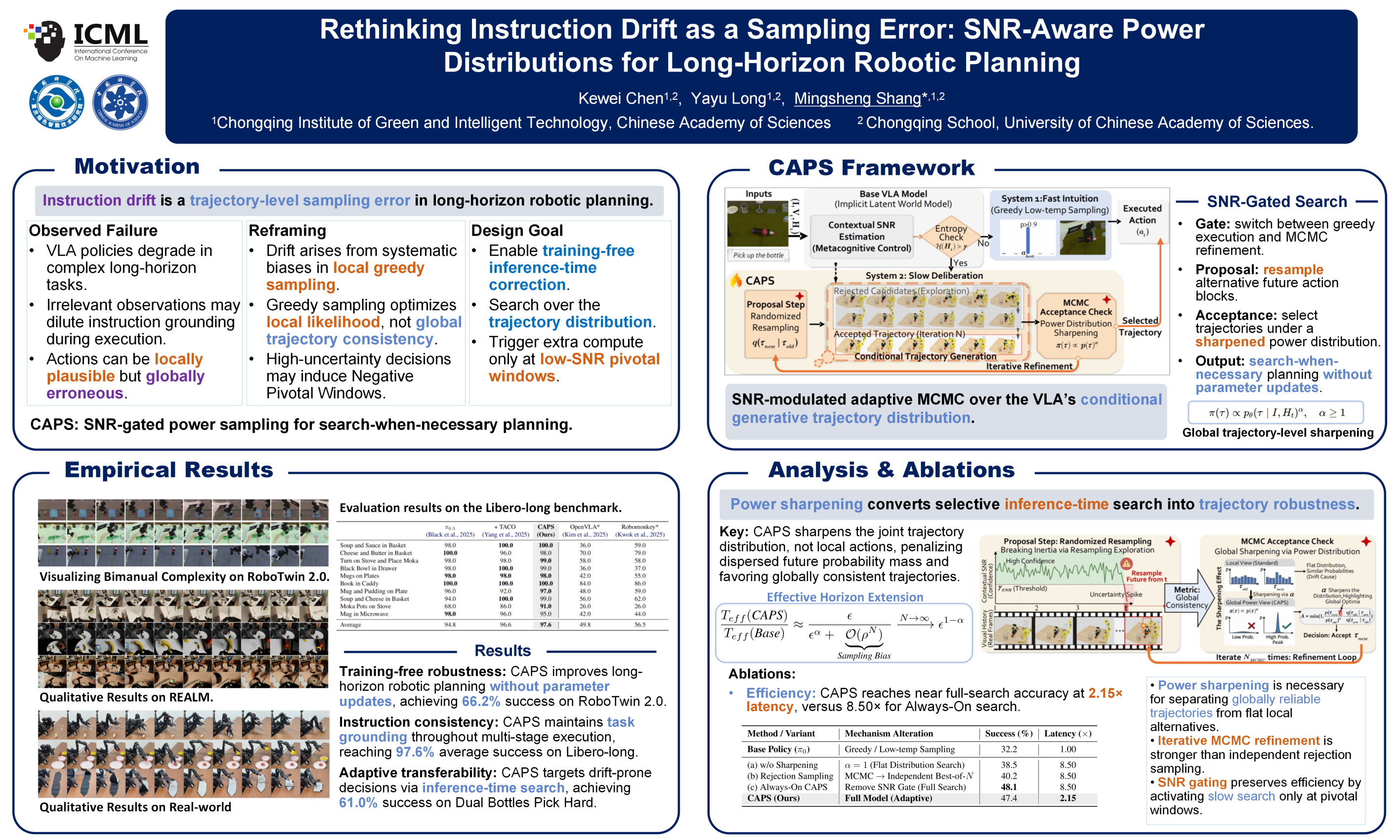
Despite rapid progress in Vision-Language-Action (VLA) models for robotic control, instruction drift remains a persistent failure mode in long-horizon tasks. This paper reconceptualizes this phenomenon, positing that instruction drift is fundamentally a systematic sampling error: local greedy sampling is prone to collapsing into “Negative Pivotal Windows”—irreversible local optima with high local probability that sever global success pathways. To address this, we propose Context-Aware Power Sampling (CAPS), a training-free inference-time computation framework. CAPS leverages power distributions to sharpen global trajectory probabilities, enabling lookahead search over the model's conditional generative trajectory distribution. Furthermore, we introduce a metacognitive control mechanism based on Signal-to-Noise Ratio (SNR). This mechanism triggers adaptive MCMC search solely when drift risk is detected, enabling a dynamic transition from “intuitive fast thinking” to “rational slow search.” Experiments on RoboTwin, Simpler-WindowX, and Libero-long benchmarks show that CAPS achieves substantial improvements over strong baselines, including OpenVLA and TACO, without parameter updates. These results support the effectiveness of adaptive inference-time computation for improving long-horizon robustness in embodied control.
Lay Summary
Robots that follow language instructions often need to make many decisions before completing a long-horizon task. A major failure mode is instruction drift: over time, the robot can make choices that look reasonable locally but gradually move it away from the user’s original goal. This paper reframes that problem as a sampling error in action selection, where the robot’s most likely next action is not always part of a successful long-term plan. We propose CAPS, a training-free method that compares possible future actions during deployment and selects actions that better preserve the user’s instruction over time. Across several robotic manipulation benchmarks, CAPS improves long-horizon task completion over strong baselines without changing the underlying robot model. The results suggest that adaptive computation at decision time can make general-purpose robots more reliable and safer in complex environments.