
DPsurv: Dual-Prototype Evidential Fusion for Uncertainty-Aware and Interpretable Whole Slide Image Survival Prediction
Abstract
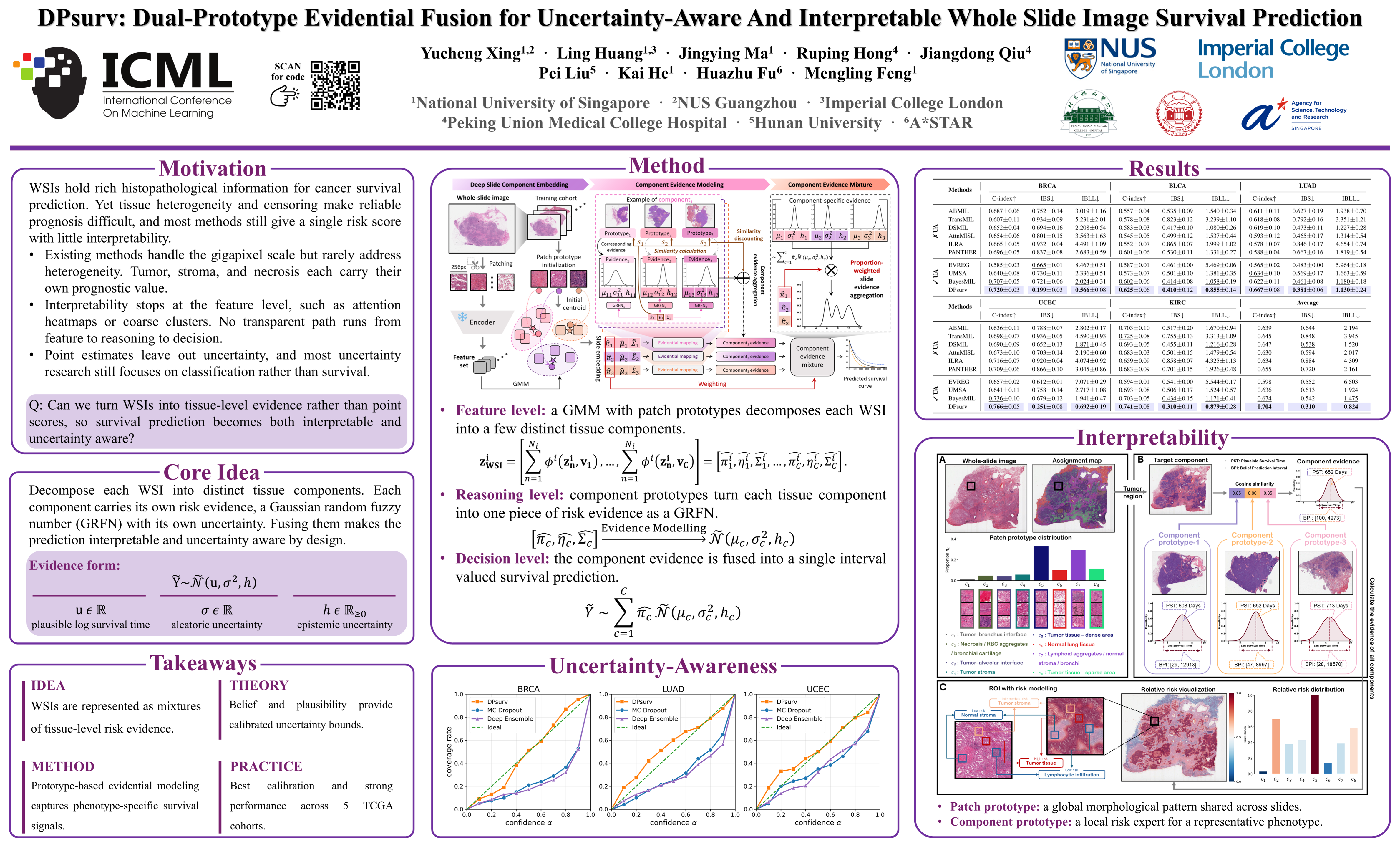
Whole-slide images (WSIs) are widely used for cancer survival analysis because of their comprehensive histopathological information at both cellular and tissue levels, enabling quantitative, large-scale, and prognostically rich tumor feature analysis. However, most existing WSI survival analysis methods struggle with limited interpretability and often overlook predictive uncertainty in heterogeneous slide images. In this paper, we propose DPsurv, a dual-prototype whole-slide image evidential fusion network that outputs uncertainty-aware survival intervals, and enables interpretable survival results through patch prototype distribution assignment, component prototype evidence reasoning, and component-wise relative risk aggregation. Experiments on five publicly available datasets demonstrate strong discriminative performance and well-calibrated predictions, validating its effectiveness and reliability. The interpretation of survival results provides transparency at the feature, reasoning, and decision levels, thereby enhancing the trustworthiness and interpretability of DPsurv.
Lay Summary
Pathologists often examine large tissue slides to assess how a patient’s cancer may progress over time. While AI models can assist with this task, many existing methods behave like “black boxes”: they produce a prediction without explaining which tissue patterns influenced the result or how reliable the prediction is. This limits their clinical usefulness. We propose DPsurv, a method that analyzes tissue slides by separating them into different morphological regions, such as tumor areas, stromal tissue, and necrotic regions, and estimating how each region contributes to patient risk. These regional predictions are then combined into a slide-level prediction together with an uncertainty estimate, allowing the model to indicate when its prediction is less reliable. Experiments across five cancer types show that DPsurv achieves strong predictive performance while also providing interpretable risk maps that highlight the tissue regions most responsible for the final prediction, making the model more transparent for clinical analysis.