
DB-KSVD: Scalable Alternating Optimization for Disentangling High-Dimensional Embedding Spaces
Abstract
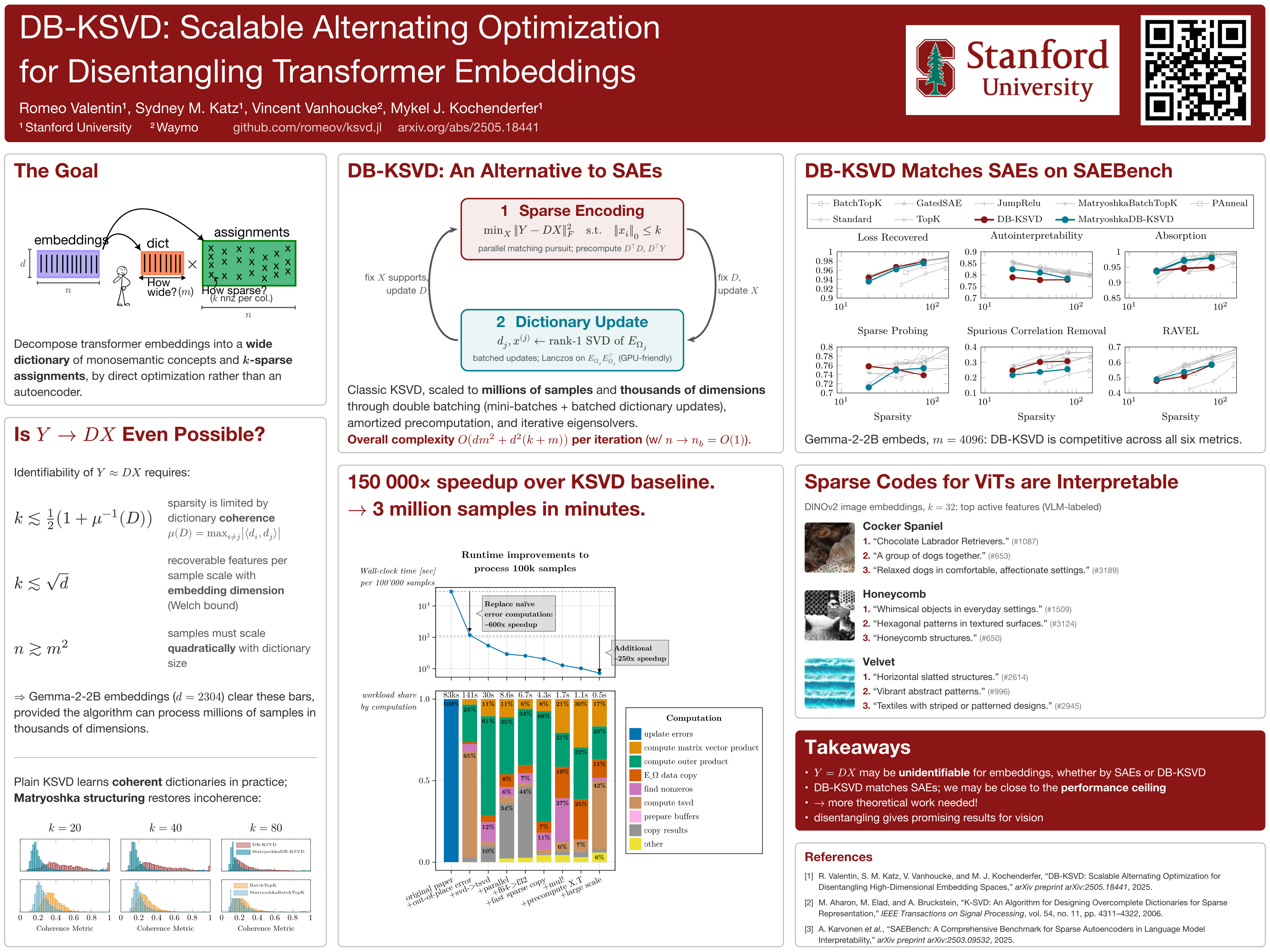
Dictionary learning has recently emerged as a promising approach for mechanistic interpretability of large transformer models. Disentangling high-dimensional transformer embeddings requires algorithms that scale to high-dimensional data with large sample sizes. Recent work has explored sparse autoencoders (SAEs) for this problem. However, SAEs use a simple linear encoder to solve the sparse encoding subproblem, which is known to be NP-hard. It is therefore interesting to understand whether this approach is sufficient to find good solutions to the dictionary learning problem or if a more sophisticated algorithm could find better solutions. In this work, we propose Double-Batch KSVD (DB-KSVD), a scalable dictionary learning algorithm that adapts the classic KSVD algorithm. DB-KSVD is informed by the rich theoretical foundations of KSVD but scales to datasets with millions of samples and thousands of dimensions. We demonstrate the efficacy of DB-KSVD by disentangling text embeddings of the Gemma-2-2B and Pythia-160M models and evaluating on six metrics from the SAEBench benchmark, where we achieve competitive results when compared to established approaches based on SAEs. We further show similar results when disentangling image embeddings obtained from the DINOv2-S and DINOv2-B models, solidifying our findings. By matching SAE performance with an entirely different optimization approach, our results suggest that (i) SAEs do find strong solutions to the dictionary learning problem and (ii) traditional optimization approaches can be scaled to the required problem sizes, offering a promising avenue for further research. We make an implementation of DB-KSVD available.
Lay Summary
Suppose we ask an LLM: “Can you tell me about Java?” What “Java” is the model thinking about? The programming language or the Indonesian island? To answer this question, we can try to understand what is going on inside the model. Specifically, we want to represent the model’s internal states in a human-interpretable way by finding the concepts that the model is thinking about. One approach to this problem is to phrase it as a dictionary learning problem, in which we try to decompose complex embeddings into a sum of simple and interpretable concept vectors. It is not obvious that we can break down embeddings as a linear sum of interpretable elements. However, the recently proposed “linear representation hypothesis” suggests the superposition of monosemantic concept vectors is a good model for the complex embeddings. Finding these concept vectors remains an ongoing challenge, and Sparse Autoencoders have been proposed for the problem. It turns out, though, that the problem of dictionary learning actually goes way back (pre-2000s!). In this paper, we show that with minor modifications, traditional methods can be scaled to sufficiently large datasets with millions of samples and thousands of dimensions and that their performance matches that of SAEs on a variety of benchmarks. We can also use established theory to gain insights on the applicability of SAEs to different problem sizes, e.g., when less data is available.