
Reasoning Compartmentalization: Bridging the Concretization Gap via Abstraction-based Routing
Abstract
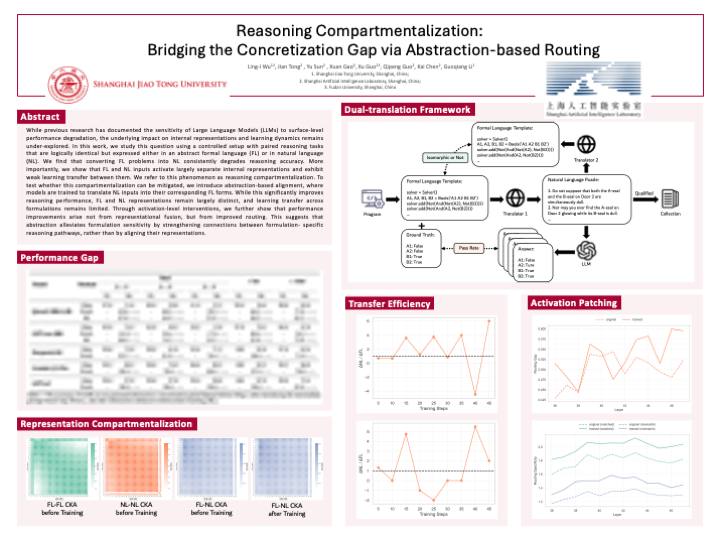
While previous research has documented the sensitivity of Large Language Models (LLMs) to surface-level performance degradation, the underlying impact on internal representations and learning dynamics remains under-explored. In this work, we study this question using a controlled setup with paired reasoning tasks that are logically identical but expressed either in an abstract formal language (FL) or in natural language (NL). We find that converting FL problems into NL consistently degrades reasoning accuracy. More importantly, we show that FL and NL inputs activate largely separate internal representations and exhibit weak learning transfer between them. We refer to this phenomenon as reasoning compartmentalization. To test whether this compartmentalization can be mitigated, we introduce abstraction-based alignment, where models are trained to translate NL inputs into their corresponding FL forms. While this significantly improves reasoning performance, FL and NL representations remain largely distinct, and learning transfer across formulations remains limited. Through activation-level interventions, we further show that performance improvements arise not from representational fusion, but from improved routing. This suggests that abstraction alleviates formulation sensitivity by strengthening connections between formulation-specific reasoning pathways, rather than by aligning their representations.
Lay Summary
This paper studies why AI language models can solve a reasoning problem when it is written in one form, but struggle when the same problem is written in another form. We create pairs of puzzles that have exactly the same underlying logic and answer: one version is written in a structured, symbolic format, and the other is written in ordinary natural language. We find that models often treat these two versions as if they were different problems. Their accuracy drops on the natural language version, and practice on one version does not transfer well to the other. We call this separation reasoning compartmentalization. We then show that teaching models to translate natural language problems into a more structured form can improve their reasoning. Our results suggest that more reliable AI reasoning requires not only stronger models, but also better ways for models to connect different ways of expressing the same problem.