
Hierarchical ODE: Learning Continuous-Time Physical Prototypes for Early Link Failure Detection
Abstract
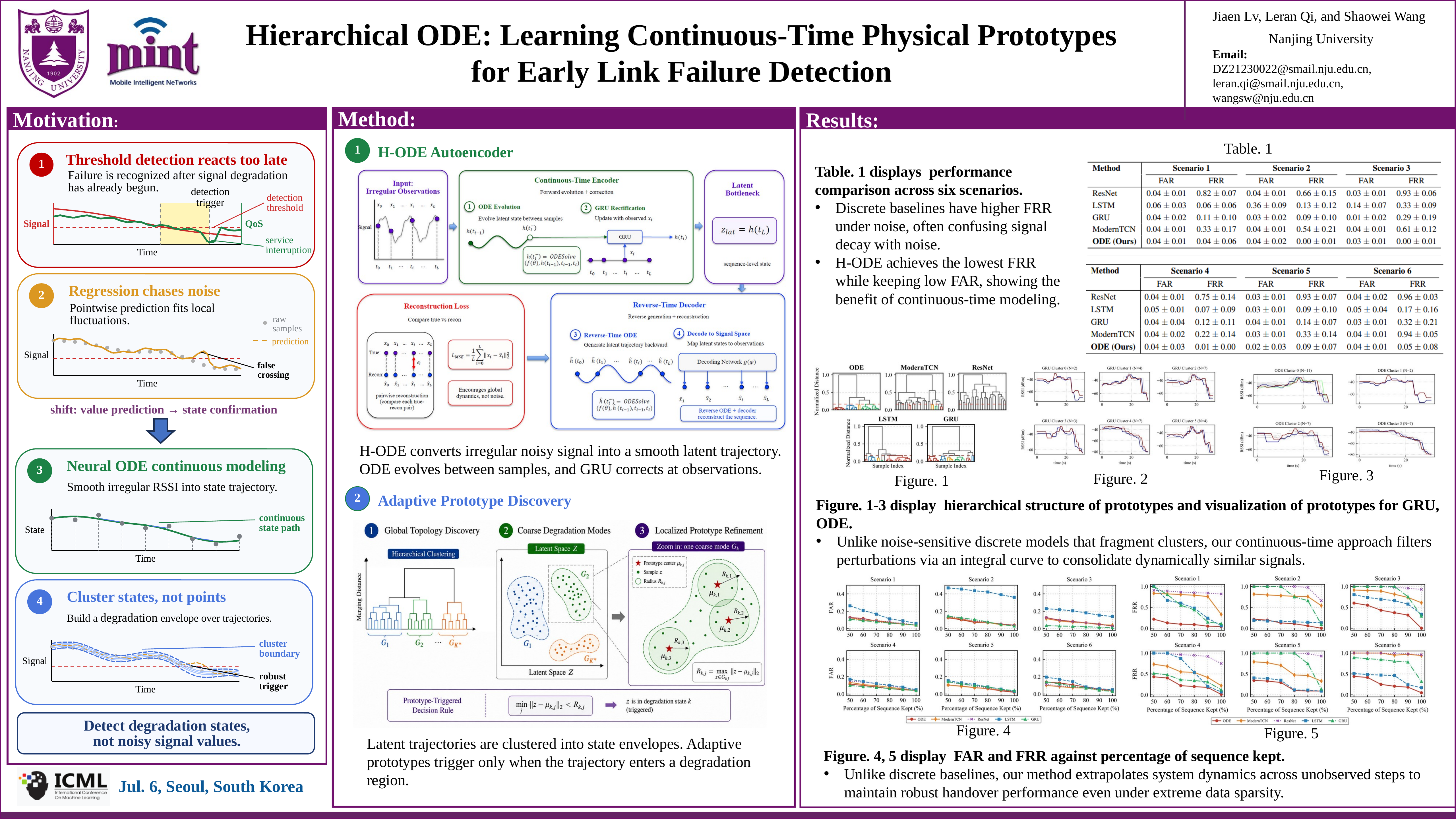
Time series prototype learning is fundamentally challenged by observational ambiguity. Discrete architectures fail to resolve this, as they lack the capacity to decouple stochastic noise from continuous dynamics. Furthermore, rigid closed-set assumptions fail to capture unseen diversity. To address these limitations, we propose a hierarchical ordinary differential equation clustering network, which utilizes neural ordinary differential equation to model latent state evolution as a continuous integral curve. This formulation enforces temporal continuity to effectively disentangle smooth feature trends from stochastic noise, while our adaptive hierarchical mechanism autonomously determines the appropriate number of prototypes without rigid prior constraints. Validated on the early link failure detection task with irregularly sampled time series, the proposed method effectively extracts underlying physical prototypes, thereby enabling robust failure detection. Our code is available at https://github.com/NJ-LNN/Hierarchical-ODE.
Lay Summary
Mobile devices often suffer from unexpected network disconnections. Predicting these failures is incredibly difficult because a harmless signal drop caused by random noise (like being temporarily shadowed by a moving obstacle, where the signal will recover shortly) looks exactly like a critical disconnection caused by real degradation (like entering an elevator) to traditional Artificial Intelligence (AI). Traditional models rely on isolated data snapshots, making them easily confused by such noise. To solve this, we designed a new AI framework that learns the continuous physical laws behind how signals fade. Instead of just connecting discrete data points to infer future signal features, it tracks the smooth, underlying trajectory of the network signal, easily separating the aforementioned random noise from real degradation. Furthermore, our system can automatically discover and categorize different types of network failures without needing humans to pre-define the categories. This enables future wireless networks to accurately anticipate network disconnections and seamlessly switch networks before a failure occurs. We have released our code openly to help others build smarter, crash-free networks.