
SKETCH: Semantic Key-Point Conditioning for Long-Horizon Vessel Trajectory Prediction
Abstract
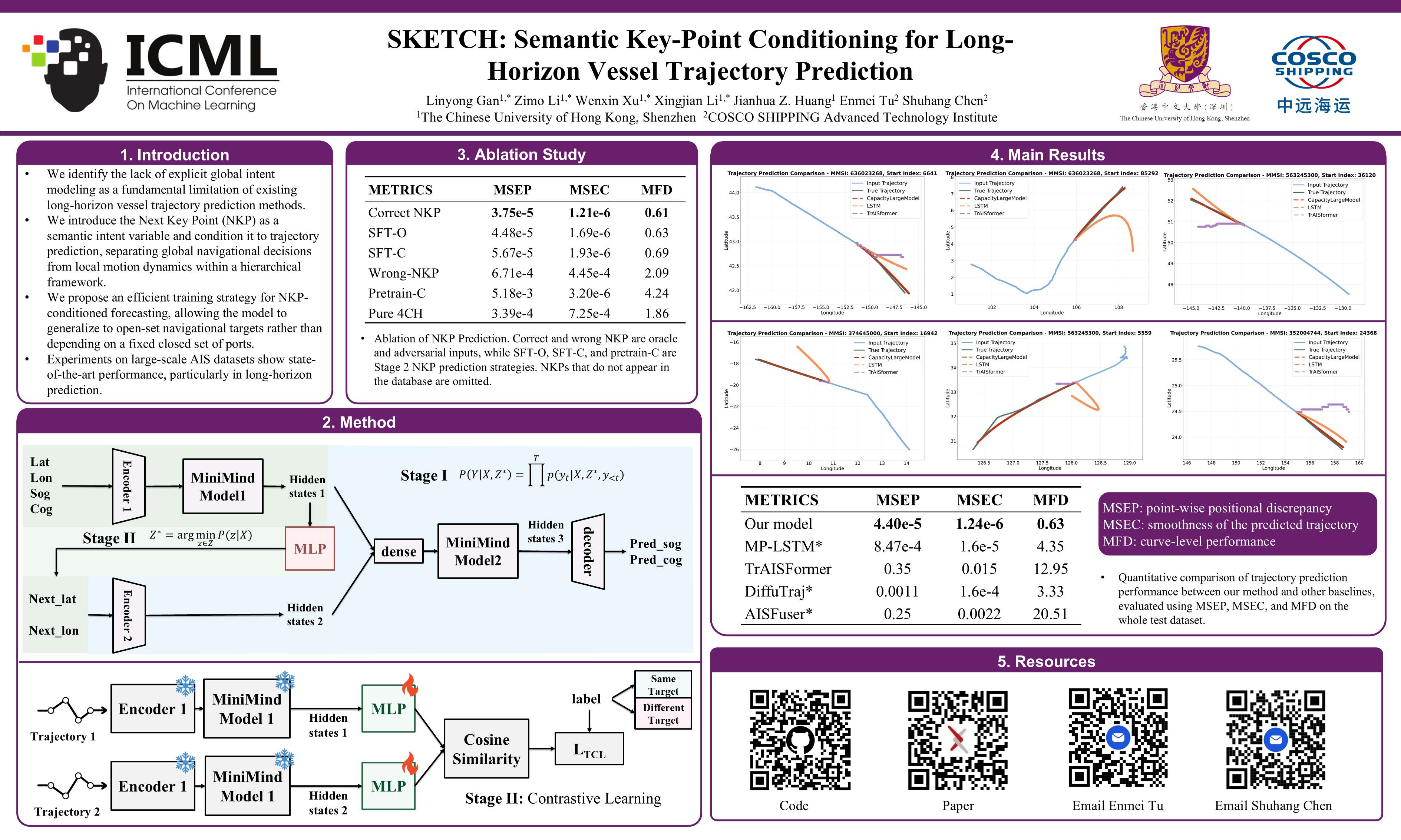
Accurate long-horizon vessel trajectory prediction remains challenging due to compounded uncertainty from complex navigation behaviors and environmental factors. Existing methods often struggle to maintain global directional consistency, leading to drifting or implausible trajectories when extrapolated over long time horizons. To address this issue, we propose a semantic-key-point-conditioned trajectory modeling framework, in which future trajectories are predicted by conditioning on a high-level Next Key Point (NKP) that captures navigational intent. This formulation decomposes long-horizon prediction into global semantic decision-making and local motion modeling, effectively restricting the support of future trajectories to semantically feasible subsets. To efficiently estimate the NKP prior from historical observations, we adopt a pretrain-finetune strategy. Extensive experiments on real-world AIS data demonstrate that the proposed method consistently outperforms state-of-the-art approaches, particularly for long travel durations, directional accuracy, and fine-grained trajectory prediction.
Lay Summary
Predicting where a ship will be many hours into the future is surprisingly hard. Existing AI models drift off course or produce unrealistic paths over long horizons because they only learn moment-to-moment motion patterns, without grasping where a vessel is actually trying to go. We drew inspiration from real captains, who plan toward landmarks like ports and straits while handling steering moment by moment. Our model, SKETCH, first forecasts the ship's next navigational landmark, its Next Key Point, by comparing the recent trajectory against a library of past voyages. It then predicts the detailed path conditioned on that landmark. Because the landmark is identified by similarity rather than selected from a fixed list, the system can handle destinations it has never seen during training. On large-scale ship-tracking data, SKETCH predicts vessel paths more accurately than prior methods, especially for long voyages. Better long-range forecasts support collision avoidance, port scheduling, search and rescue, and fuel-efficient routing — all critical to the maritime industry, which moves over 80% of global trade. More broadly, separating "where am I heading" from "how do I move" offers a general recipe for long-term prediction problems in which decisions occur at multiple levels.