
Interleaved Selective State Space Models for Efficient WiFi-Based 3D Multi-Person Pose Estimation
Abstract
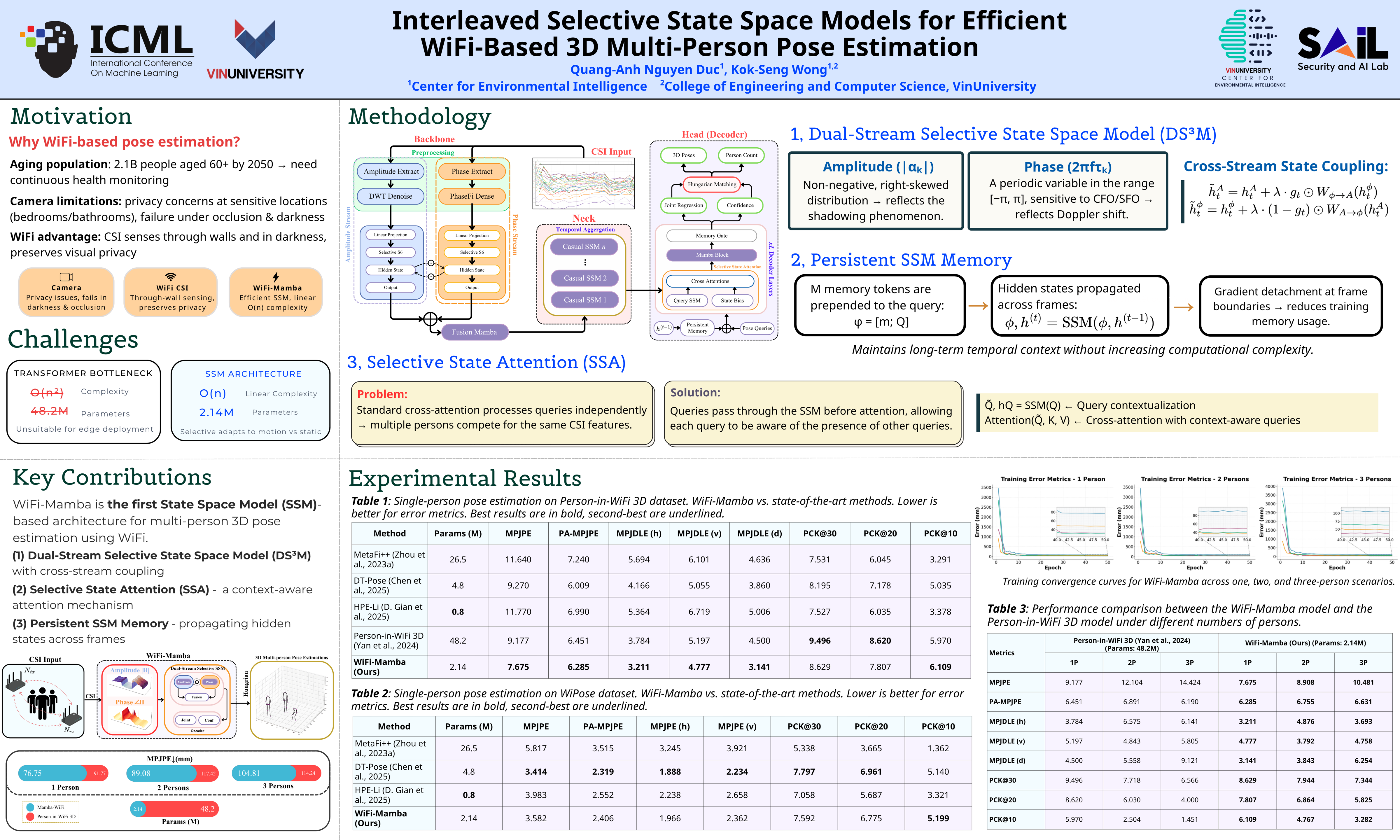
WiFi-based human pose estimation offers privacy-preserving and occlusion-robust sensing, but current Transformer-based approaches suffer from quadratic complexity and lack explicit inductive biases for the structure of Channel State Information (CSI). We propose WiFi-Mamba, the first State Space Model (SSM) architecture for WiFi-based 3D multi-person pose estimation. Our approach introduces three key contributions: (1) a Dual-Stream Selective SSM that processes amplitude and phase through parallel pathways with cross-stream state coupling to respect their distinct physical properties, (2) Selective State Attention for pose query decoding with SSM-derived sequential context, and (3) Persistent SSM Memory for temporal consistency across frames without recurrent memory explosion. Extensive experiments on the Person-in-WiFi 3D dataset, covering both single-person and multi-person, demonstrate a 16-27% MPJPE reduction across varying numbers of persons while using only 4.4\% of the baseline parameters (2.14M vs. 48.2M), achieving superior efficiency-accuracy trade-offs particularly beneficial for edge deployment in privacy-sensitive continuous monitoring scenarios.
Lay Summary
Human pose estimation can help monitor movement for applications such as fall detection, rehabilitation, and assisted living. However, many current systems rely on cameras, which can raise privacy concerns and often struggle in dark environments or when people are hidden behind objects. WiFi-based sensing offers an alternative because wireless signals can detect human movement without capturing visual images. Despite its potential, accurately estimating the body positions of multiple people from WiFi signals remains challenging because the signals from different people can overlap and become difficult to separate. In this work, we develop a new approach that uses WiFi signals to estimate the 3D body poses of multiple people while using far fewer computational resources than existing methods. Our system learns how to better interpret different characteristics of wireless signals and maintain a consistent understanding over time as people move. Experiments show that our approach improves accuracy while reducing the model size substantially, making it more suitable for practical use on lightweight devices. This work may support privacy-preserving applications in healthcare, smart homes, and continuous monitoring systems where cameras may not be desirable.