
Omni-fMRI: A Universal Atlas-Free fMRI Foundation Model
Abstract
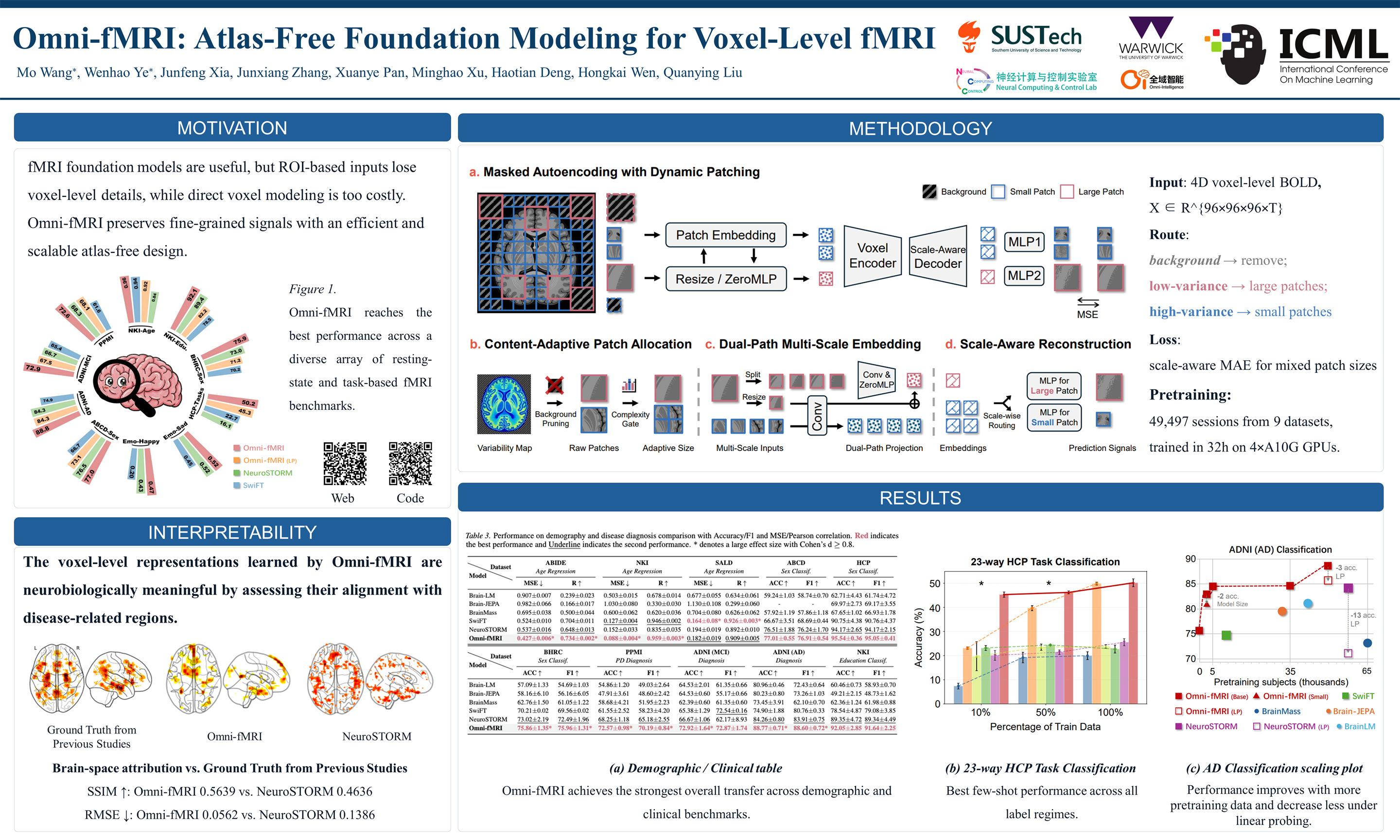
Self-supervised fMRI foundation models have shown promising transfer performance, yet most rely on predefined region-level parcellations that discard fine-grained voxel information and introduce atlas-dependent biases. We propose Omni-fMRI, an atlas-free foundation model that operates directly on voxel-level signals. To enable scalable pretraining on 49,497 fMRI sessions across nine datasets, Omni-fMRI introduces a dynamic patching mechanism that substantially reduces computational cost while preserving informative spatial structure. To support reproducibility and fair comparison, we establish a comprehensive benchmark suite spanning 11 datasets and a diverse set of resting-state and task-based fMRI tasks. Experimental results demonstrate that Omni-fMRI consistently outperforms existing foundation models, providing a scalable and reproducible framework for atlas-free brain representation learning. Code is available.
Lay Summary
Functional MRI is a brain imaging technique that records how activity changes across the whole brain over time. These scans contain rich information, but they are also very large and difficult for models to use directly. Many existing approaches first simplify the brain into a fixed set of predefined regions. While convenient, this can remove fine-grained information and may not fit every person’s brain equally well. We introduce Omni-fMRI, a model that learns directly from whole-brain fMRI scans without relying on a predefined brain map. To make this practical, the model automatically spends more computation on informative brain areas and less on background or redundant regions. This allows it to keep detailed brain activity patterns while reducing unnecessary computation. We train and evaluate Omni-fMRI on large public datasets covering many participants and tasks. Across tasks such as predicting demographic information, disease, brain states, emotions. Omni-fMRI performs better than previous models. Our benchmark and released evaluation details aim to make future comparisons in fMRI representation learning more reliable and reproducible. This work is a research tool for building better brain activity representations.