
Orthogonal Hierarchical Decomposition for Structure-Aware Table Understanding with Large Language Models
Abstract
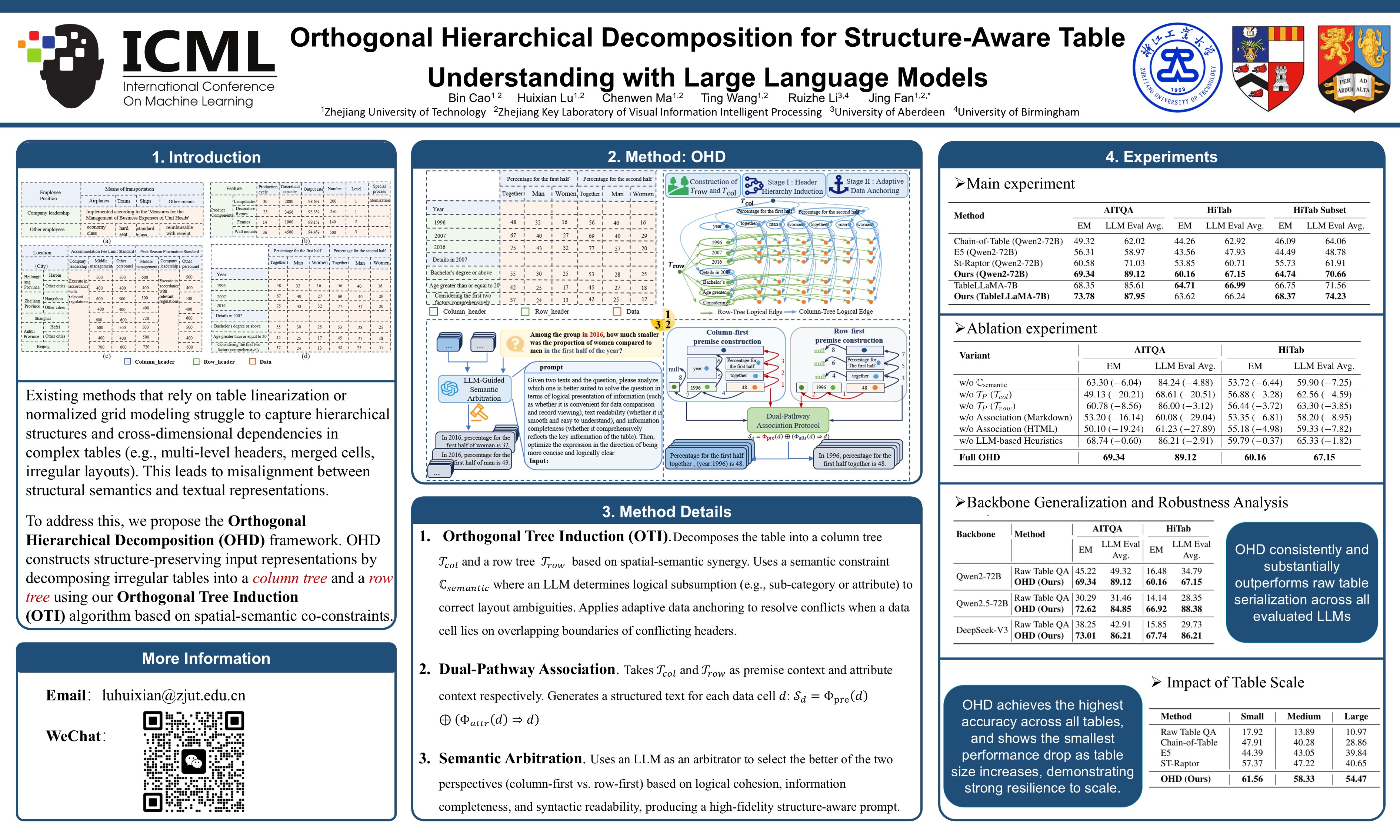
Complex tables with multi-level headers, merged cells and heterogeneous layouts pose persistent challenges for large language models (LLMs) in both understanding and reasoning. Existing approaches typically rely on table linearization or normalized grid modeling. However, these representations struggle to explicitly capture hierarchical structures and cross-dimensional dependencies, which can lead to misalignment between structural semantics and textual representations for non-standard tables. To address this issue, we propose an Orthogonal Hierarchical Decomposition (OHD) framework that constructs structure-preserving input representations of complex tables for LLMs. OHD introduces an Orthogonal Tree Induction (OTI) method based on spatial--semantic co-constraints, which decomposes irregular tables into a column tree and a row tree to capture vertical and horizontal hierarchical dependencies, respectively. Building on this representation, we design a dual-pathway association protocol to symmetrically reconstruct the semantic lineage of each cell, and incorporate an LLM as a semantic arbitrator to align multi-level semantic information. We evaluate OHD framework on two complex table question answering benchmarks, AITQA and HiTab. Experimental results show that OHD consistently outperforms existing representation paradigms across multiple evaluation metrics.
Lay Summary
Real‑world tables in financial reports or scientific studies often have multi‑level headers, merged cells, and irregular layouts, yet existing methods convert them into linear text representations that do not capture hierarchical structure or cross‑dimensional dependencies. Consequently, LLMs misread relationships between data cells and produce wrong answers when true table understanding is required. We propose Orthogonal Hierarchical Decomposition (OHD), which breaks each table into independent column and row trees, reassembles them into a text representation that preserves the original logic, and adds an LM step to check inconsistencies. OHD significantly outperforms existing methods on two challenging table QA benchmarks, enabling reliable LLM reasoning over complex real‑world tables and advancing trustworthy AI in finance, science, and healthcare.