
Learning Long Range Spatio-Temporal Representations over Continuous Time Dynamic Graphs with State Space Models
Abstract
Lay Summary
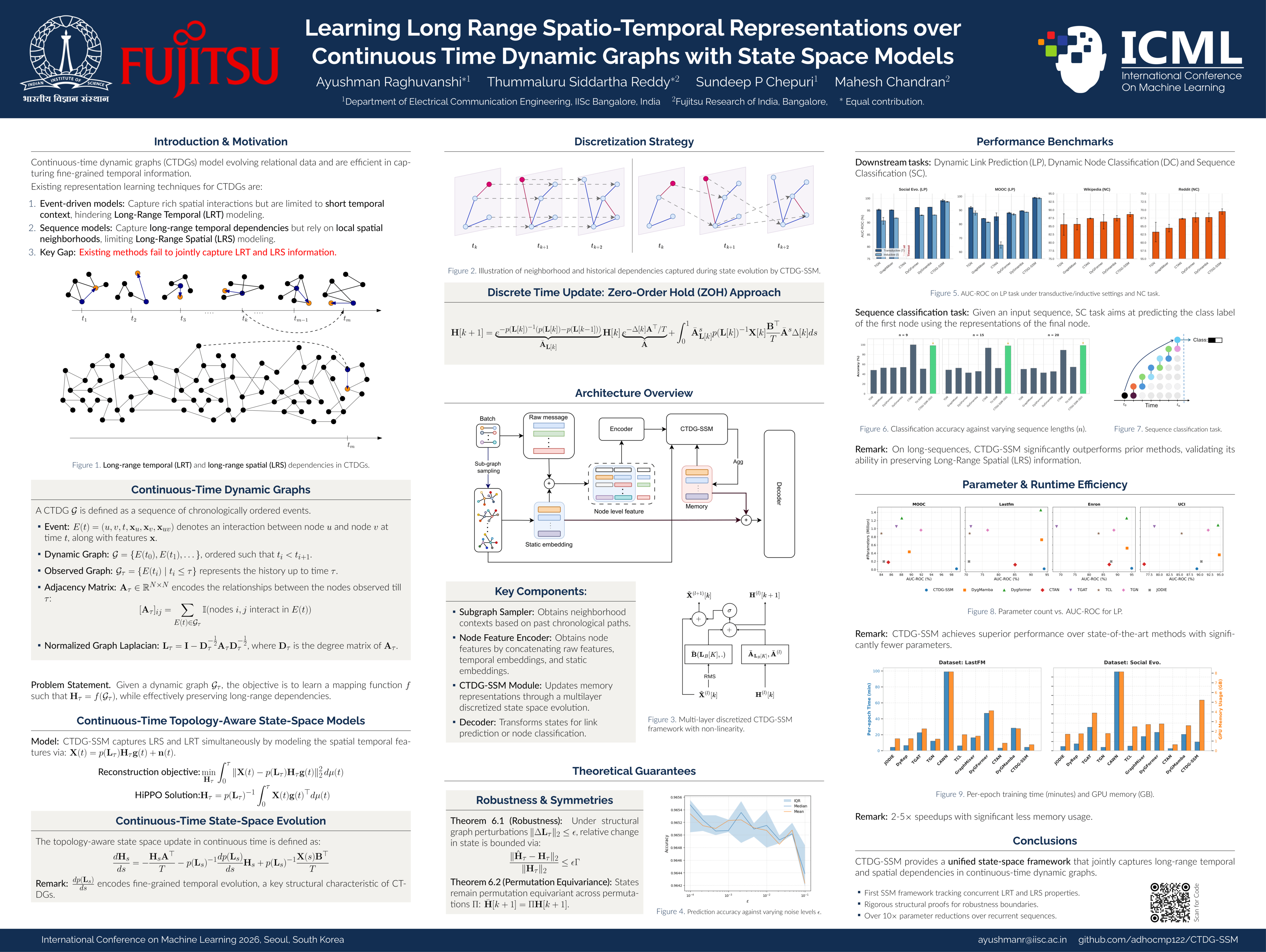
Many real-world networks, such as financial transactions, communication networks, and social media platforms, change continuously over time. To analyze these systems accurately, AI models need to remember a vast history of interactions and understand how a change in one corner of a network impacts distant areas. Existing AI methods struggle because they either have short-term memory or can only look at immediate, local connections, missing the global picture. We address this limitation by creating a new mathematical framework called CTDG-SSM. This framework acts as an advanced memory system that compresses an endless history of network changes into a compact set of equations. Crucially, it blends time and network structure together, allowing information to travel deep across the network without losing track of past context. Our model is exceptionally lightweight and efficient. When tested on real-world datasets, it matched or outperformed the best existing AI models while requiring significantly fewer adjustable settings. This makes it a powerful, cost-effective tool for tracking complex, fast-moving networks over long periods.