
Federated Graph Learning via Structure-Aware Fusion Using a Kalman Framework with Learnable Dynamics
Abstract
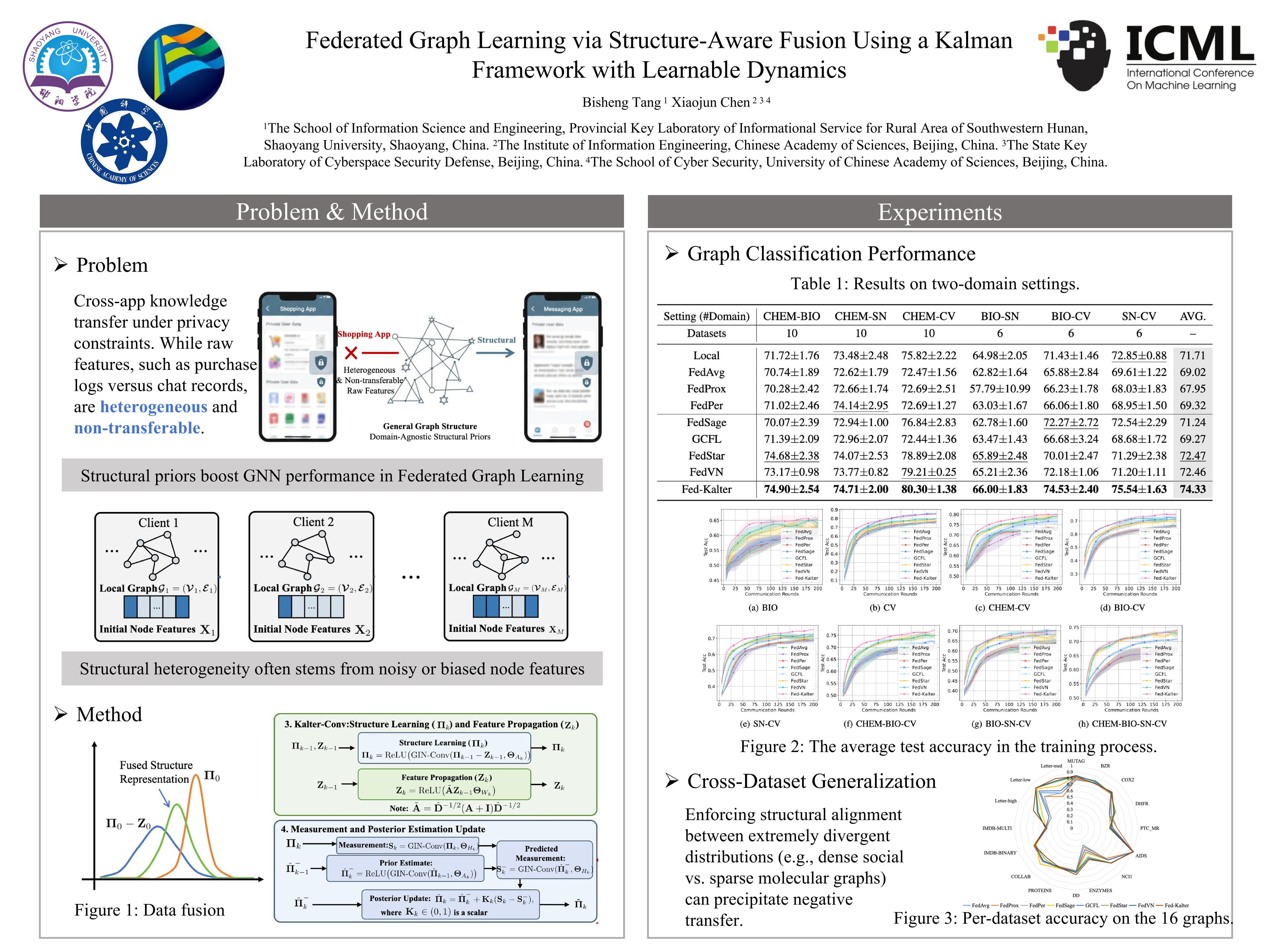
Federated Graph Learning (FGL) enables collaborative training across distributed clients without sharing raw graph data. However, its performance is severely hindered by graph-specific heterogeneity arising from divergent node feature distributions and disparate graph structures. Existing FGL methods primarily focus on aligning or personalizing node features but largely overlook the role of structural knowledge, leading to aggregation-induced representation drift during message passing. We observe that structural heterogeneity often originates from feature-driven connection biases shaped by local data collection practices or user preferences. To address this, we propose \textbf{Fed-Kalter}, a novel FGL framework that integrates Kalman filtering principles into graph neural networks. Fed-Kalter introduces Kalter-Conv, a graph convolution grounded in a Kalman framework with learnable dynamics, which treats structural embeddings as latent states and feature-augmented neighborhoods as noisy observations, thereby filtering feature-induced structural noise in a layer-wise manner. Only structural parameters are aggregated globally, enabling effective cross-client knowledge transfer while preserving local personalization. Extensive experiments on 16 graph classification datasets spanning 4 domains demonstrate that Fed-Kalter consistently outperforms state-of-the-art FGL methods. Further ablation and hyperparameter studies confirm its robustness, efficiency, and effectiveness in mitigating structural heterogeneity.
Lay Summary
Computers often learn from networks such as social connections or road maps. In Federated Learning, different organizations collaborate to train a shared AI without exchanging their private data. However, a major problem arises when the shape of these networks differs between groups. Local quirks or biases can confuse the AI, leading to poor results. We developed a new system called Fed-Kalter to solve this. Inspired by the smart filters used in GPS technology, our method separates the fundamental skeleton of the network from the specific noisy details of the individual data points. By treating the local details as noise and the network structure as the true signal, we can filter out local biases. Participants share only the purified general rules about network structures while keeping their unique personal details private. We found that this approach helps the AI learn more accurately and perform better than existing methods across many different types of data, from molecular chemistry to social networks.