
From Conflict to Consensus: Boosting Medical Reasoning via Multi-Round Agentic RAG
Abstract
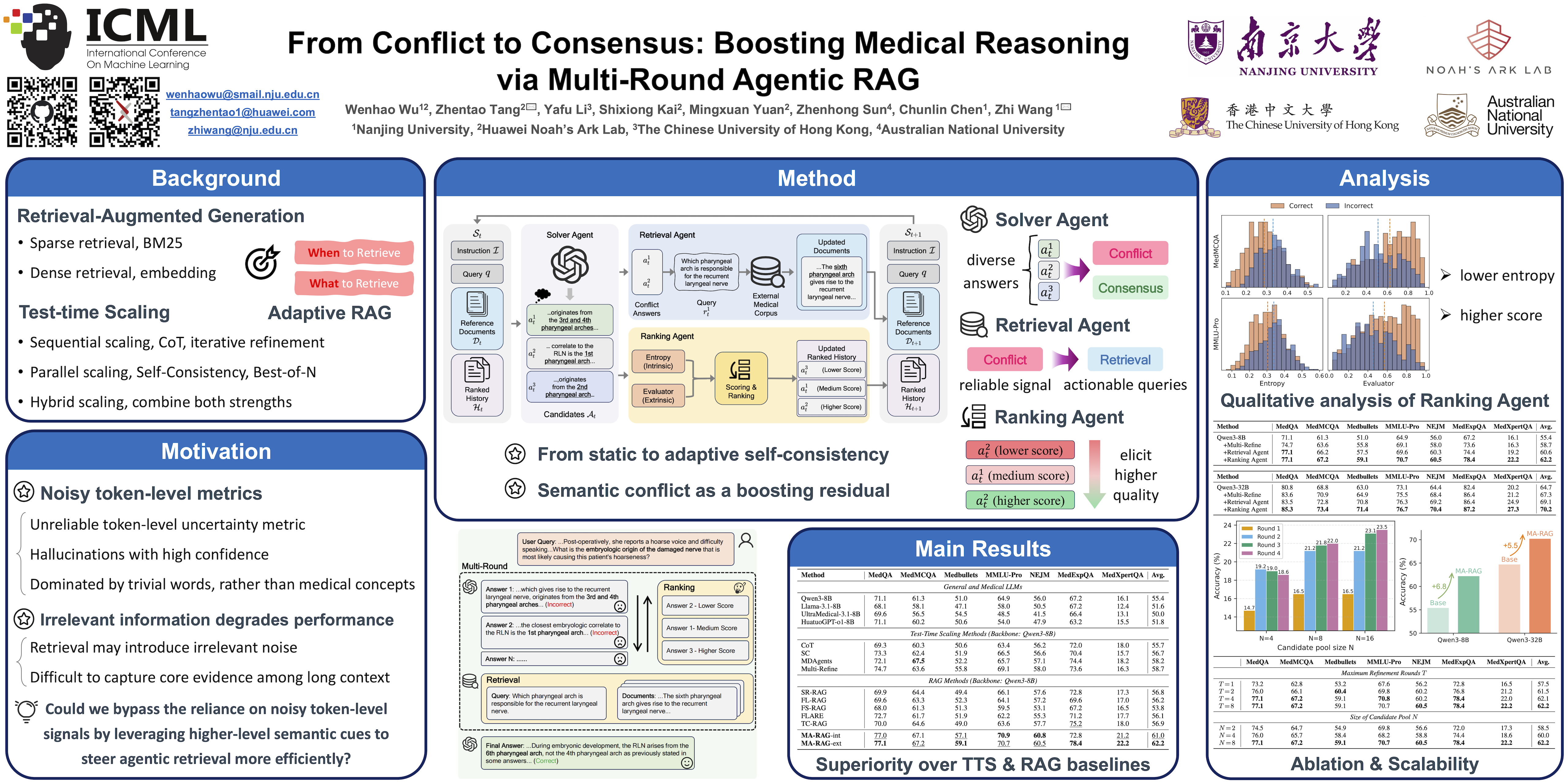
Large Language Models (LLMs) exhibit high reasoning capacity in medical question-answering, but their tendency to produce hallucinations and outdated knowledge poses critical risks in healthcare fields. While Retrieval-Augmented Generation (RAG) mitigates these issues, existing methods rely on noisy token-level signals and lack the multi-round refinement required for complex reasoning. In this paper, we propose MA-RAG (Multi-Round Agentic RAG), a framework that facilitates test-time scaling for complex medical reasoning by iteratively evolving both external evidence and internal reasoning history within an agentic refinement loop. At each round, the agent transforms semantic conflict among candidate responses into actionable queries to retrieve external evidence, while optimizing history reasoning traces to mitigate long-context degradation. MA-RAG extends the self-consistency principle by leveraging the lack of consistency as a proactive signal for multi-round agentic reasoning and retrieval, and mirrors a boosting mechanism that iteratively minimizes the residual error toward a stable, high-fidelity medical consensus. Extensive evaluations across 7 medical Q&A benchmarks show that MA-RAG consistently surpasses competitive inference-time scaling and RAG baselines, delivering substantial +6.8 points on average accuracy over the backbone model. Our code is available at https://github.com/NJU-RL/MA-RAG.
Lay Summary
Large language models (LLMs) can be used to answer medical questions, but they still make dangerous factual errors or hallucinations, by confidently inventing incorrect diagnoses. While searching external medical databases helps reduce these errors, current methods struggle to precisely decide when and what to look up, often relying on unreliable internal signals like how confident the model outputs. We propose MA-RAG, a framework that improves medical reasoning by turning disagreement into a signal. Instead of trusting a single answer, our system generates multiple candidate diagnoses at once. When these candidates disagree, MA-RAG treats the conflict as a roadmap: it automatically pinpoints the specific medical facts in dispute to guide targeted searches across a library of textbooks, research articles, and clinical guidelines for the missing evidence. This process repeats over several rounds, each time narrowing the gap between conflicting answers until a stable, evidence-backed consensus emerges. Tested across seven medical benchmarks, MA-RAG consistently outperformed existing methods, improving average accuracy by nearly 7 percentage points over the base LLM. On the hardest expert-level questions, it achieved up to 37% relative improvement. By iteratively resolving medical conflicts with external evidence, MA-RAG transforms LLMs into dependable assistants.