
TSRBench: A Comprehensive Multi-task Multi-modal Time Series Reasoning Benchmark for Generalist Models
Abstract
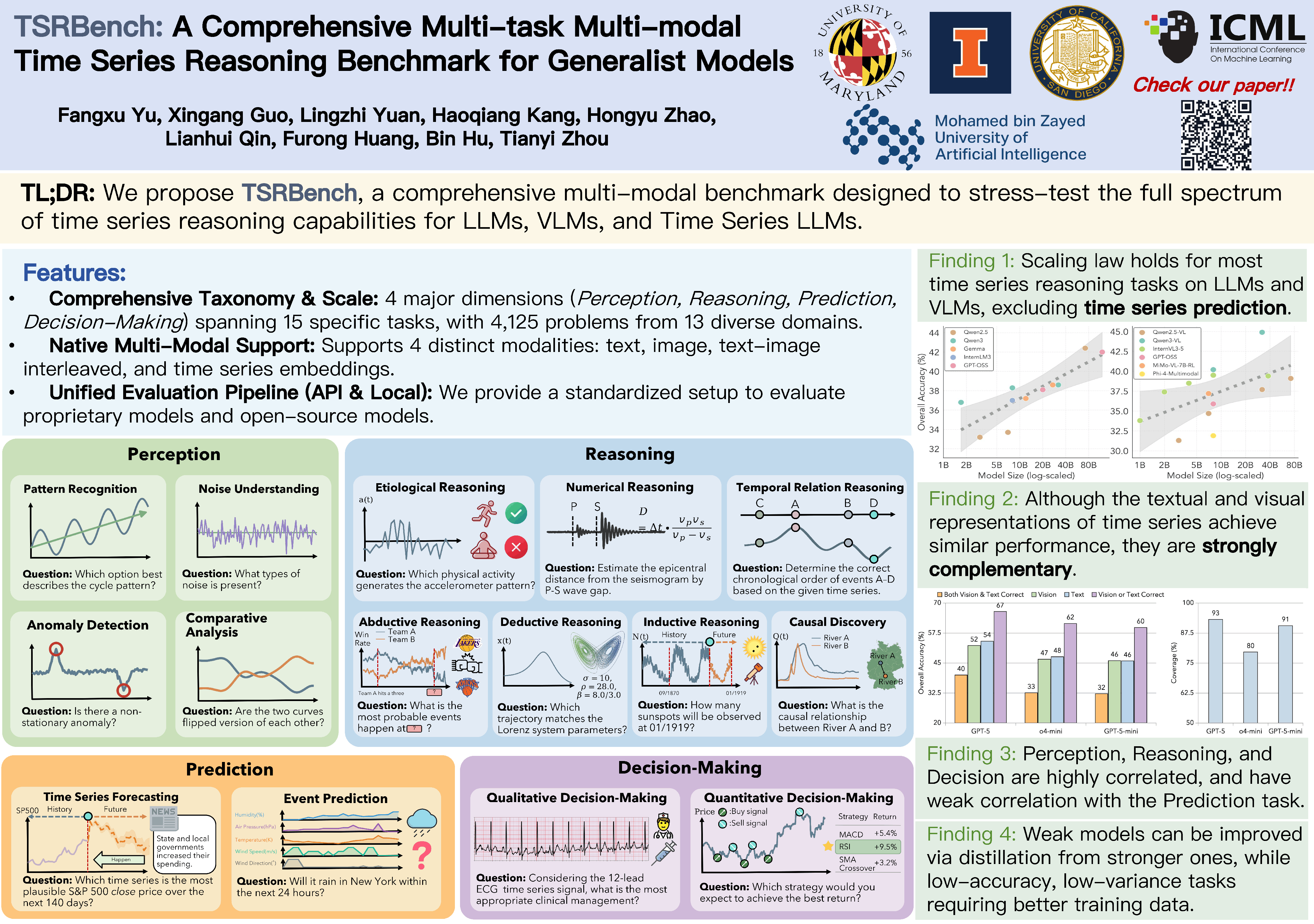
Time series are ubiquitous in real-world scenarios and crucial for applications ranging from energy management to traffic control. Consequently, the ability to reason over time series is a fundamental skill for generalist models to solve complex problems. However, current benchmarks for generalist models largely overlook this dimension. To bridge this gap, we introduce TSRBench, a comprehensive multi-modal benchmark designed to stress-test the full spectrum of time series reasoning capabilities. TSRBench features: i) a diverse set of 4125 problems from 14 domains, and is categorized into 4 major dimensions: Perception, Reasoning, Prediction, and Decision-Making. ii) 15 tasks from the 4 dimensions evaluating essential reasoning capabilities (e.g., numerical reasoning). Through extensive experiments, we evaluate over 30 leading proprietary and open-source LLMs, VLMs, and TSLLMs within TSRBench. Our findings reveal that: i) scaling laws hold for perception and reasoning but break down for prediction; ii) strong reasoning does not guarantee accurate context-aware forecasting, indicating a decoupling between semantic understanding and numerical prediction; and iii) despite the complementary nature of textual and visual forms of time series as inputs, current multimodal models fail to effectively fuse them for reciprocal performance gains. TSRBench provides a standardized evaluation platform that not only highlights existing challenges but also offers valuable insights to advance generalist models. Our code and dataset are available at https://tsrbench.github.io/.
Lay Summary
A lot of the world's information arrives as numbers that change over time. Heart rate readings, river levels, stock prices, weather measurements, and electricity demand are all examples. People are starting to ask AI assistants to make sense of this kind of data. We wanted to know how well today's AI systems can actually do this. We built a test called TSRBench. It contains 4,125 questions drawn from 14 fields, including medicine, finance, weather, and physics. The questions cover four basic skills. The first is noticing patterns. The second is reasoning about what those patterns mean. The third is predicting what comes next. The fourth is making decisions based on the data. We ran the test on more than 30 AI systems, including GPT-5, Claude, Gemini, and several open-source models. We also tried showing the same data in different forms, sometimes as plain numbers and sometimes as a chart. The results were mixed. Most systems could spot basic patterns. They did much worse at reasoning, predicting the future, and making decisions. Larger models tended to perform better on most skills but not on prediction, where extra size brought almost no gain. Charts and numerical descriptions of the same data each helped with different questions, but no model managed to combine the two effectively. The benchmark shows where current AI is weak and where future work is needed before these systems can be trusted with real decisions in fields like healthcare and finance.