
BEDTime: A Unified Benchmark for Automatically Describing Time Series
Abstract
Lay Summary
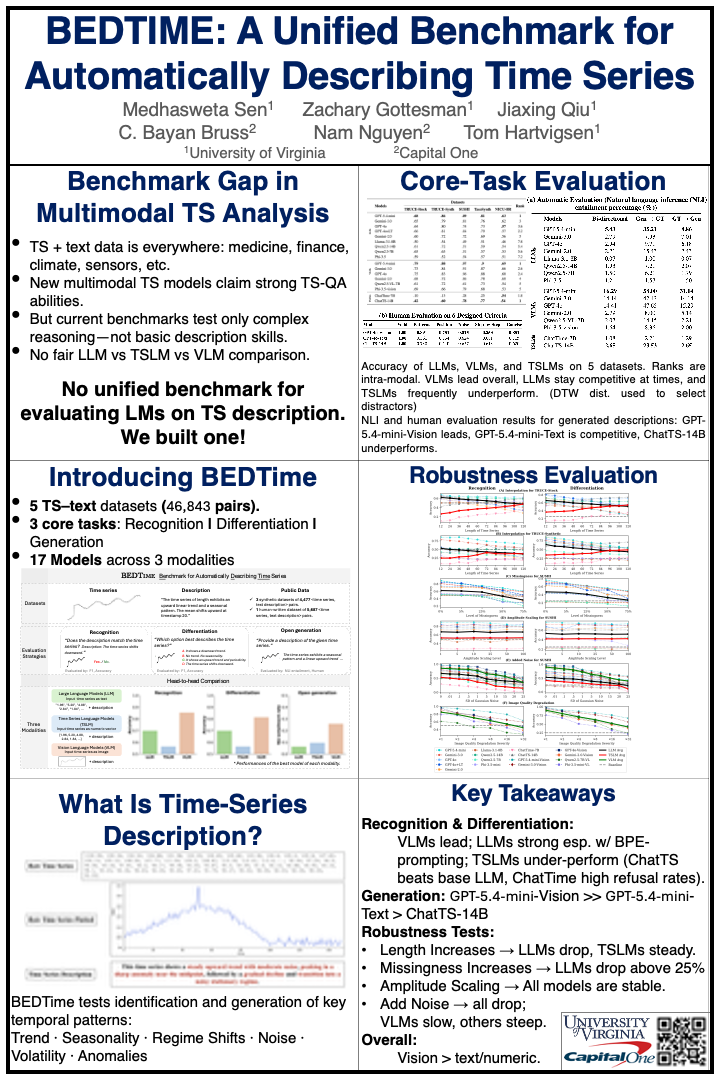
A time series is a sequence of numbers collected over time, like a patient's heart rate or daily stock prices. They are everywhere in medicine, finance, and engineering. Recent Language Models (LMs) claim to analyze and reason about these patterns using natural language, but they're typically tested on complicated tasks before anyone checks whether they can handle the basics. So, we asked a simple question: can these models actually describe what a time series looks like? To find out, we built BEDTime, a unified test that asks 17 leading LMs to do three things: recognize whether a description matches a time series, differentiate the best description from multiple choices, and write a description of a given time series. We assembled over 40,000 examples from five existing datasets and tested the models across three different modalities. The findings were revealing. Models that see time series as images performed best, while text-only approaches struggled, and specialized "time series language models" underperformed expectations. Every model broke down when we added realistic challenges like noise or missing values, exposing how fragile current systems really are. This is the gap BEDTime addresses: it contributes the first unified benchmark for this foundational skill, letting researchers directly compare models, diagnose where they fail, and track real progress on describing time series.