
Kinematics-Driven Gaussian Shape Deformation for Blurry Monocular Dynamic Scenes
Abstract
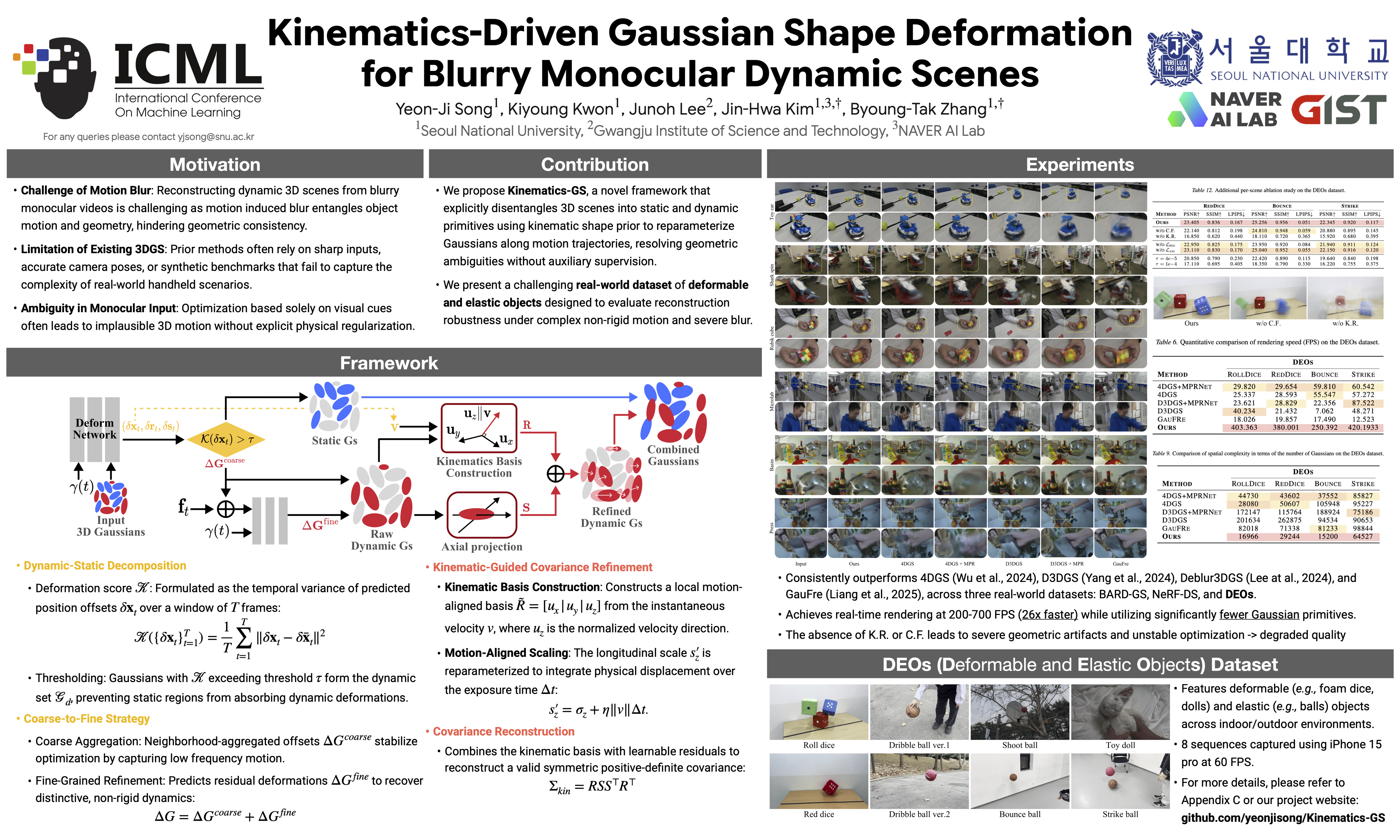
Reconstructing dynamic 3D scenes from blurry monocular videos is challenging because motion-induced blur entangles object motion and geometry, hindering geometric consistency. We present Kinematics-GS, a kinematics-aware framework that models blur as motion-aligned deformation and introduces a kinematic prior to reparameterize Gaussian shapes along motion trajectories, thereby mitigating degenerate shape collapse without auxiliary motion supervision. To stabilize optimization, we decompose scenes into dynamic and static components using temporal deformation variance and employ a coarse-to-fine deformation strategy to capture both global motion and fine-grained details. We also introduce a challenging real-world dataset of deformable and elastic objects exhibiting non-rigid motion with spatially non-uniform motion blur that obscures geometric cues. Extensive experiments on real-world benchmarks with realistic motion blur demonstrate that Kinematics-GS outperforms prior methods by a clear margin in monocular dynamic scene reconstruction, highlighting its effectiveness in handling complex and non-rigid motion scenarios.
Lay Summary
Reconstructing dynamic 3D scenes from monocular videos is a fundamental challenge in computer vision, particularly when fast-moving objects create motion blur. In standard video capture, rapid object movement causes fine details to smear along motion trajectories, making it difficult for AI models to distinguish between an object’s true geometry and the artifactual streaks caused by its motion. This ambiguity often results in geometric collapse or floating artifacts in the digital reconstruction. To resolve this, we introduce Kinematics-GS, a framework that links instantaneous velocity to Gaussian covariance, modeling motion blur as a motion-aligned deformation. By separating the scene into dynamic and static primitives, we enable robust 3D reconstruction from blurry monocular videos without explicit motion supervision. Furthermore, we present the DEOs (Deformable and Elastic Objects) dataset, which features real-world sequences of objects undergoing complex non-rigid transformations and elastic collisions. Our experiments demonstrate that Kinematics-GS significantly outperforms existing models, producing high-fidelity and physically consistent 3D scenes even in unconstrained, everyday environments.