
NaviCache: Test-Time Self-Calibration Caching for Video Generation
Abstract
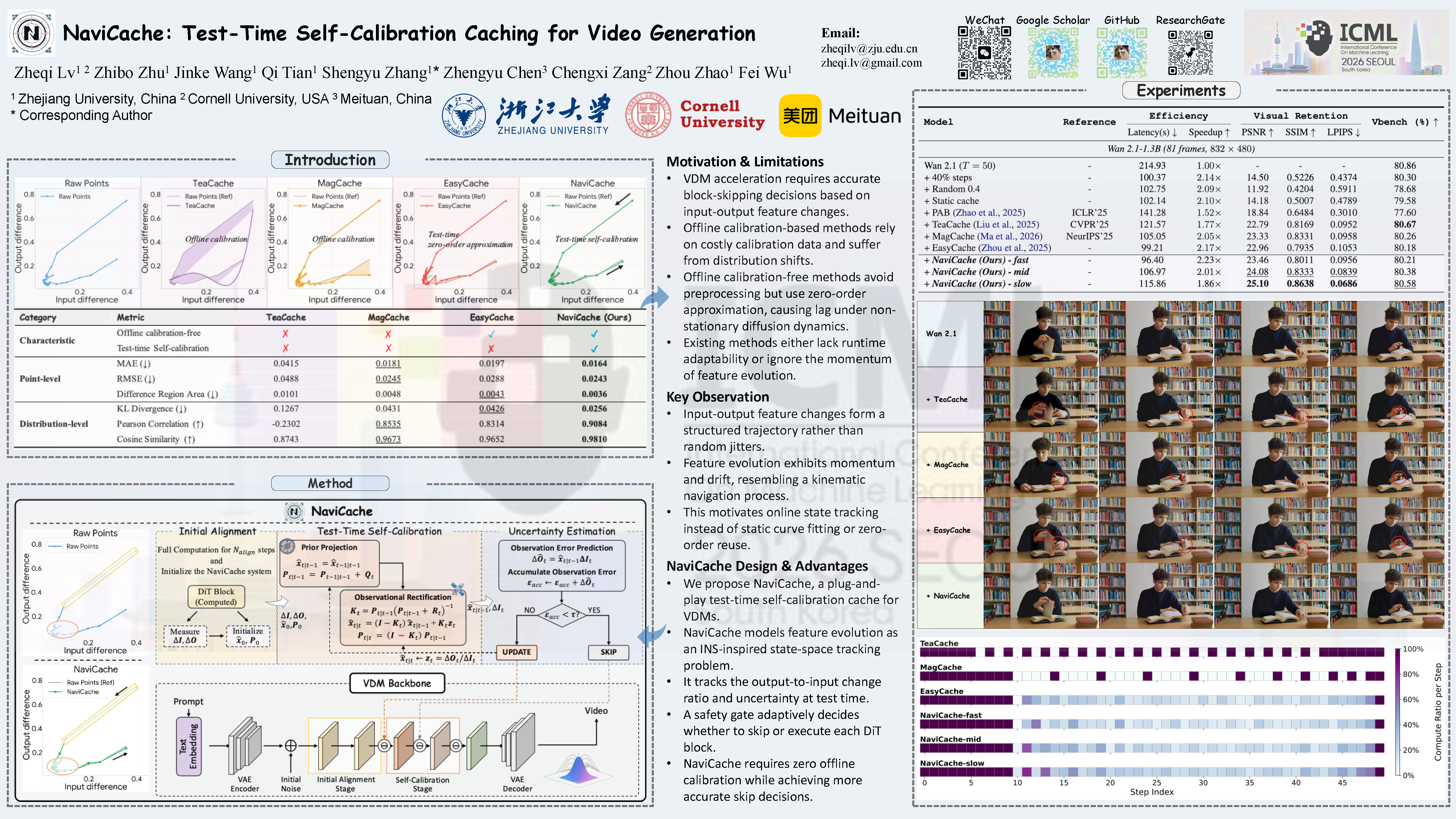
Video Diffusion Models (VDMs) is constrained by immense computational costs. While offline calibration-based acceleration suffers from calibration data dependency, prohibitive calibration duration, and susceptibility to distribution shifts, offline calibration-free methods eliminate these hurdles. However, since they rely on instantaneous zero-order approximations where the mapping between input and output differences varies in real-time, they are susceptible to observational noise and ignore the intrinsic momentum within the diffusion trajectory. In this paper, we propose NaviCache, a plug-and-play test-time self-calibration method re-conceptualizing feature evolution as an Inertial Navigation System (INS) problem. NaviCache bridges the fundamental domain gap and the non-stationary nature of diffusion by modeling the relative coupling between input and output variations. We introduce a dual-state estimation architecture that adaptively tracks the feature change ratio and its latent drift, initialized via a specialized Initial Alignment phase. By integrating a time-dependent noise schedule with an uncertainty-aware Measurement Update mechanism, NaviCache provides a theoretically grounded mechanism for error-bounded block skipping. Extensive experiments on the HunyuanVideo, Wan, and Open-Sora series demonstrate that NaviCache exhibits more accurate error judgment for block skipping and achieves outstanding comprehensive performance.
Lay Summary
AI models that generate high-quality videos are incredibly powerful, but they are also painfully slow because they require massive amounts of step-by-step calculation. To speed them up, researchers often try to make the models "skip" redundant computational steps. However, current shortcuts have major flaws: they either require the AI to "pre-study" a specific set of data beforehand (which makes them rigid and prone to errors when generating new, unfamiliar content), or they rely on short-sighted, instantaneous guesses that ignore the natural, continuous flow of how a video is formed. In this paper, we introduce NaviCache, a new approach that treats the video generation process not as a series of random, disconnected jumps, but as a moving object with clear "momentum." Inspired by the navigation systems used in airplanes and submarines, NaviCache continuously tracks the trajectory of the video being generated on the fly. It works by taking careful, fully calculated steps at the very beginning of the generation to "get its bearings." Once aligned, it uses a dual-tracking engine to predict the video's momentum, smartly deciding which future calculations can be safely skipped. If the system ever senses that it is becoming too uncertain, it briefly recalculates to re-anchor itself on the right path. Without needing any prior practice on datasets, NaviCache mathematically guarantees fewer errors than older guessing methods. When tested on popular AI video generators, it significantly speeds up the creative process while keeping the final videos sharp and realistic.