
On Group Relative Policy Optimization Collapse in Agent Search: The Lazy Likelihood-Displacement
Abstract
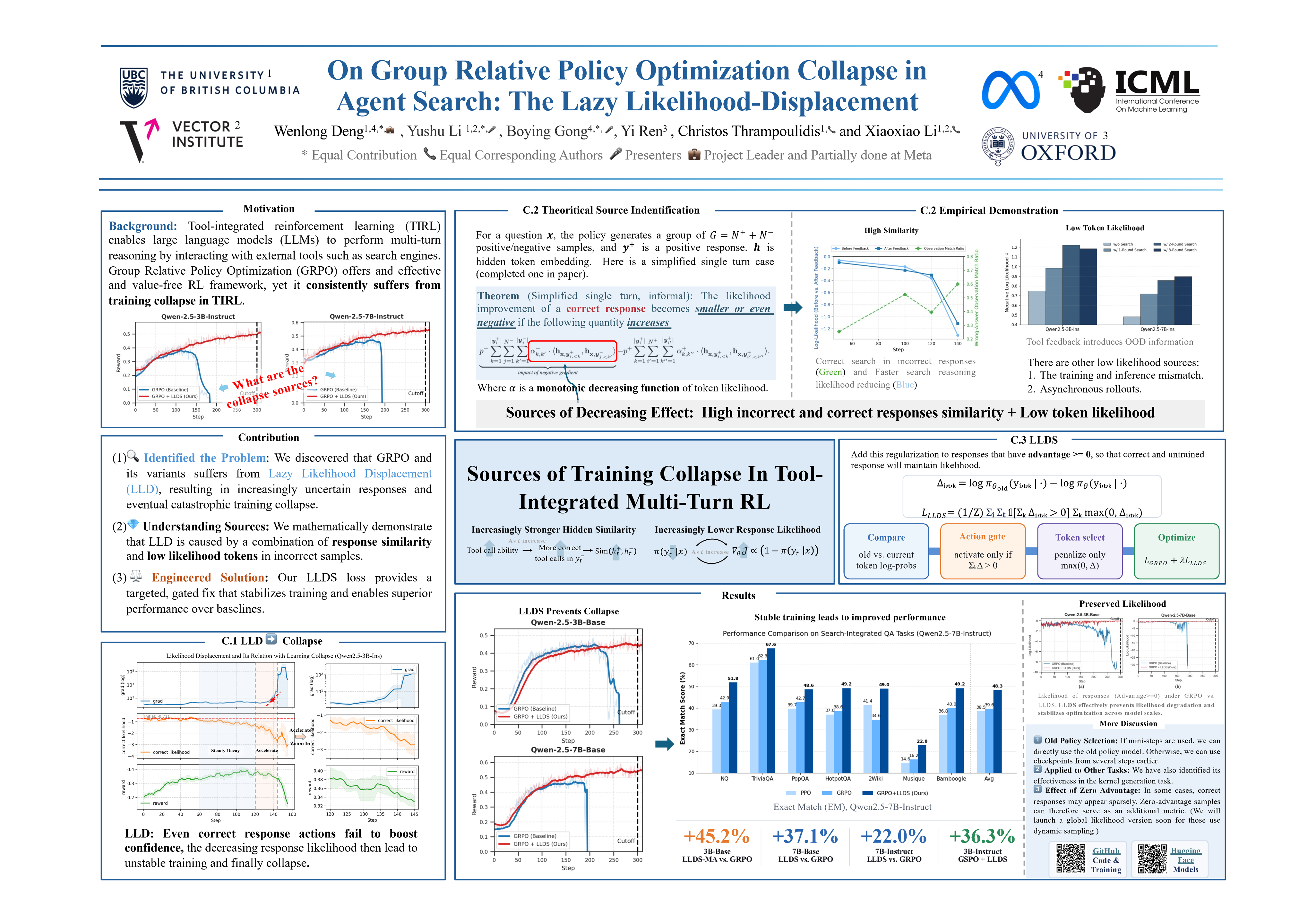
Tool-integrated (TI) reinforcement learning (RL) enables large language models (LLMs) to perform multi-step reasoning by interacting with external tools such as search engines and retrievers. Group Relative Policy Optimization (GRPO), exemplified by the recent Search-R1, offers fast convergence and a value-free formulation that makes it appealing for this setting, yet consistently suffers from training collapse. We identify Lazy Likelihood Displacement (LLD), a systematic reduction or stagnation in the likelihood of both correct and incorrect responses, as the core mechanism driving this failure. LLD emerges early and triggers a self-reinforcing LLD Death Spiral, where declining likelihood leads to low-confidence responses, inflating gradients, and ultimately causing collapse. We empirically characterize this process across models on a Search-R1-style, search-integrated question answering task, revealing a consistent three-phase trajectory: early stagnation, steady decay, and accelerated collapse. To address this, we propose a likelihood-preserving regularization LLDS that activates only when a response action’s likelihood decreases, and regularizes only the tokens responsible. This fine-grained structure mitigates LLD with minimal interference. Our method stabilizes training, prevents gradient explosion, and yields substantial performance improvements across seven benchmarks, including relative improvements of +45.2% on Qwen2.5-3B and +37.1% on Qwen2.5-7B over vanilla GRPO training. Our results establish LLD as a previously overlooked bottleneck in GRPO- based TIRL and provide a practical path toward stable, scalable training of tool-integrated RL.
Lay Summary
Tool-integrated reinforcement learning allows large language models to solve complex tasks by using external tools such as search engines. However, a popular training method called GRPO often becomes unstable and collapses during training. We identify the main cause of this failure, called Lazy Likelihood Displacement (LLD), where the model gradually loses confidence in both correct and incorrect answers, leading to unstable updates and eventual collapse. To address this, we propose LLDS, a lightweight stabilization method that selectively prevents harmful confidence drops. Our approach stabilizes training, avoids gradient explosion, and significantly improves performance across seven benchmarks, achieving gains of up to 45.2% over standard GRPO training. These results provide a practical path toward more reliable and scalable tool-using AI systems.