
MoLF: Mixture-of-Latent-Flow for Pan-Cancer Spatial Gene Expression Prediction from Histology
Abstract
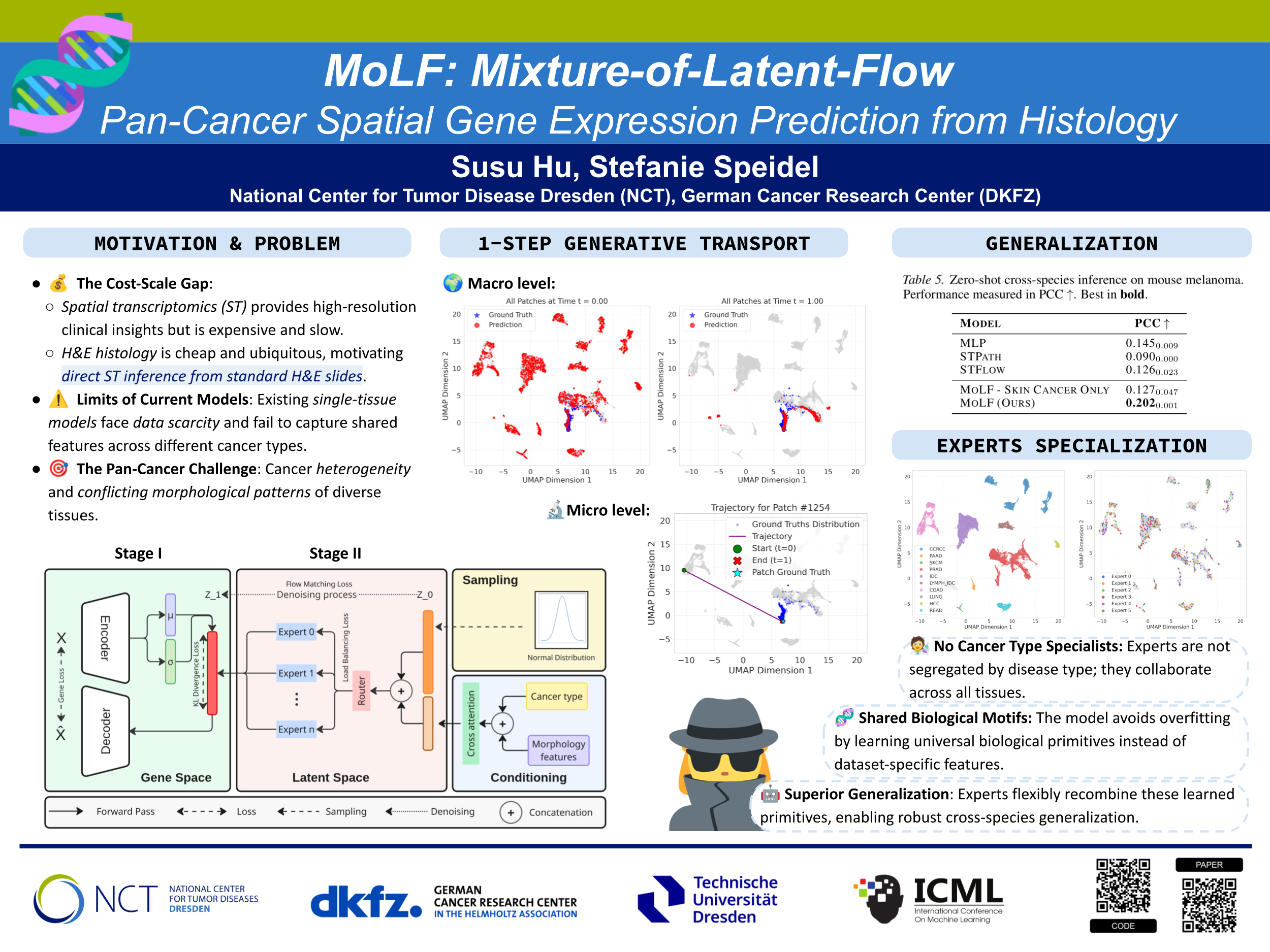
Inferring spatial transcriptomics (ST) from histology enables scalable histogenomic profiling, yet current methods are largely restricted to single-tissue models. This fragmentation fails to leverage biological principles shared across cancer types and hinders application to data-scarce scenarios. While pan-cancer training offers a solution, the resulting heterogeneity challenges monolithic architectures. To bridge this gap, we introduce MoLF (Mixture-of-Latent-Flow), a generative model for pan-cancer histogenomic prediction. MoLF leverages a conditional Flow Matching objective to map noise to the gene latent manifold, parameterized by a Mixture-of-Experts (MoE) velocity field. By dynamically routing inputs to specialized sub-networks, this architecture effectively decouples the optimization of diverse tissue patterns. Our experiments demonstrate that MoLF establishes a new state-of-the-art, consistently outperforming both specialized and foundation model baselines on pan-cancer benchmarks. Furthermore, MoLF exhibits zero-shot generalization to cross-species data, suggesting it captures fundamental, conserved histo-molecular mechanisms.
Lay Summary
Mapping gene activity within tumors is crucial for understanding cancer, but the process is expensive and slow. Our AI model, MoLF, predicts this activity directly from cheap, standard microscope tissue slides. Because different cancers look vastly different, previous AI tools struggled to analyze multiple cancer types simultaneously. MoLF solves this using a "Mixture-of-Experts" approach, dynamically routing different tissue patterns to specialized AI sub-networks. MoLF accurately predicts gene activity across diverse human cancers and even works on unseen mouse data, proving it learns fundamental, universal biological rules.