
Mitigating Error Accumulation in Continuous Navigation via Memory-Augmented Kalman Filtering
Abstract
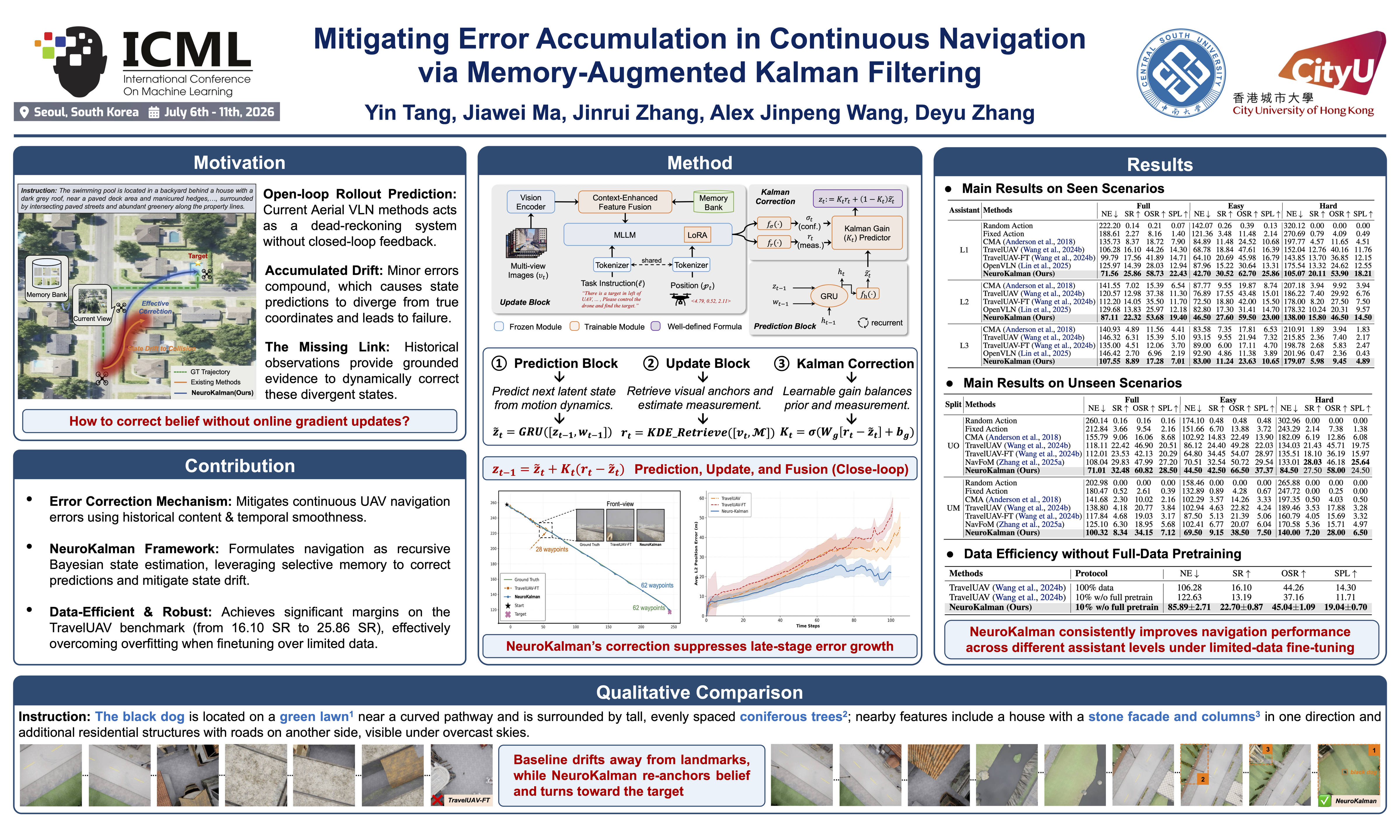
Continuous prediction in complex environments is critical for Unmanned Aerial Vehicle (UAV). However, the existing Vision-Language Navigation (VLN) models follows the dead-reckoning, which iteratively predicts the next waypoint and updates its position, thereby constructing the complete trajectory. Then, such stepwise manner will inevitably lead to accumulated errors of position over time, resulting in misalignment between internal belief and objective coordinates, which is known as ``state drift'' and ultimately compromises the subsequent trajectory prediction. Drawing inspiration from classical control theory, we propose to correct for errors by formulating the continuous prediction as a recursive Bayesian state estimation problem. In this paper, we design NeuroKalman, a novel framework that decouples navigation into two complementary processes: a Prior Prediction, based on motion dynamic,s and a Likelihood Correction, from historical observation. We first mathematically associate Kernel Density Estimation of the measurement likelihood with the attention-based retrieval mechanism, which then allows the system to rectify the latent representation using retrieved historical anchors without gradient updates. Comprehensive experiments on TravelUAV benchmark demonstrate that, with only 10\% of the full training data fine-tuning, our method clearly outperforms strong baselines and regulates drift accumulation.
Lay Summary
Unmanned aerial vehicles need to continuously decide where to move in complex environments. Existing vision-language navigation systems plan step by step, repeatedly predicting the next waypoint and updating their estimated position. However, small errors can accumulate over time, causing the system’s internal estimate of its location to drift away from the true position and making later navigation decisions less reliable. This paper introduces NeuroKalman, a framework that reduces such drift by combining two types of information: a motion-based prediction of where the UAV is likely to go, and a correction based on useful past observations. By retrieving historical observations as reference points, the system can adjust its internal state during navigation without extra training updates. Experiments on the TravelUAV benchmark show that NeuroKalman outperforms strong existing methods, even when fine-tuned with only 10% of the training data. This suggests that correcting accumulated errors with past observations can make UAV navigation more stable and reliable.