
ReSeek: A Self-Correcting Framework for Search Agents with Instructive Rewards
Abstract
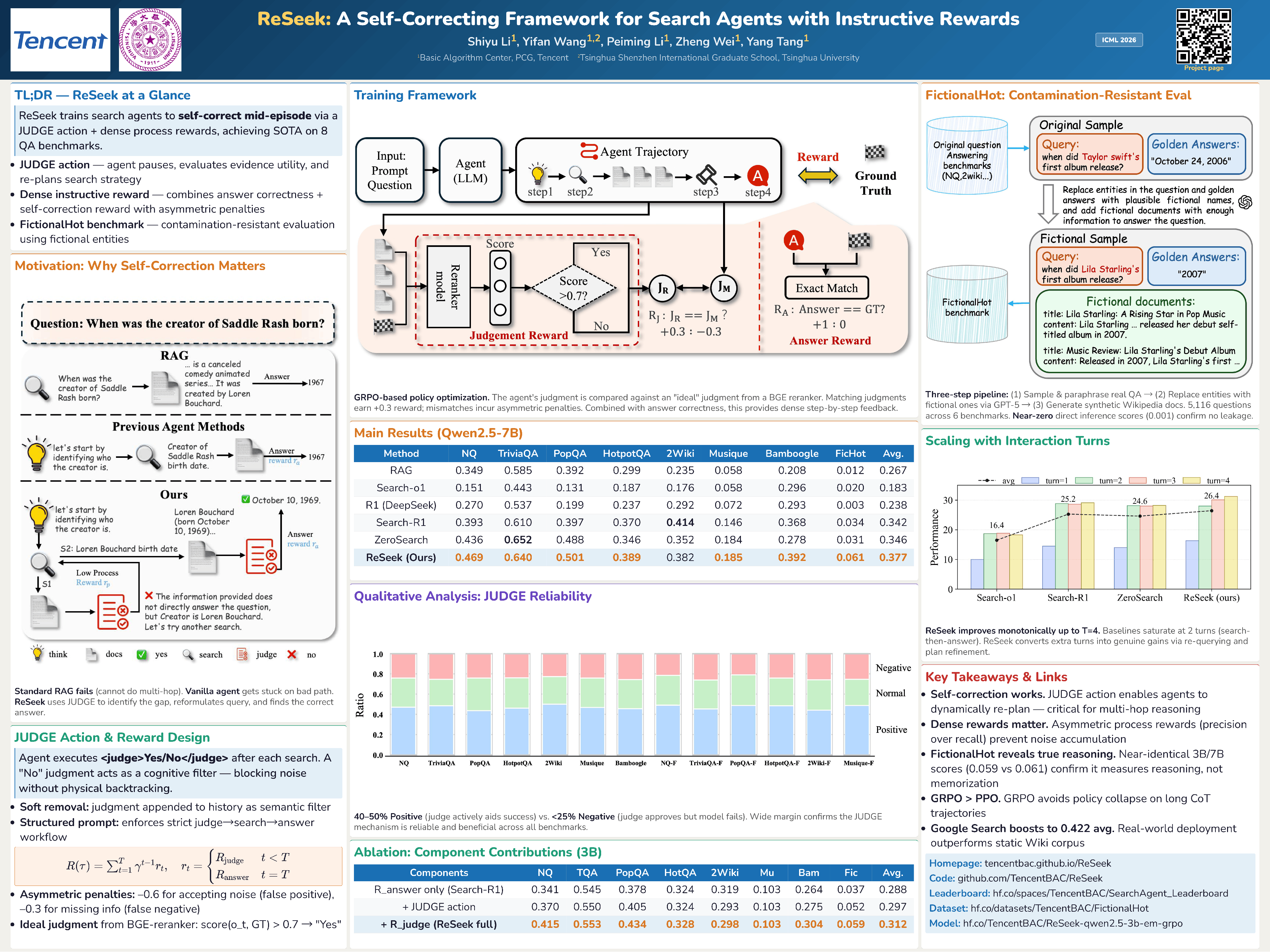
Search agents powered by Large Language Models have demonstrated significant potential in tackling knowledge-intensive tasks. Reinforcement learning has emerged as a powerful paradigm for training these agents to perform complex, multi-step reasoning. However, prior RL-based methods often rely on sparse or rule-based rewards, which can lead agents to commit to suboptimal or erroneous reasoning paths without the ability to recover. To address these limitations, we propose ReSeek, a self-correcting framework enabling search agents to recover from erroneous search paths during an episode. By invoking a special JUDGE action, the agent can judge the information and re-plan its search strategy. To guide this process, we design a dense, instructive process reward function, which decomposes into a correctness reward for retrieving factual information and a utility reward for finding information genuinely useful for the query. Additionally, to mitigate the risk of data contamination in existing datasets, we introduce FictionalHot, a contamination-free benchmark requiring complex reasoning. Experiments show ReSeek significantly outperforms SOTA baselines in task success and path faithfulness.
Lay Summary
Search agents powered by Large Language Models have demonstrated significant potential in tackling knowledge-intensive tasks. Reinforcement learning has emerged as a powerful paradigm for training these agents to perform complex, multi-step reasoning. However, prior RL-based methods often rely on sparse or rule-based rewards, which can lead agents to commit to suboptimal or erroneous reasoning paths without the ability to recover. To address these limitations, we propose ReSeek, a self-correcting framework enabling search agents to recover from erroneous search paths during an episode. By invoking a special JUDGE action, the agent can judge the information and re-plan its search strategy. To guide this process, we design a dense, instructive process reward function, which decomposes into a correctness reward for retrieving factual information and a utility reward for finding information genuinely useful for the query. Additionally, to mitigate the risk of data contamination in existing datasets, we introduce FictionalHot, a contamination-free benchmark requiring complex reasoning. Experiments show ReSeek significantly outperforms SOTA baselines in task success and path faithfulness.