
MDN: Parallelizing Stepwise Momentum for Delta Linear Attention
Abstract
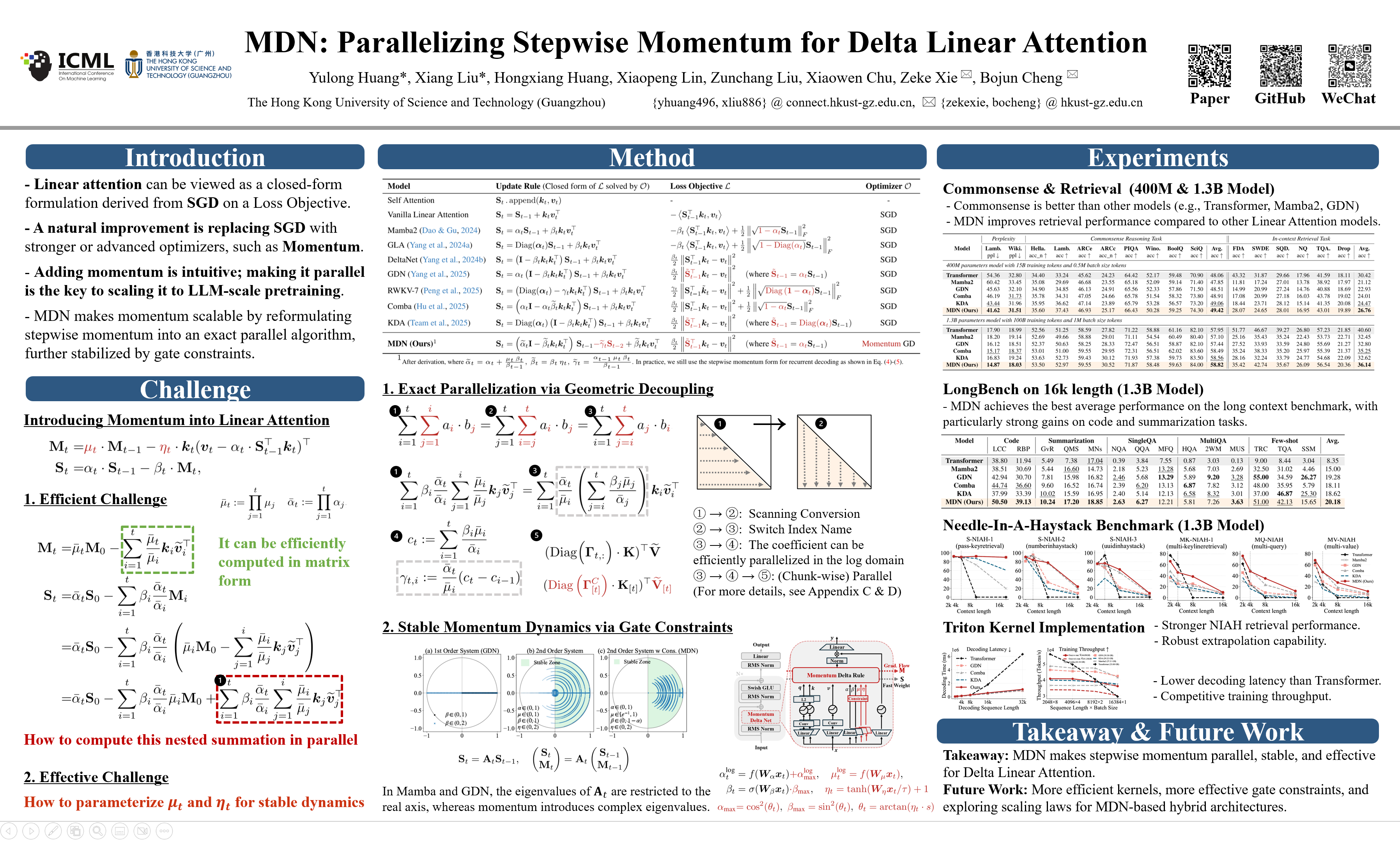
Linear Attention (LA) offers a promising paradigm for scaling large language models (LLMs) to long sequences by avoiding the quadratic complexity of self-attention. Recent LA models such as Mamba2 and GDN interpret linear recurrences as closed-form online stochastic gradient descent (SGD), but naive SGD updates suffer from rapid information decay and suboptimal convergence in optimization. While momentum-based optimizers provide a natural remedy, they pose challenges in simultaneously achieving training efficiency and effectiveness. To address this, we develop a chunkwise parallel algorithm for LA with a stepwise momentum rule by geometrically reordering the update coefficients. Further, from a dynamical systems perspective, we analyze the momentum-based recurrence as a second-order system that introduces complex conjugate eigenvalues. This analysis guides the design of stable gating constraints. The resulting model, Momentum DeltaNet (MDN), leverages Triton kernels to achieve comparable training throughput with competitive linear models such as Mamba2 and KDA. Extensive experiments on the 400M and 1.3B parameter models demonstrate consistent performance improvements over strong baselines, including Transformers, Mamba2 and GDN, across diverse downstream evaluation benchmarks. Code: https://github.com/HuuYuLong/MomentumDeltaNet.
Lay Summary
Large language models increasingly rely on hybrid architectures, which combine different mechanisms to balance performance and efficiency. Linear attention has become an important component of such models because it can process long sequences more efficiently than standard attention. However, existing linear attention models still face difficulties in retrieving useful information from long contexts and updating their internal memory effectively. This paper introduces Momentum DeltaNet (MDN), a new linear attention architecture inspired by momentum-based optimization. In simple terms, many modern linear attention models can be viewed as systems that update an internal memory step by step. MDN improves this process by introducing a momentum-like mechanism, allowing the model to carry forward useful update directions rather than relying only on the current input. This idea introduces two main challenges. First, step-by-step momentum updates are difficult to train efficiently because they seem to depend on previous steps. Second, the additional hidden states must be carefully controlled so that they improve the model rather than making it unstable. MDN addresses these challenges through a chunkwise parallel training algorithm and a stable gating design. Experiments show that MDN improves both language modeling and long-context performance, making it a promising building block for future efficient hybrid language models.