
iWorld-Bench: A Benchmark for Interactive World Models with a Unified Action Generation Framework
Abstract
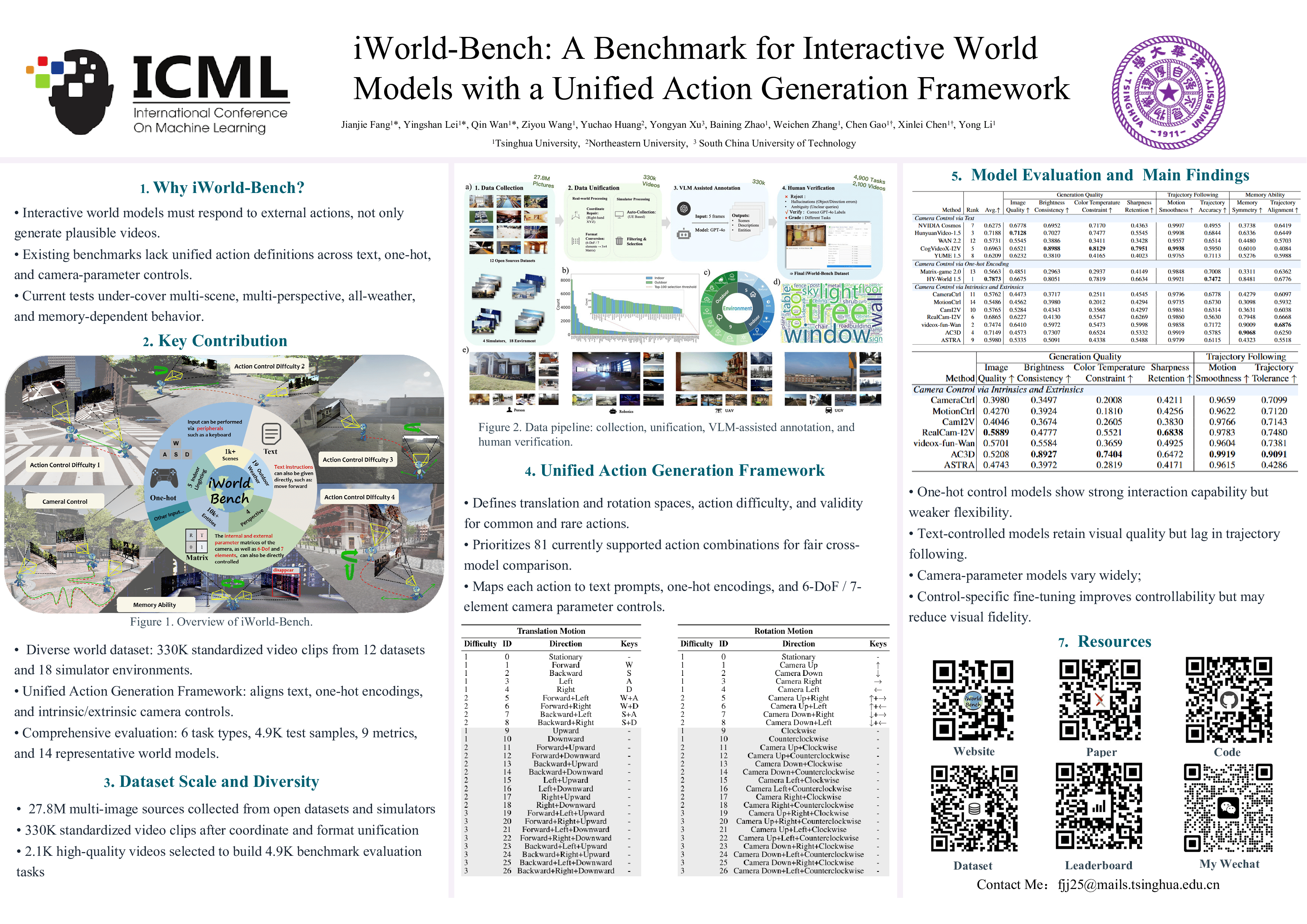
Achieving Artificial General Intelligence (AGI) requires agents that learn and interact adaptively, with interactive world models providing scalable environments for perception, reasoning, and action. Yet current research still lacks large-scale datasets and unified benchmarks to evaluate their physical interaction capabilities. To address this, we propose iWorld-Bench, a comprehensive benchmark for training and testing world models on interaction-related abilities such as distance perception and memory. We construct a diverse dataset with 330k video clips and select 2.1k high-quality samples covering varied perspectives, weather, and scenes. As existing world models differ in interaction modalities, we introduce an Action Generation Framework to unify evaluation and design six task types, generating 4.9k test samples. These tasks jointly assess model performance across visual generation, trajectory following, and memory. Evaluating 14 representative world models, we identify key limitations and provide insights for future research. The iWorld-Bench model leaderboard is publicly available at iWorld-Bench.com.
Lay Summary
Interactive world models are currently hard to evaluate fairly and consistently because they support different ways of controlling actions. To address this, we build an action-generation framework that enables unified evaluation across these models. Our paper organizes a wide range of scenarios and environments, standardizes how data should be processed for interactive world models, and redesigns the action vocabulary used to define their outputs. We then create a benchmark with 6 types of questions and 4,900 generation tasks to evaluate world models under different control settings. Our evaluation measures three key abilities: generation quality, action-following, and memory. By providing this new and effective benchmark, we offer the community a more reliable way to compare interactive world models and draw insights that can help guide future research.