
Functional Decomposition and Shapley Interactions for Interpreting Survival Models
Abstract
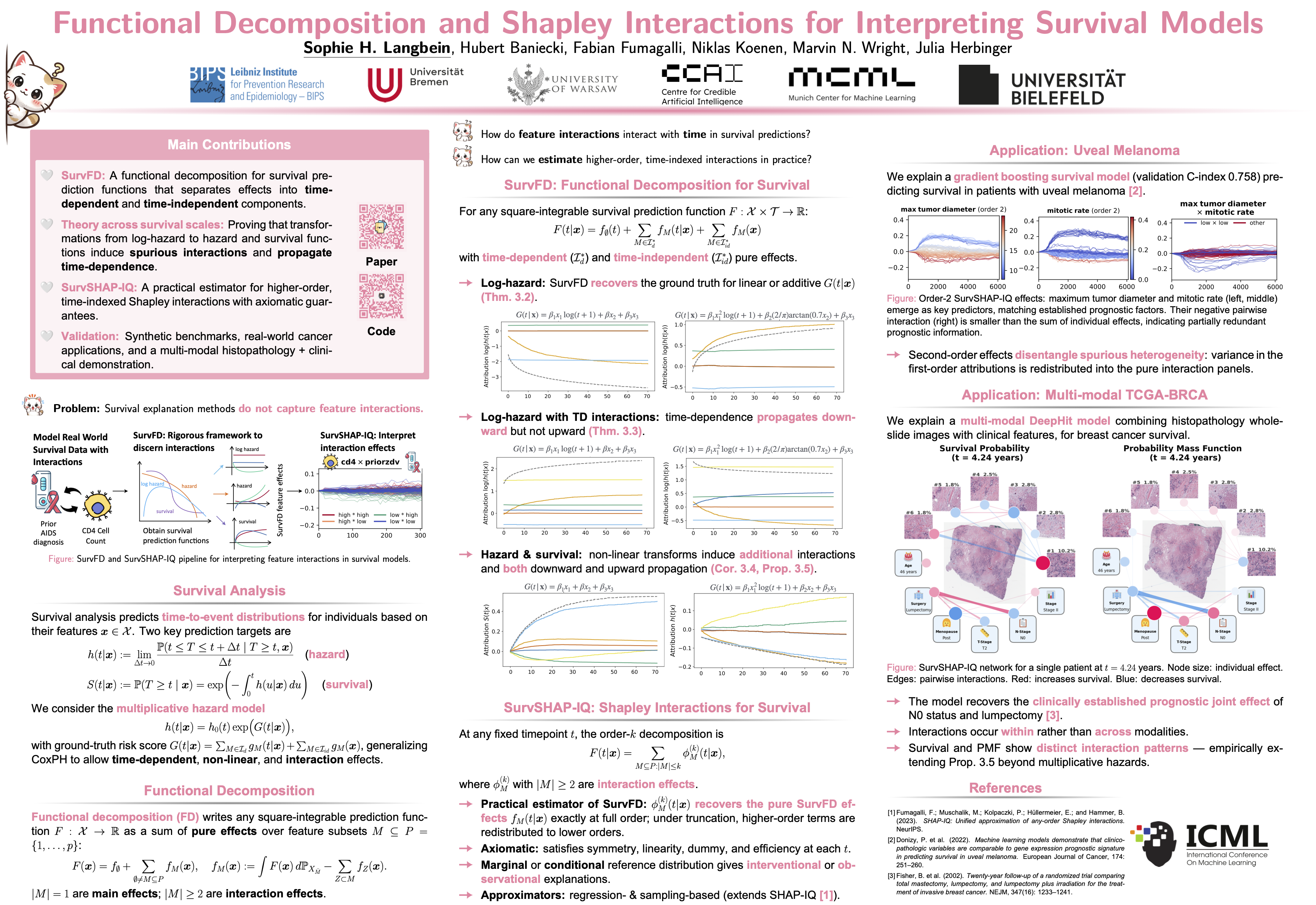
Hazard and survival functions are natural, interpretable targets in time-to-event prediction tasks such as patient survival and disease progression modeling, but their inherent non-additivity fundamentally limits standard additive explanation methods. We introduce Survival Functional Decomposition (SurvFD), a principled approach for analyzing feature interactions in machine learning survival models. By decomposing higher-order effects into time-dependent and time-independent components, SurvFD offers a previously unrecognized perspective on survival explanations, explicitly characterizing when and why additive explanations fail. Building on this theoretical decomposition, we propose SurvSHAP-IQ, which extends Shapley interactions to time-indexed functions, providing a practical estimator for higher-order, time-dependent interactions. We validate the framework on simulated data and demonstrate its utility through cancer survival applications, including multi-modal breast cancer prognosis combining histopathology with clinical features. Together, SurvFD and SurvSHAP-IQ establish an interaction- and time-aware interpretability approach for survival modeling, with broad applicability across medicine, healthcare and other time-to-event prediction tasks.
Lay Summary
When doctors estimate how long a patient might live after a diagnosis, they often rely on computer models that learn from past patient data. These models can be very accurate, but it is often unclear why they make a particular prediction, especially when multiple factors combine in unexpected ways. For example, a patient's age and tumor size might each matter on their own, but their combination might matter differently still. We developed two new tools, SurvFD and SurvSHAP-IQ, that pull apart these predictions to show not only how much each factor contributes, but also how factors interact with each other and how their influence changes over time. We tested our approach on cancer survival data, including a breast cancer study that combines tissue images with clinical information. Our tools help doctors and researchers better understand what these models have learned, making them more trustworthy for medical decisions.