
Implicit Actor Critic Coupling via a Supervised Learning Framework for RLVR
Jiaming Li ⋅ Longze Chen ⋅ Ze Gong ⋅ Yukun Chen ⋅ Lu Wang ⋅ Wanwei He ⋅ Zhihao Yang ⋅ Minzheng Wang ⋅ Lei Zhang ⋅ Haoran Ye ⋅ Min Yang
Abstract
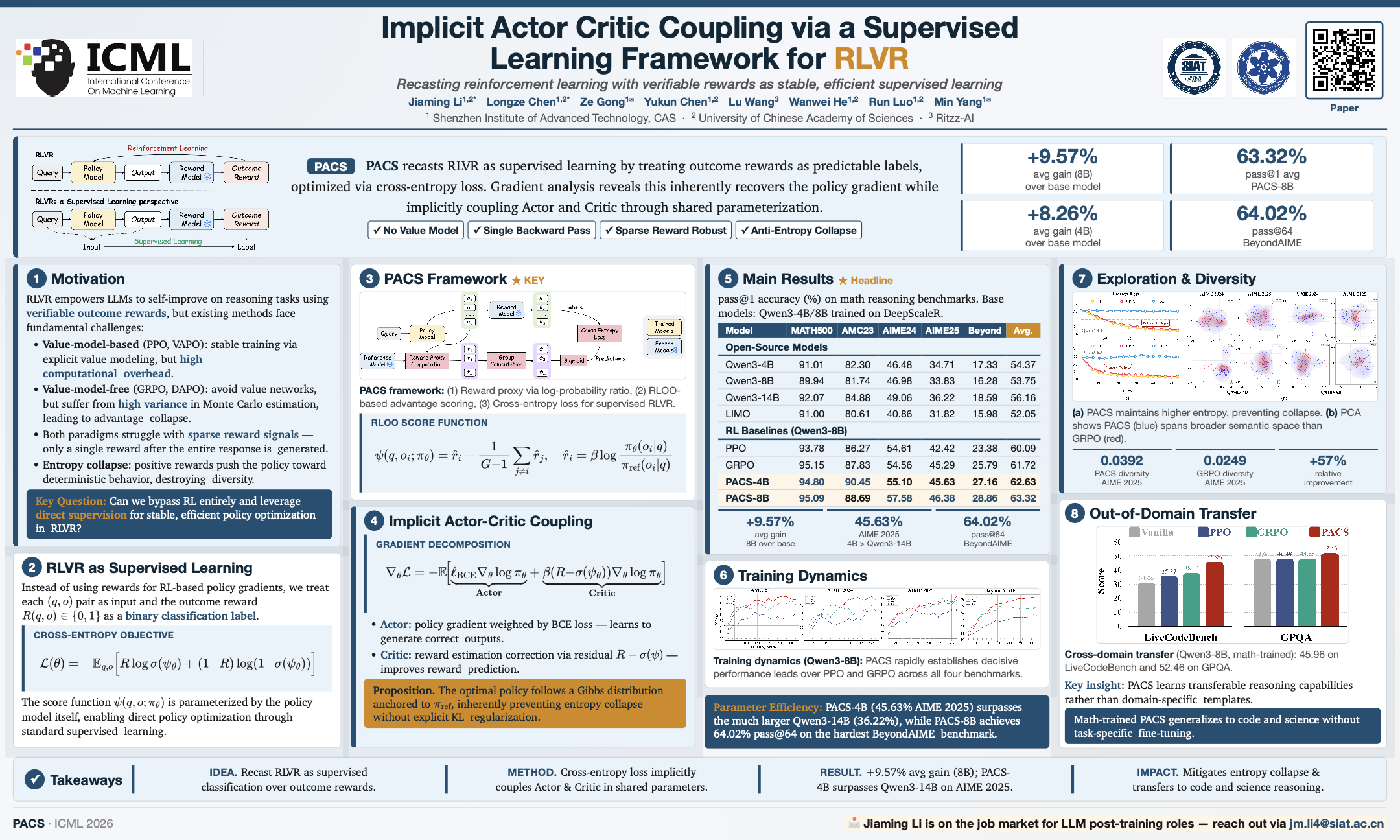
Recent advances in Reinforcement Learning with Verifiable Rewards (RLVR) have empowered large language models (LLMs) to tackle challenging reasoning tasks such as mathematics and programming, however existing RLVR methods often suffer from sparse reward signals and unstable policy gradient updates inherent to RL-based approaches. To address the challenges, we propose $\textbf{PACS}$, a novel RLVR framework that achieves im$\textbf{P}$licit $\textbf{A}$ctor $\textbf{C}$ritic coupling via a $\textbf{S}$upervised learning framework. By treating the outcome reward as a predictable label, we reformulate the RLVR problem into a supervised learning task over a score function parameterized by the policy model and optimized using cross-entropy loss. A detailed gradient analysis shows that this supervised formulation inherently recovers the classical policy gradient update while providing more stable and efficient training. Extensive experiments demonstrate that PACS significantly outperforms strong open-source models and RLVR baselines, yielding substantial average gains of $\textbf{+8.26\%}$ (4B) and $\textbf{+9.57\%}$ (8B) over base models offering a promising avenue for LLMs post-training with verifiable rewards. Our code and data are available as open source at https://github.com/ritzz-ai/PACS.
Lay Summary
Training large language models for complex reasoning using reinforcement learning is often unstable and inefficient due to sparse feedback. We introduce PACS, a framework that reformulates this process into a stable supervised learning task. By treating the final reward as a predictable label, PACS mathematically recovers the benefits of traditional methods while greatly improving training efficiency. PACS boosts the reasoning performance of open-source models by up to 9.57%, significantly outperforming existing baselines. This open-source method provides a highly reliable pathway to advance AI reasoning capabilities.
Video
Chat is not available.
Successful Page Load