
ST-TGExplainer: Disentangling Stability and Transition Patterns for Temporal GNN Interpretability
Abstract
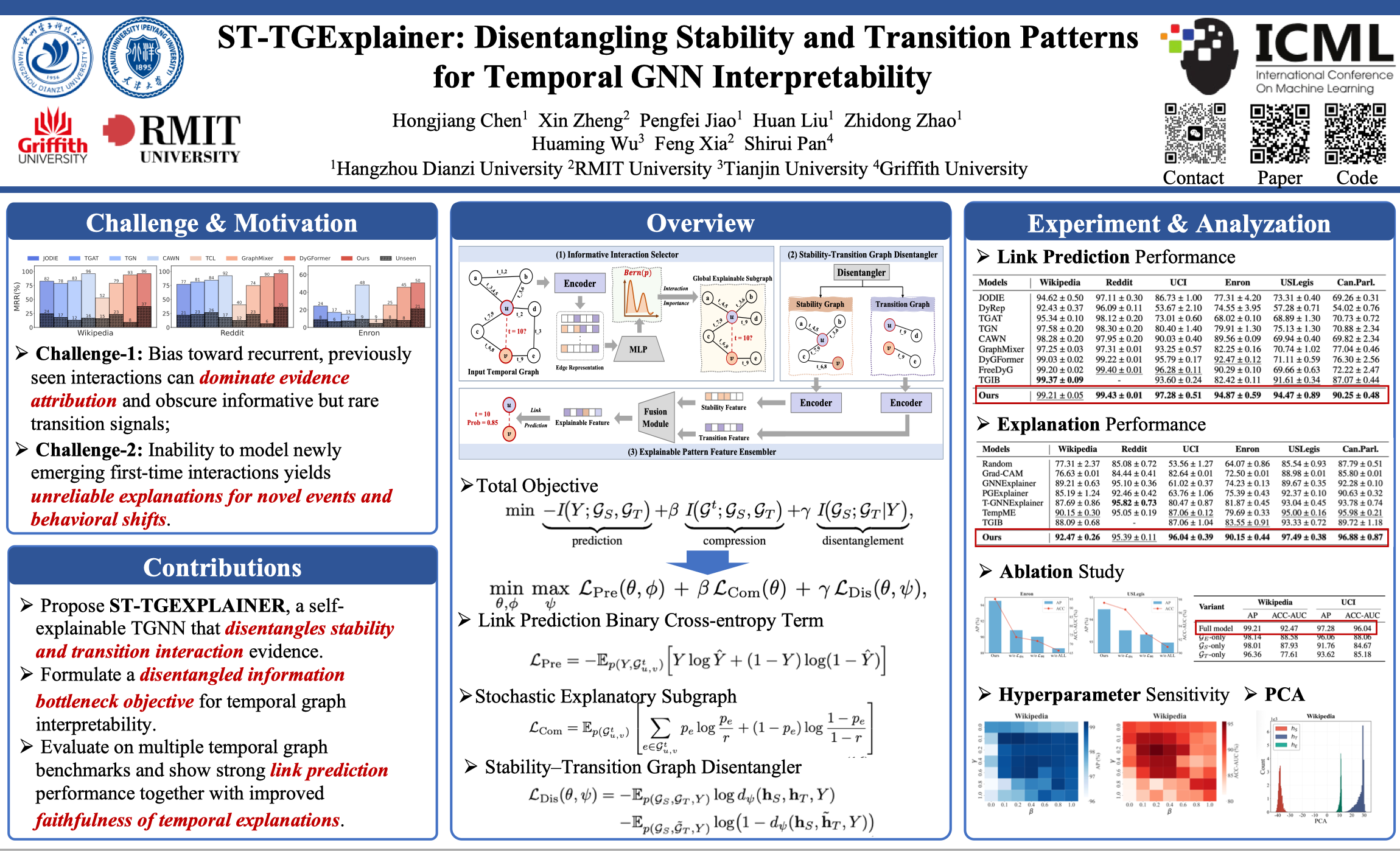
Temporal graph neural networks (TGNNs) have gained significant traction for solving real-world temporal graph tasks. However, their interpretability remains limited, as most TGNNs fail to identify which historical interactions most influence a given prediction. Despite promising progress on interpretable TGNNs, existing methods predominantly focus on previously seen historical interactions, which we term stability patterns, while overlooking newly emerging first-time interactions, which we term transition patterns. Both types of patterns are essential for faithful temporal explanations. To address this limitation, we propose ST-TGExplainer, a self-explainable TGNN that disentangles Stability and Transition patterns in temporal graphs for a more faithful Temporal GNN Explainer. Guided by a disentangled information bottleneck objective, ST-TGExplainer learns a compact explanatory subgraph that remains predictive of the event label while explicitly suppressing label-conditioned redundancy between stability and transition patterns. Extensive experiments demonstrate that ST-TGExplainer achieves strong predictive performance and yields more faithful explanations. Code is available at https://github.com/hjchen-hdu/ST-TGExplainer.
Lay Summary
Many real-world networks change over time: people repeatedly contact familiar friends, users buy from the same shops, and institutions exchange messages in recurring patterns. At the same time, important changes often appear as new or rare interactions, such as a new relationship, a sudden behavioral shift, or an unusual transaction. Modern machine learning models can predict such future interactions, but they often give little insight into which past events actually influenced a prediction. Existing explanation methods tend to focus on repeated historical patterns and may miss these newly emerging signals. This paper proposes ST-TGExplainer, a method that explains predictions by separating two kinds of evidence: stable patterns from repeated past interactions and transition patterns from new or rare interactions. It then selects a small set of past events that is sufficient to support the model’s prediction. Experiments on several real-world temporal networks show that this separation improves both prediction quality and explanation faithfulness. By making temporal network predictions easier to inspect, this work can support more trustworthy use of such models in domains where decisions must be understood, such as finance, healthcare, communication analysis, and security.