
DistMatch: Adaptive Binning via Distribution Matching for Robust Sequential Conformal Prediction
Abstract
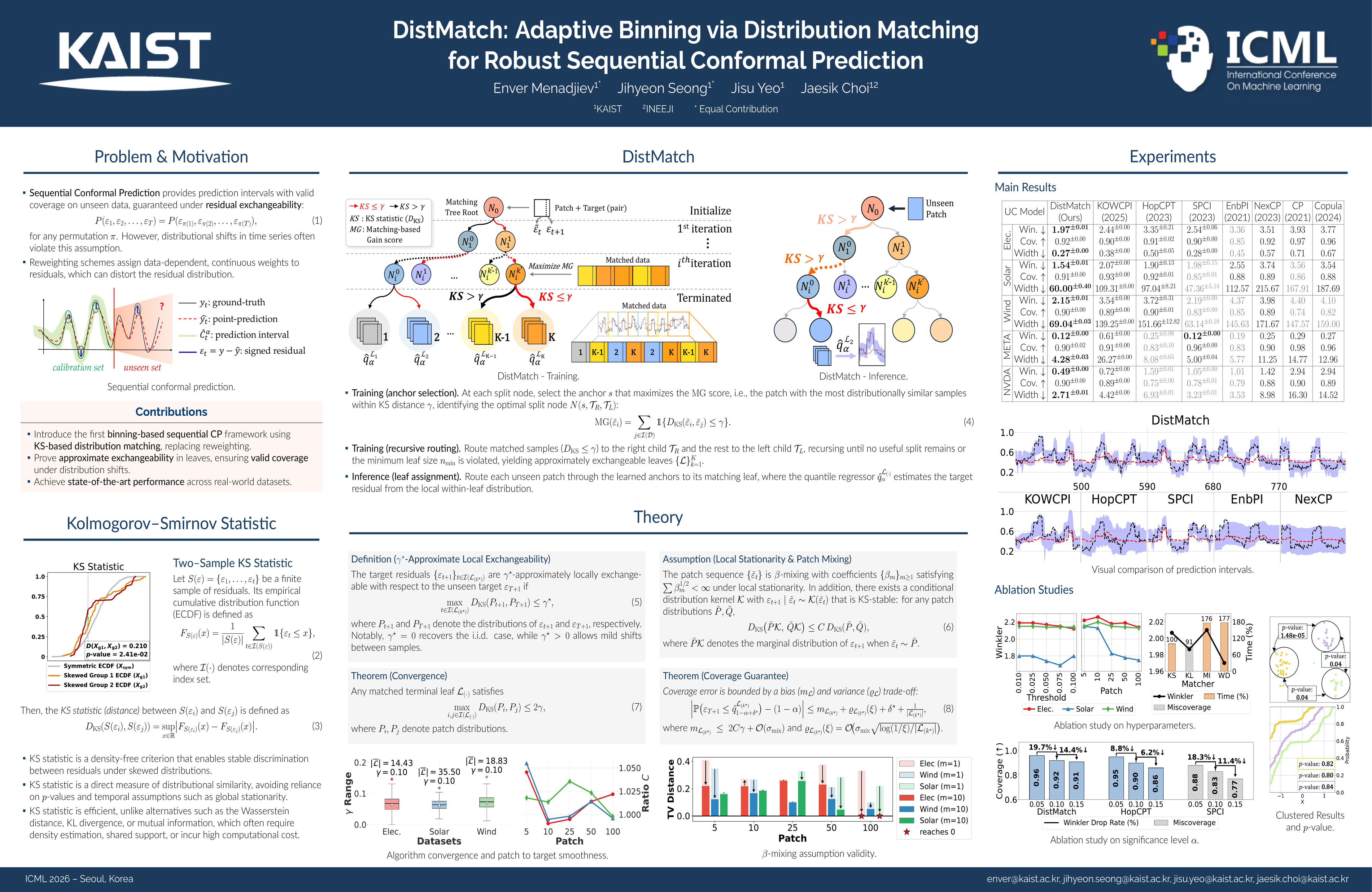
Sequential conformal prediction (CP) provides valid uncertainty quantification under the assumption of residual exchangeability. However, this assumption is often violated in real-world time series due to temporal dependencies and distributional shifts. While recent methods attempt to approximate exchangeability through reweighting, identifying optimal weights remains an open challenge. To address this limitation, we propose DistMatch, a binning-based method that recursively partitions residuals within a binary tree using the Kolmogorov–Smirnov (KS) statistic. We theoretically show that this partitioning induces approximately exchangeable leaves, thereby avoiding the need for reweighting. By applying quantile regression with online updates within each leaf, DistMatch enables locally adaptive inference and improves robustness to distributional shifts. Extensive experiments demonstrate that DistMatch outperforms existing sequential CP methods.
Lay Summary
Knowing how confident a prediction is can matter as much as the prediction itself. Conformal prediction offers this by producing a range guaranteed to contain the true outcome with a certain probability. However, this guarantee rests on an assumption called exchangeability — that the order of the data does not matter — which rarely holds for time series, where patterns drift over time. Previous methods try to repair it by reweighting past observations to compensate for the broken assumption, but finding the right weights remains an open problem. We take a different route called binning: our method DistMatch sorts past prediction errors into groups that behave similarly, repeatedly splitting the data into two whenever the halves look statistically different. We prove that the data inside each group behaves approximately as if it were exchangeable, which restores the guarantee without any reweighting. By testing on real-world datasets, we highlight that binning produces more reliable uncertainty quantification under distribution shifts, where calibrated prediction intervals can support safer decision-making.