
ForensicConcept: Transferable Forensic Concepts for AIGI Detection
Abstract
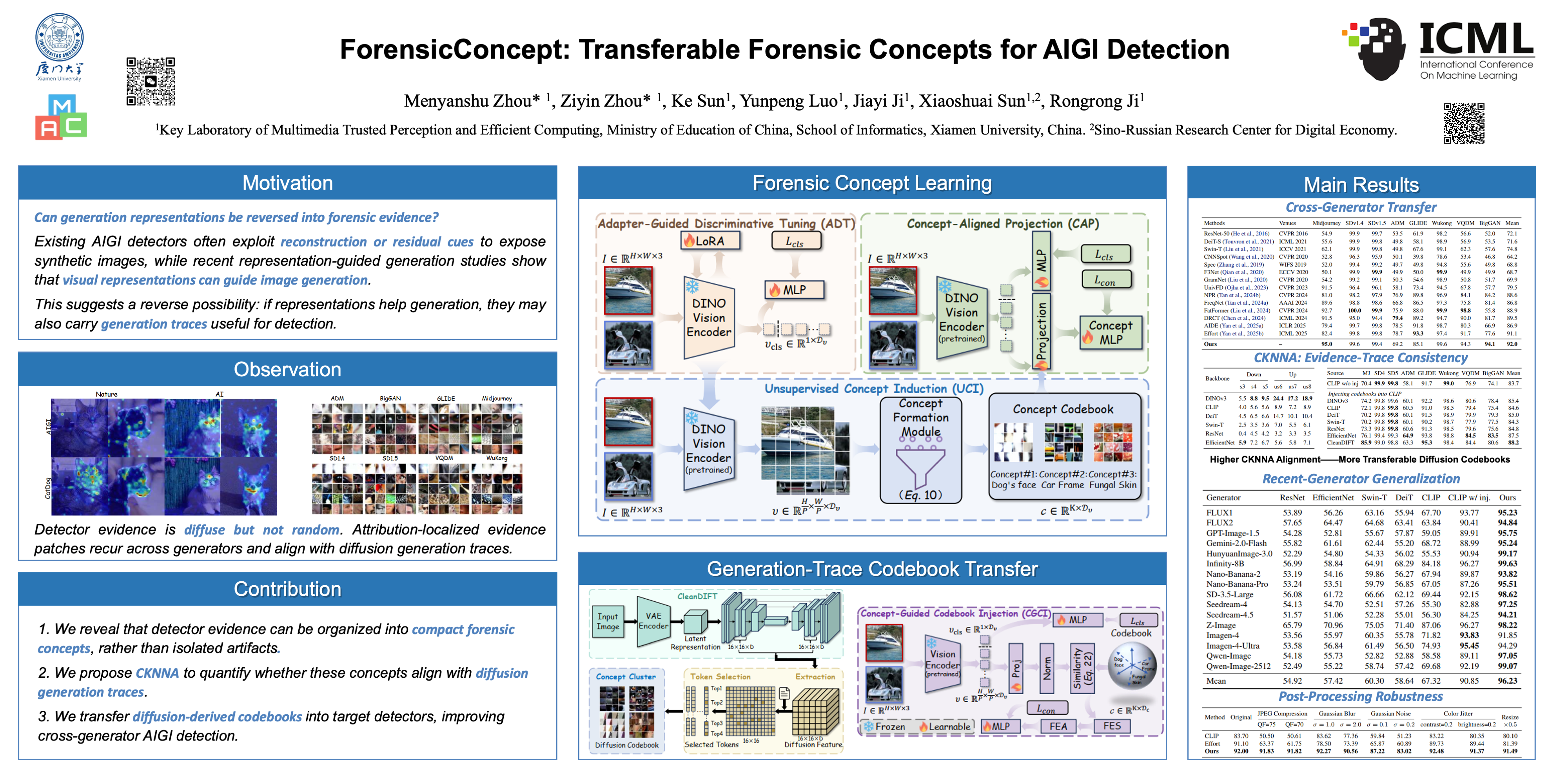
AI-generated image detectors achieve high accuracy on in-distribution data but often fail on unseen generators. A key obstacle to understanding this failure is the black-box nature of current detectors: they do not reveal which evidence drives their decisions. We propose \textsc{ForensicConcept}, a framework that extracts explicit forensic concepts from detectors and enables their transfer across backbones. Our method localizes decision-critical patches via Transformer attribution, clusters them into a compact concept codebook, and uses a concept-aligned projection to produce auditable evidence readouts. Motivated by prior studies showing that DINO representations can guide diffusion generation and exhibit concept-level correspondence with diffusion features, we introduce a generation-trace reference based on CleanDIFT diffusion features and quantify backbone-trace alignment via neighborhood-structure consistency (CKNNA). We further propose concept codebook injection to transfer diffusion-derived concepts into target backbones. Experiments on GenImage, GAN-family, and Chameleon benchmarks show consistent improvements over prior methods. We also find that CKNNA alignment predicts transfer effectiveness, providing a principled explanation for why some backbones yield more transferable forensic evidence than others.
Lay Summary
AI-generated images are becoming increasingly realistic, making it difficult to tell whether an image is real or synthetic. This paper studies how to build a detector that does not only memorize artifacts from known image generators, but instead learns more transferable forensic clues. We introduce a method that discovers and uses forensic concepts from the image regions that are most important for detection. These concepts help the detector generalize better to images produced by unseen or newer generators, while also making its decisions easier to interpret. This work can support more reliable detection of AI-generated visual content as generative models continue to evolve.