
Doppler Prompting for Stable mmWave-based Human Pose Estimation
Abstract
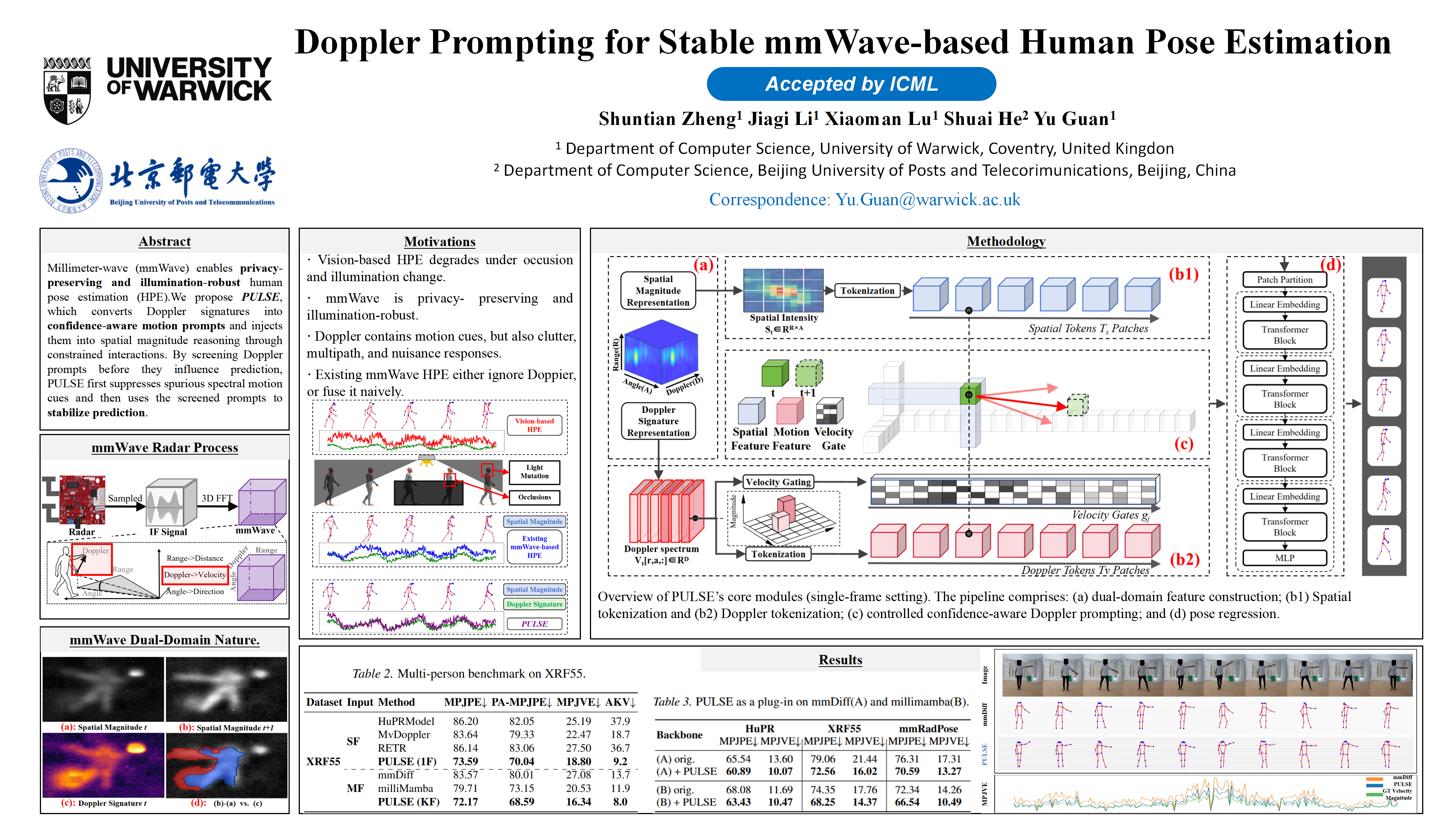
Millimeter-wave (mmWave) enables privacy-preserving, illumination-robust human pose estimation (HPE), with each mmWave frame represented as a range--angle--Doppler tensor, providing spatial magnitude for localization and Doppler signatures for motion-related cues. However, existing mmWave-based HPE methods either underutilize or naïvely fuse Doppler signatures with spatial magnitude, disregarding their distinct physical semantics. As a result, non-human Doppler signatures can be misinterpreted as human motion cues, leading to jittery trajectories. We propose \textbf{PULSE}, which converts Doppler signatures into confidence-aware motion prompts and injects them into spatial magnitude reasoning through constrained interactions. By screening Doppler prompts before they influence prediction, PULSE first suppresses spurious spectral motion cues and then uses the screened prompts to stabilize prediction. Across three datasets spanning single- and multi-person settings, PULSE consistently improves pose accuracy and temporal stability, indicating that controlled Doppler prompting is a practical direction for stable mmWave HPE. Codes are available in supplementary materials.
Lay Summary
Human pose estimation helps systems understand how people move, which matters for applications such as rehabilitation monitoring, fall prevention, and long-term health tracking. Cameras can do this well, but they raise privacy concerns and often fail in poor lighting or when people are blocked from view. Millimeter-wave radar offers a more privacy-preserving alternative because it senses reflected radio signals instead of recording detailed images. However, existing radar-based methods often produce jittery pose predictions because they cannot reliably separate true human motion from background reflections and sensor noise. We address this problem with PULSE, a method that uses motion-related changes in the radar signal, known as Doppler patterns, as carefully screened hints rather than mixing them directly with spatial information. PULSE first estimates which motion cues are trustworthy and then uses only those cues to guide pose prediction. Across three public datasets, including both single-person and multi-person settings, our method improves both pose accuracy and temporal stability. These results suggest that radar-based pose estimation can become more reliable for real-world monitoring while still preserving privacy.