
Improving Explicit Dynamic Gaussian Splatting Optimization via Update Mixture
Abstract
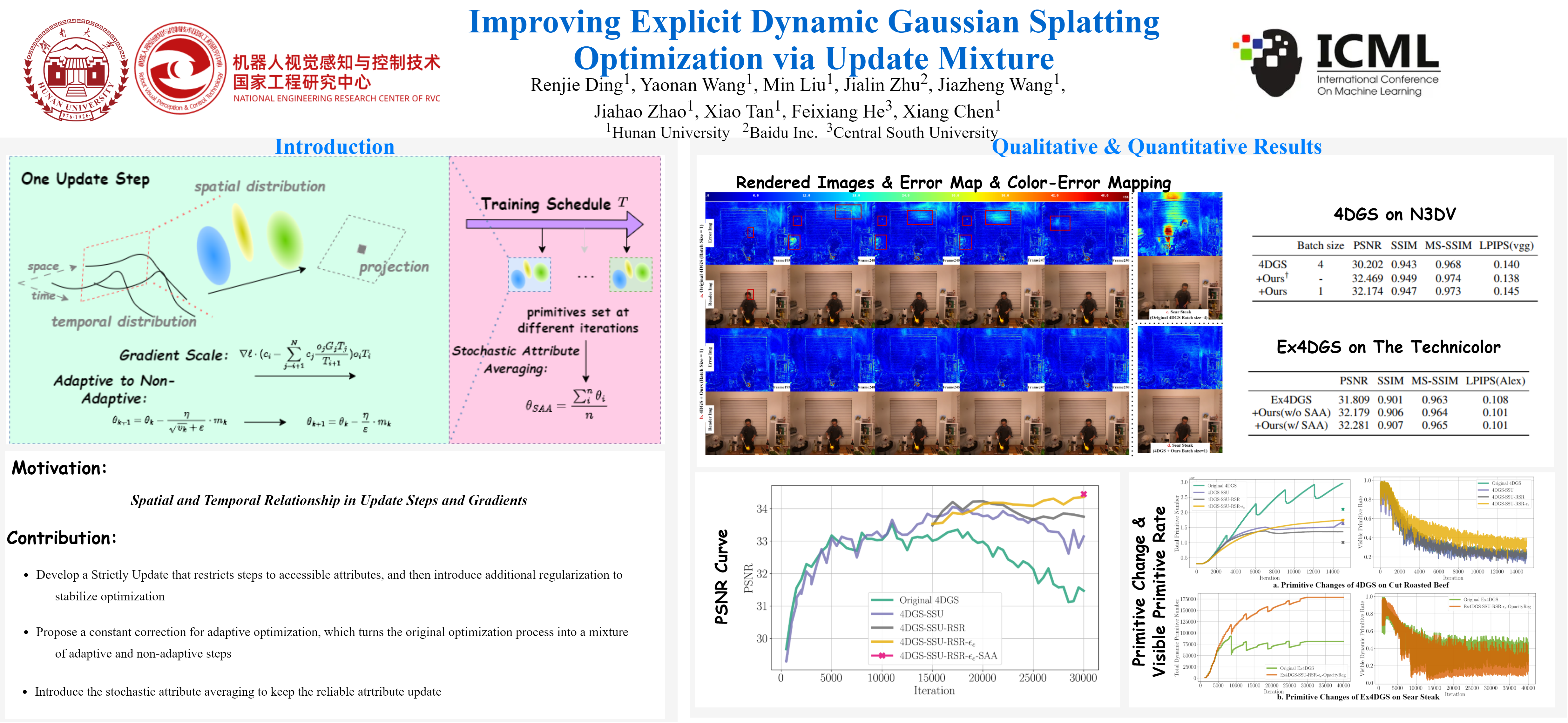
3D Gaussian Splatting (3DGS) enables real-time, high-fidelity view synthesis via explicit scene representations and has recently been extended to dynamic scene modeling. Despite their excellent rendering quality and interpretability, we find that explicit Dynamic GS often exhibits generalization degradation in scenes with large motion. Motivated by generalization behavior in deep neural optimization and the characteristics of Gaussian primitive optimization, we propose an update mixture strategy. This work focuses on two representative open-source explicit Dynamic GS pipelines and our approach consists of three components: (i) a space–time dependent Strictly Sparse Update with additional regularization to stabilize adaptive updates; (ii) a constant-corrected adaptive algorithm that alleviates over-scaling of primitive gradients and yields a stable mixture of adaptive and non-adaptive steps; and (iii) attributes mixing via Stochastic Attribute Averaging to mitigate frame-preference under motion disturbances. Experiments show consistent improvements and reduced generalization issues, highlighting the role of non-adaptive updates and the impact of frame-preference in explicit Dynamic GS optimization.
Lay Summary
Dynamic Gaussian Splatting reconstructs moving 3D scenes using Gaussian primitives, but large motion can make the model fit the training video too closely and perform poorly on new views or time steps. This limits its ability to build high-quality dynamic 3D scenes. To address this problem, we analyze how these Gaussian primitives are updated during training. Inspired by studies of deep neural network optimization, we propose an update-mixture strategy that uses properly rescaled update steps and averages primitive attributes near the end of training. Our method improves reconstruction quality and offers a practical way to make dynamic 3D reconstruction more robust.