
SDiD:Shared diffusion prior for efficient distributed stereo image compression
Abstract
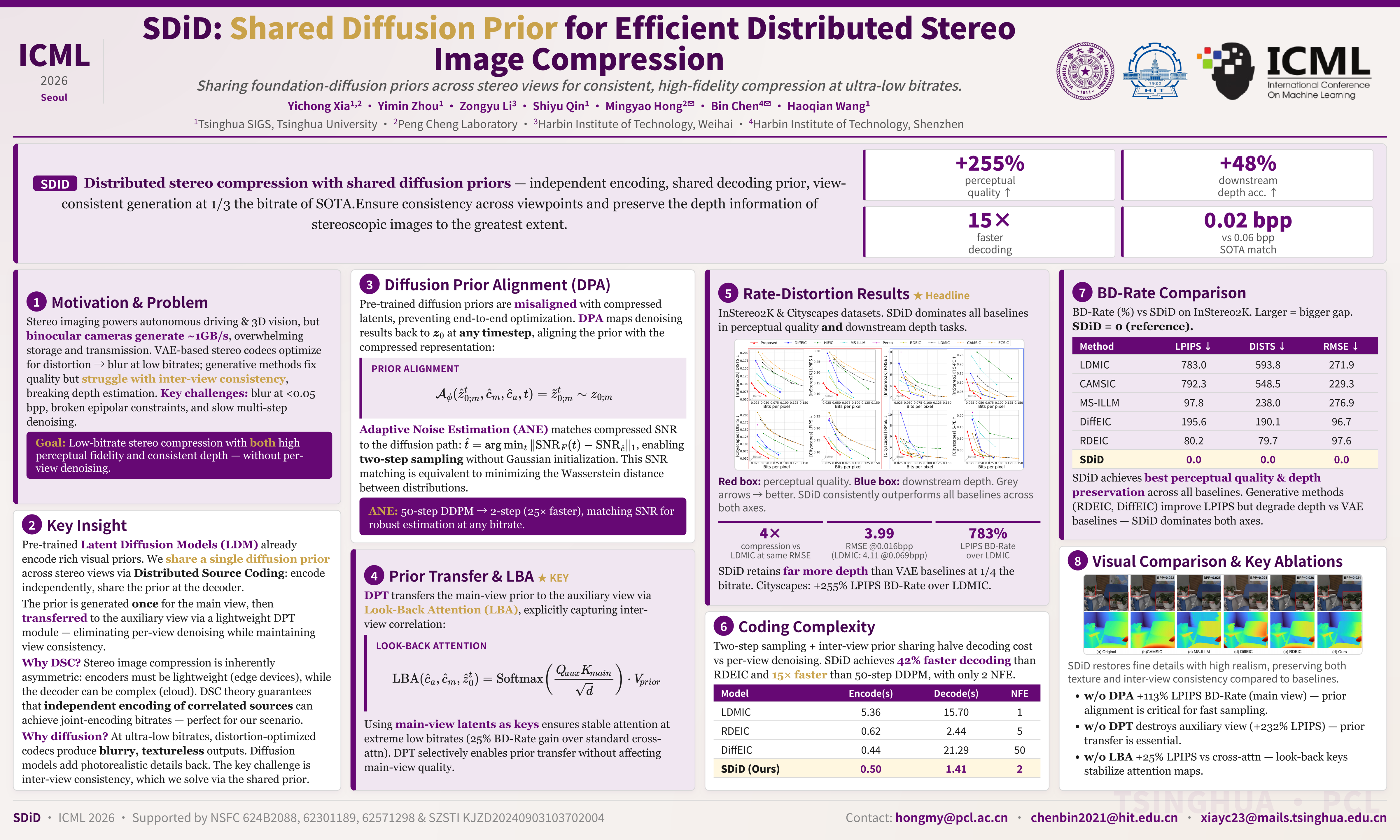
Stereo vision is widely utilized in automotive imagery and 3D reconstruction, creating a demand for compressing stereo images. Existing methods for stereo image compression often employ VAE-like architectures based on distortion optimization, leading to subpar perceptual quality at low bitrates. While generative compression excels in high perceptual fidelity at low bitrates, it struggles to maintain consistency across viewpoints, making decoded images less useful for critical downstream tasks. To address this, we introduce SDiD, a distributed stereo image compression architecture based on shared pre-trained diffusion priors. We employ a diffusion prior alignment module to efficiently obtain the main-view-prior from the foundation diffusion, and utilize a prior transformation structure to enable the auxiliary view to achieve reliable and fast perceptual enhancement while maintaining consistency. Through extensive experiments, we demonstrate that SDiD outperforms existing methods in perceptual quality across multiple datasets. Even at extremely low bitrates, SDiD can accurately recover depth information between decoded images. On the InStereo2K dataset, SDiD requires only one-third of the bits compared to the state-of-the-art baseline (0.02 bpp vs. 0.06 bpp) to reconstruct image pairs with similar depth information.
Lay Summary
Stereo vision technology is widely used in vehicle imaging and 3D scene reconstruction, which makes efficient compression for stereo images essential. Traditional stereo image compression tools focus on reducing image distortion through classic structural models, but they produce poor visual image quality when the data volume is highly limited. Although new generative compression methods deliver better visual effects under low data volume conditions, they fail to maintain consistency between the two viewing angles of stereo images, so the processed images cannot support important follow-up technical tasks well. To solve these problems, this study proposes a new stereo image compression framework built on shared pre-trained diffusion models. This design adopts a diffusion feature-matching module to extract core visual features from the basic diffusion model and uses a feature-conversion structure to rapidly optimize and enhance the auxiliary viewing image. Meanwhile, it ensures the two viewing images remain consistent. Massive experimental tests show that this new framework achieves better visual quality than existing compression methods on various image datasets. It can also accurately restore the depth information of stereo images even with extremely low data usage.