
KromHC: Manifold-Constrained Hyper-Connections with Kronecker-Product Residual Matrices
Abstract
Lay Summary
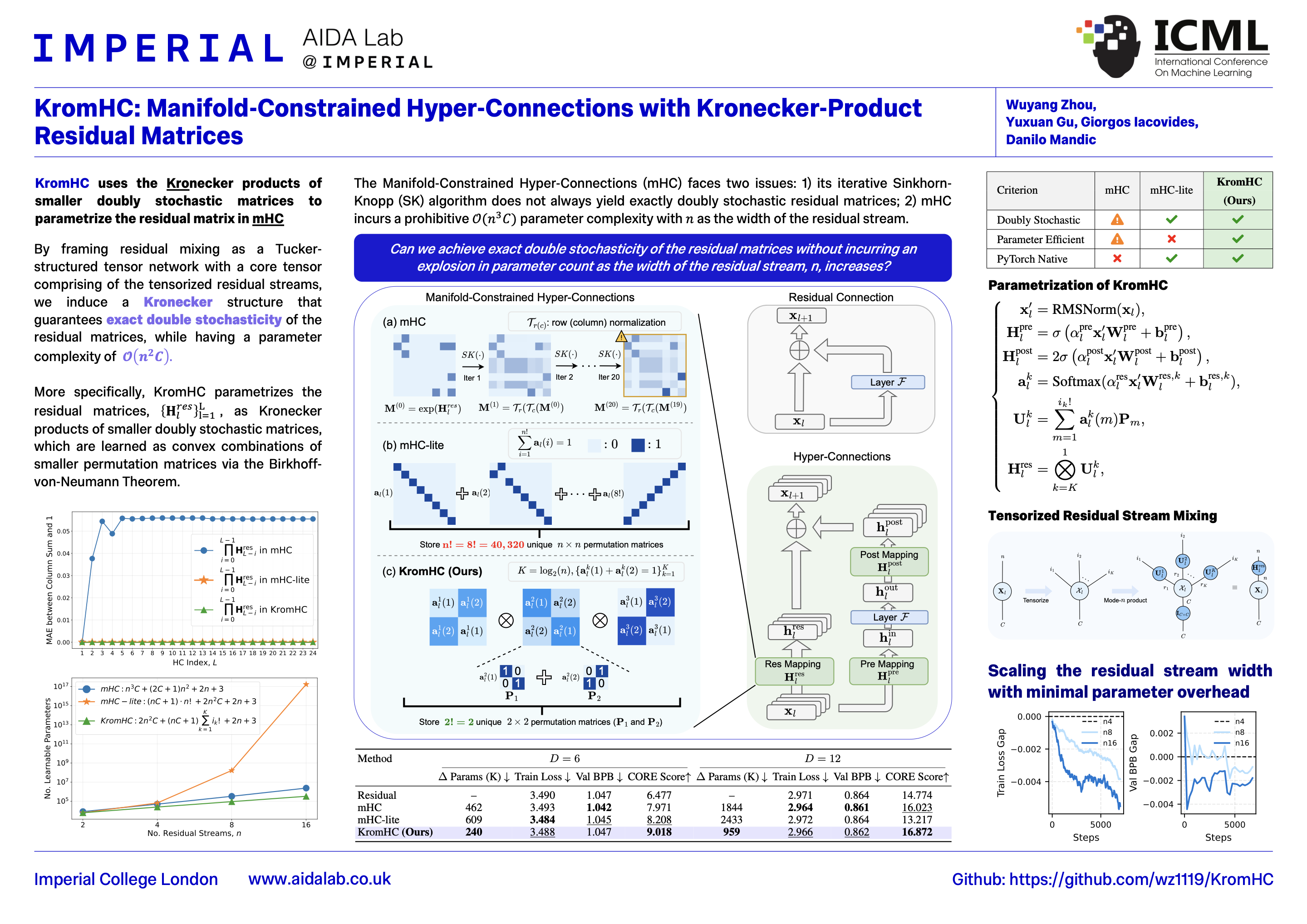
Deep AI models pass information between their internal layers using direct connections. Hyper-connections expand these pathways into multiple streams to improve the model's expressiveness, but they suffer from training instability. Existing solutions attempt to fix this using a mathematical constraint, but they either fail to enforce it exactly or cause an explosion in the number of parameters in the AI model. To solve this trade-off, we introduce KromHC. Instead of learning one massive matrix to route information, our method uses a mathematical operation, the Kronecker product, to assemble the matrix from much smaller matrices. This approach guarantees that the constraint is enforced exactly while significantly decreasing the number of parameters in the AI model. As a result, KromHC matches or outperforms state-of-the-art methods, allowing for training scalable deep AI models with significantly lower parameter overhead.