
Divide and Learn: Multi-Objective Combinatorial Optimization at Scale
Abstract
Lay Summary
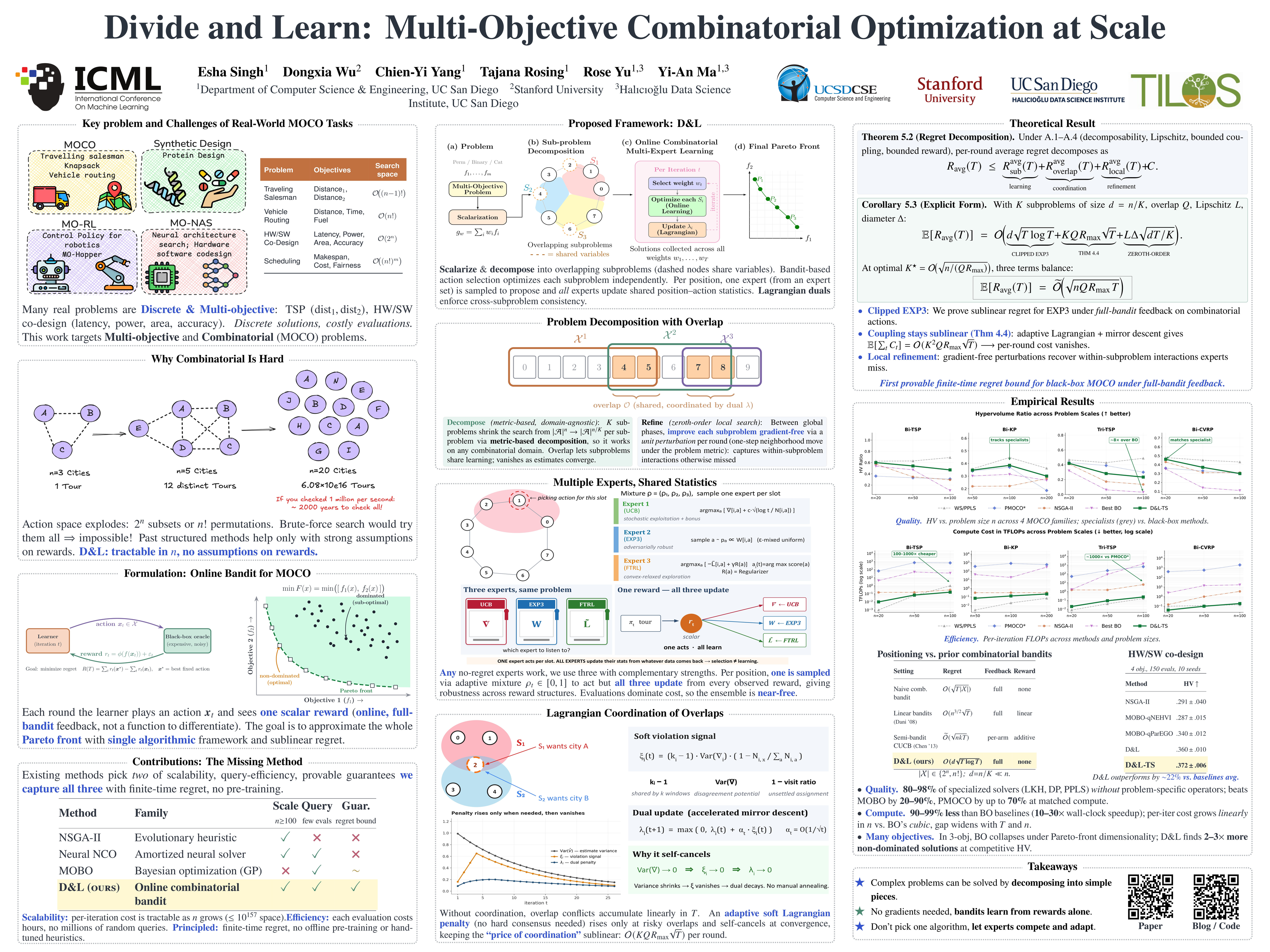
Many real world design problems require balancing several goals at once. For example, making a computer chip that is fast, cheap, energy efficient, and reliable, where the choices are discrete (which parts to use, in what order) and testing each option is slow and expensive. The number of possible designs is astronomically large, so trying them all is impossible. We built a method called Divide and Learn that breaks a huge problem into smaller, overlapping pieces and learns which choices work well by trial and error, improving as it goes. Unlike approaches that need a hand-built model of the problem or pre-training on similar tasks, our method learns from scratch on each new problem, directly from each result it sees, while a lightweight coordinator keeps the pieces consistent. Across classic routing and packing problems and a real chip design task, our method matches specialized solvers while using far less computation. We also prove mathematically that its average performance converges toward that of the best fixed design, no matter how complex the problem.