
From Basis to Basis: Gaussian Particle Representation for Interpretable PDE Operators
Abstract
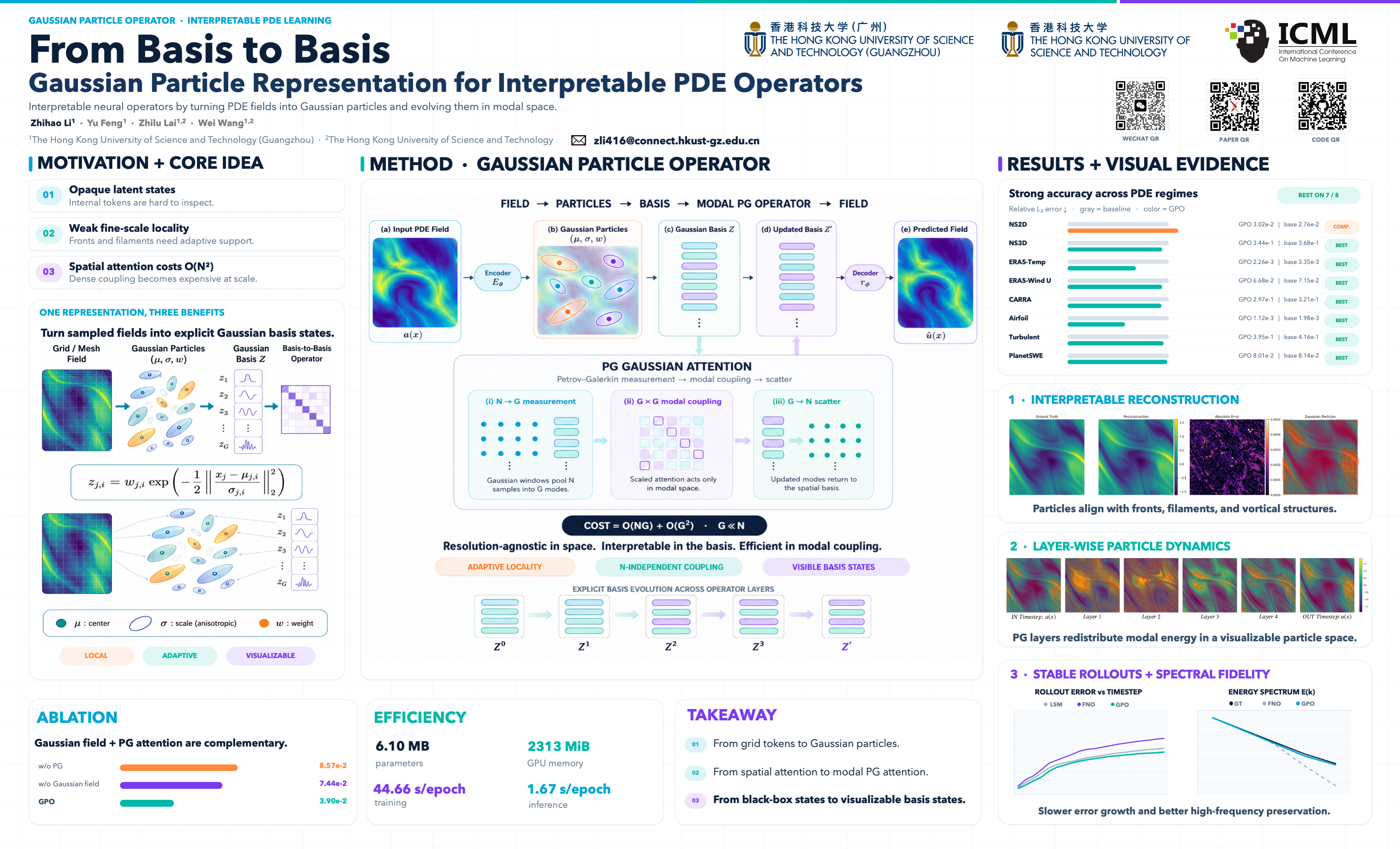
Learning fluid PDE dynamics has increasingly benefited from neural operators and Transformer-based models, but their latent states often remain opaque, and sample-wise attention can be costly at high resolutions. We propose the \emph{Gaussian Particle Operator} (GPO), a basis-to-basis neural operator that represents fields with a learned \emph{Gaussian basis}. Each atom carries explicit geometric parameters, including centers, anisotropic scales, and weights, yielding a compact, mesh-agnostic, and directly visualizable intermediate representation. GPO operates in modal space: learned Gaussian modal windows perform Petrov--Galerkin measurements, and a PG Gaussian Attention module couples the resulting modes globally before scattering them back to the spatial domain. This design is resolution-agnostic, scales near-linearly with the number of samples for a fixed modal budget, and naturally applies to irregular geometries and 3D domains. We separately evaluate Gaussian-basis reconstruction and operator prediction. Across standard PDE benchmarks and real reanalysis datasets, GPO achieves competitive accuracy against neural-operator and Transformer baselines, ranking best on most tasks and close to the best on the remainder. The learned particles and modal couplings further provide representation-level interpretability, positioning GPO as a useful intermediate representation rather than a one-to-one decomposition of physical structures. The code is available at \url{https://github.com/lizhihao2022/GPO}.
Lay Summary
Many important systems, such as weather, ocean circulation, and fluid flow around aircraft, are described by physical equations that are expensive to simulate accurately. Machine learning can speed up these simulations, but many existing models work like black boxes: they may predict well, yet it is hard to see what they have learned or why they make a certain prediction. We propose a new model called the Gaussian Particle Operator. Instead of representing a physical field only as values on a grid, our method describes it using small, flexible “particles” with visible positions, sizes, and weights. These particles form a compact picture of the field, and the model learns how information moves between them to predict future or target states. This design makes the model easier to inspect, works across regular grids, irregular shapes, and 3D data, and keeps computation efficient as resolution grows. Experiments on fluid, weather, and reanalysis datasets show that the method is competitive with strong existing models while providing more transparent intermediate representations.