
Adaptive Contracts for Cost-Effective AI Delegation
Abstract
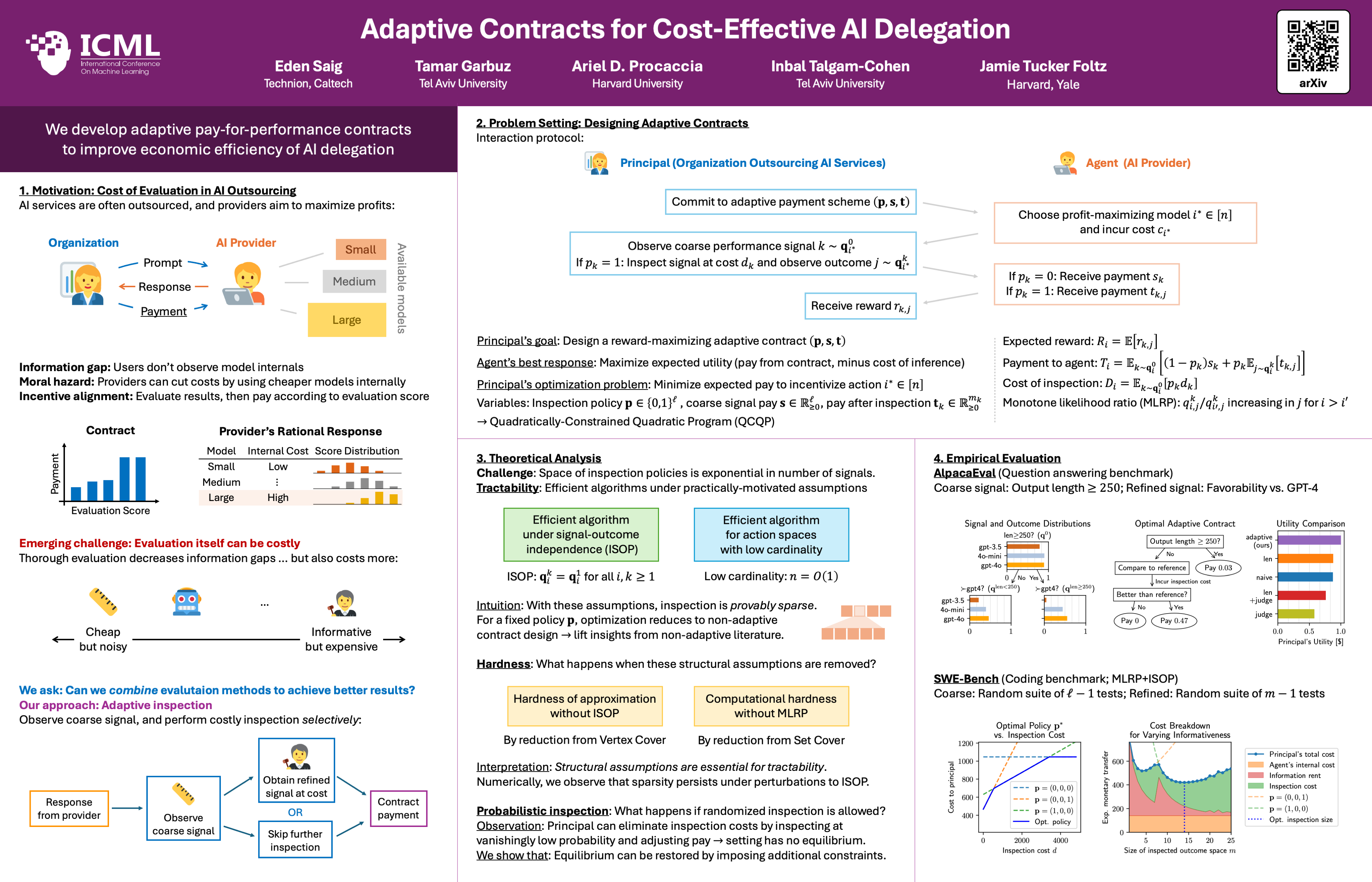
When organizations delegate text generation tasks to AI providers via pay-for-performance contracts, expected payments rise when evaluation is noisy. As evaluation methods become more elaborate, the economic benefits of decreased noise are often overshadowed by increased evaluation costs. In this work, we introduce adaptive contracts for AI delegation, which allow detailed evaluation to be performed selectively after observing an initial coarse signal in order to conserve resources. We make three sets of contributions: First, we provide efficient algorithms for computing optimal adaptive contracts under natural assumptions or when core problem dimensions are small, and prove hardness of approximation in the general unstructured case. We then formulate alternative models of randomized adaptive contracts and discuss their benefits and limitations. Finally, we empirically demonstrate the benefits of adaptivity over non-adaptive baselines using question-answering and code-generation datasets.
Lay Summary
When organizations delegate complex tasks such as text or code generation to AI providers, they must ensure they get what they pay for. However, evaluating AI performance brings up a dilemma: Human inspection and the latest AI judges are accurate but very expensive, while cheap metrics like checking response length are noisy and unreliable. This lack of affordable visibility makes performance-based pricing risky and can incentivize AI providers to cut corners behind the scenes. To address this challenge, we introduce "adaptive contracts" for delegation of AI tasks. Instead of checking everything thoroughly, the organization first applies a quick, cheap initial check. Based on this first signal, the system selectively decides whether it is necessary to pay for a detailed, secondary inspection. We provide efficient algorithms to calculate the optimal, most cost-effective contract setup for these scenarios. When tested on question-answering and coding datasets, our adaptive contracts significantly lowered costs and boosted value compared to rigid contracts. By reducing evaluation costs, our framework helps make advanced AI services more affordable and widely accessible.