
Learning Self-Interpretation from Interpretability Artifacts: Training Lightweight Adapters on Vector-Label Pairs
Abstract
Lay Summary
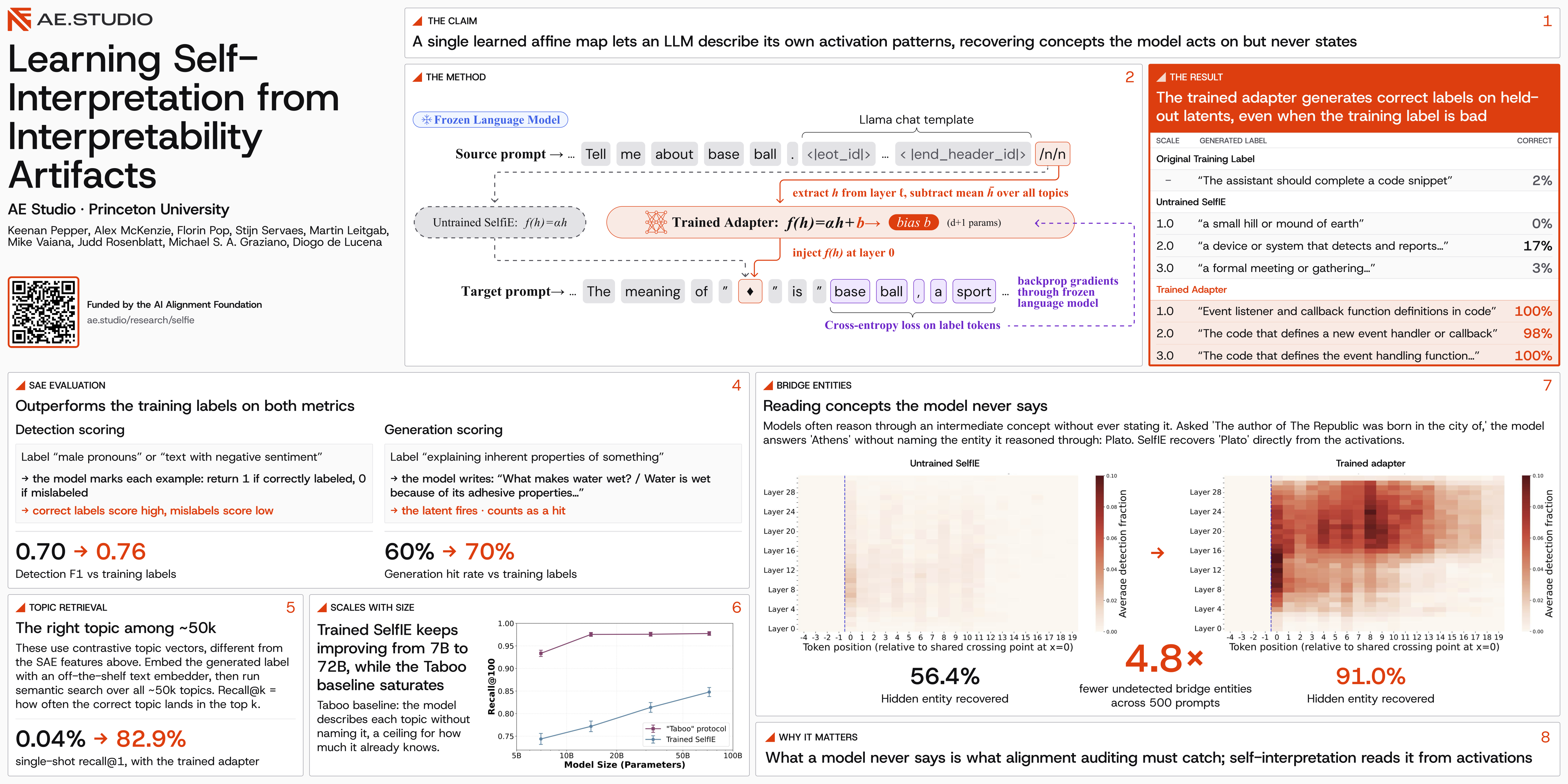
Modern AI language models do their "thinking" in huge arrays of internal numbers that people can't read directly. One appealing idea is to feed one of these activation patterns into the model in place of a word and ask the model to explain it. This works, but unpredictably: the explanations sometimes sound sensible yet are entirely made up. We show that a tiny add-on, an "adapter" with only a few thousand numbers, fixes this. We train it on examples that pair an internal pattern with a known description of its meaning, data the field already produces in bulk. Crucially, the add-on feeds these patterns back into the same model, so the model interprets itself. This opens the door to future AI that can examine its own thinking from the inside. The model then reliably describes what its hidden states represent, sometimes more accurately than the descriptions used to train the add-on itself. Strikingly, when a model answers a multi-step question instantly with no visible reasoning, our method can often recover the intermediate fact it worked out silently but never stated. Surfacing such hidden steps could help us verify whether AI systems are being honest about what they're really doing.