
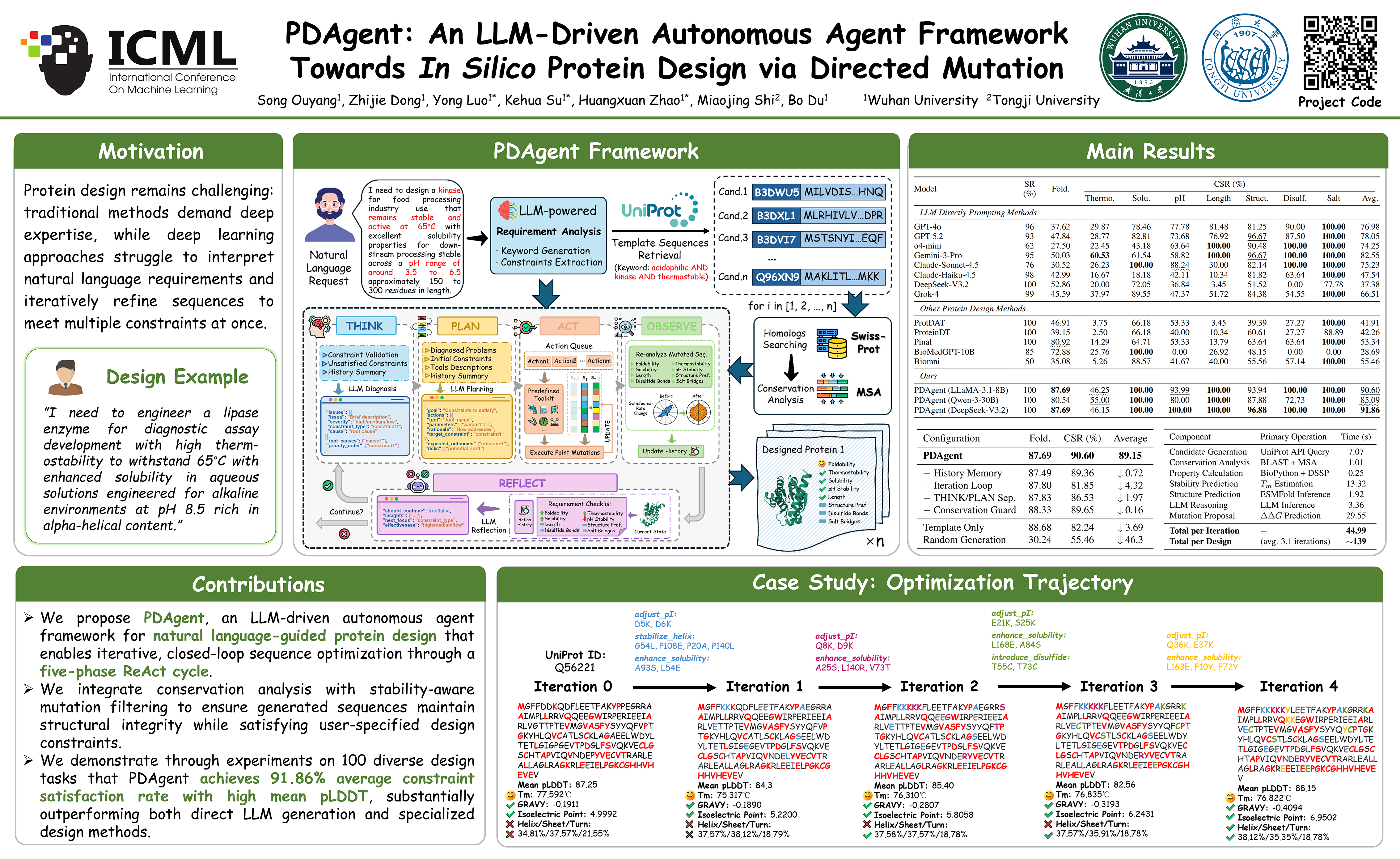
PDAgent: An LLM-Driven Autonomous Agent Framework Towards *In Silico* Protein Design via Directed Mutation
Abstract
Computational protein design holds immense promise across diverse domains, but existing approaches face significant challenges: traditional physics-based methods require substantial domain expertise, while emerging deep learning methods often rely on restricted functional ontologies, struggle to bridge the semantic gap between text and protein sequences, or lack closed-loop optimization mechanisms. In this paper, we present PDAgent, an LLM-driven autonomous agent framework that enables in silico protein design through template-based directed mutation. Our framework accepts natural language specifications of desired protein properties and employs a ReAct-style reasoning loop comprising five phases: THINK, PLAN, ACT, OBSERVE, and REFLECT. PDAgent integrates template retrieval, conservation-aware mutation strategies, and domain-specific computational tools for property optimization across seven biophysical dimensions. Experiments on 100 diverse protein design tasks demonstrate that PDAgent achieves a 91.86% average constraint satisfaction rate with high structural quality (mean pLDDT 87.69), substantially outperforming both direct LLM generation and specialized deep learning methods. We provide the source code at https://github.com/Gift-OYS/PDAgent.
Lay Summary
Proteins are tiny molecular machines that do almost every essential job in living cells, from digesting food to fighting infections. Designing new proteins for specific tasks, such as enzymes that work in harsh industrial conditions or proteins for treating diseases, could transform medicine and biotechnology. But it is very difficult, because the number of possible combinations is astronomical. We built PDAgent, an AI system that lets researchers describe in plain English what kind of protein they need, for example "an enzyme that works at 70 degrees and dissolves well in water", and produces a candidate design. PDAgent works like a careful research assistant: it finds similar natural proteins as starting points, identifies which parts must not be changed, and then makes small targeted edits while checking after each step whether the design meets every requirement. Evaluated on 100 design tasks, PDAgent met about 92% of the requested properties, substantially better than existing approaches. We hope PDAgent will serve as a practical tool for scientists working on protein engineering.