
GI-GCN: Global Interacted Graph Convolutional Networks via Dominant Sets for Graph Classification
Abstract
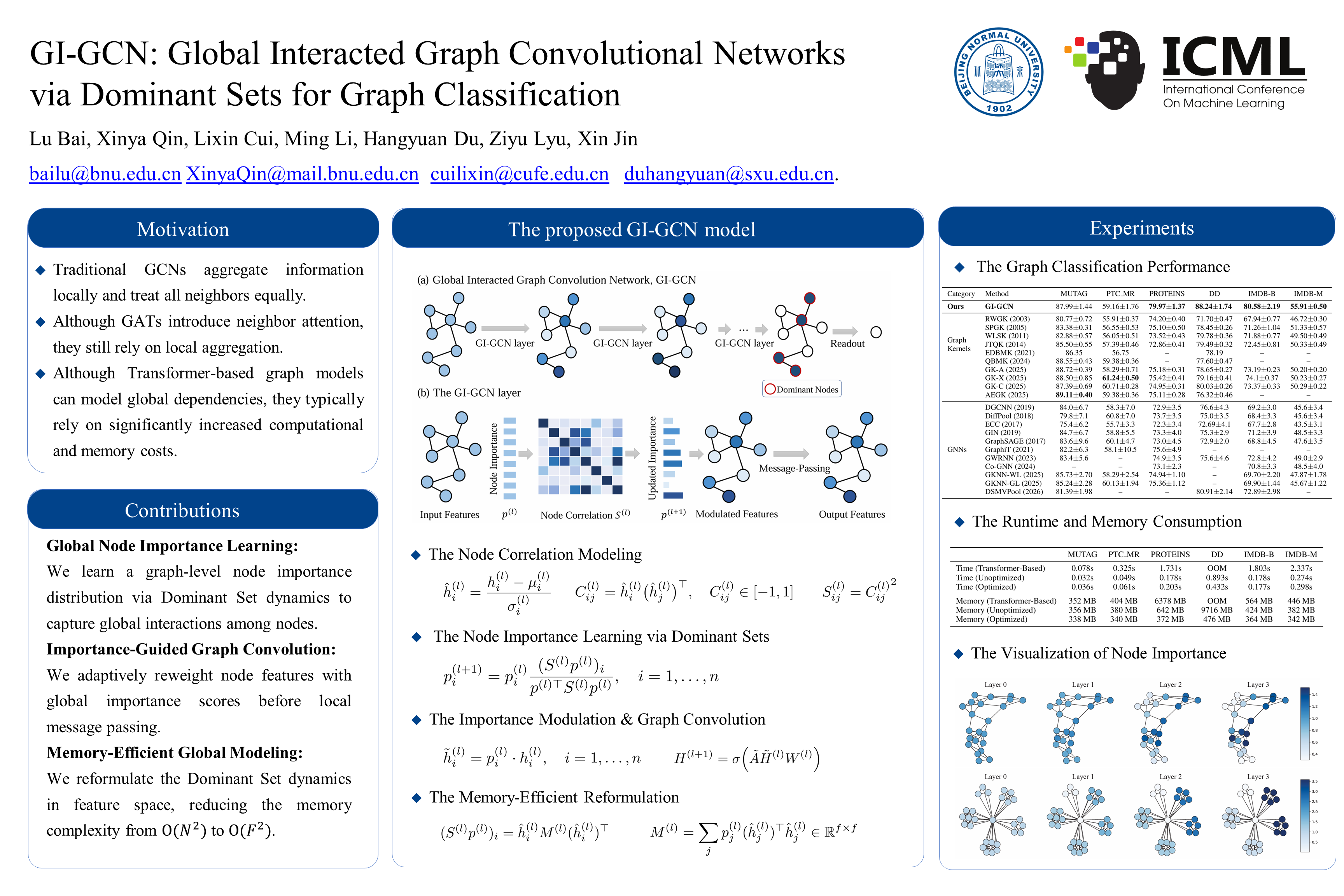
Graph Convolutional Networks (GCNs) are defined based on aggregating the information of adjacent nodes, that are usually treated as equally important and may limit the representational power of existing GCNs. To address this shortcoming, we propose a novel Global Interacted Graph Convolutional Network (GI-GCN), that leverages the solution vectors maintained during the iterative updates of the Dominant Set to adaptively characterize the global importance distribution over all nodes. Specifically, at each convolution layer, this distribution is adopted to adaptively modulate the importance weights of node features before performing the local message passing. We show that this convolution strategy can effectively capture the highly correlated information between nonadjacent nodes through the Dominant Set algorithm, not only emphasizing the critical graph-level information but also enhancing the discriminative power of graph representations. Furthermore, we optimize the memory complexity of the framework, significantly reducing the memory overhead associated with the global interaction modeling. Experiments demonstrate the effectiveness of the proposed GI-GCN model.
Lay Summary
Many real-world problems can be represented as graphs, such as molecules, social networks, and biological interaction systems. A key challenge is that making accurate predictions on graphs often requires identifying a few critical nodes and understanding how they influence distant parts of the graph. Existing graph learning methods usually face a trade-off: some focus only on local connections and miss long-range interactions, while others model global relationships but require heavy computation and memory. We developed a new graph learning method called GI-GCN that helps neural networks identify globally important nodes while still preserving local structural information. Instead of comparing every node with every other node using expensive attention mechanisms, our method uses an optimization-based process to assign each node an importance score and then uses these scores to guide information flow through the graph. This makes the model both efficient and scalable. Across benchmark tasks involving molecules, proteins, and social networks, GI-GCN achieves strong predictive performance while using substantially less memory than transformer-based graph models. Our results suggest that efficient global reasoning can be achieved without the large computational cost typically associated with graph transformers, making graph learning more practical for larger scientific and industrial applications.